

United we stand, divided we poll
With chaos in Catalonia over a separation referendum, some see a ‘war of independence’ while others wonder if the vote is worth the tear in the social fabric
 Add ToI as a Preferred Source on Google
Joshua Davidovich is The Times of Israel's Deputy Editor
With Israeli newspapers being sent to the printer hours before a gunman opened fire at a Las Vegas concert, killing at least 50 — an item that will surely dominate the news landscape for the coming days — it’s violence in Catalonia surrounding a contested breakaway referendum, as well as a rule change that would allow for more political appointments in the bureaucratic ranks of Israeli government, that lead the news agenda.
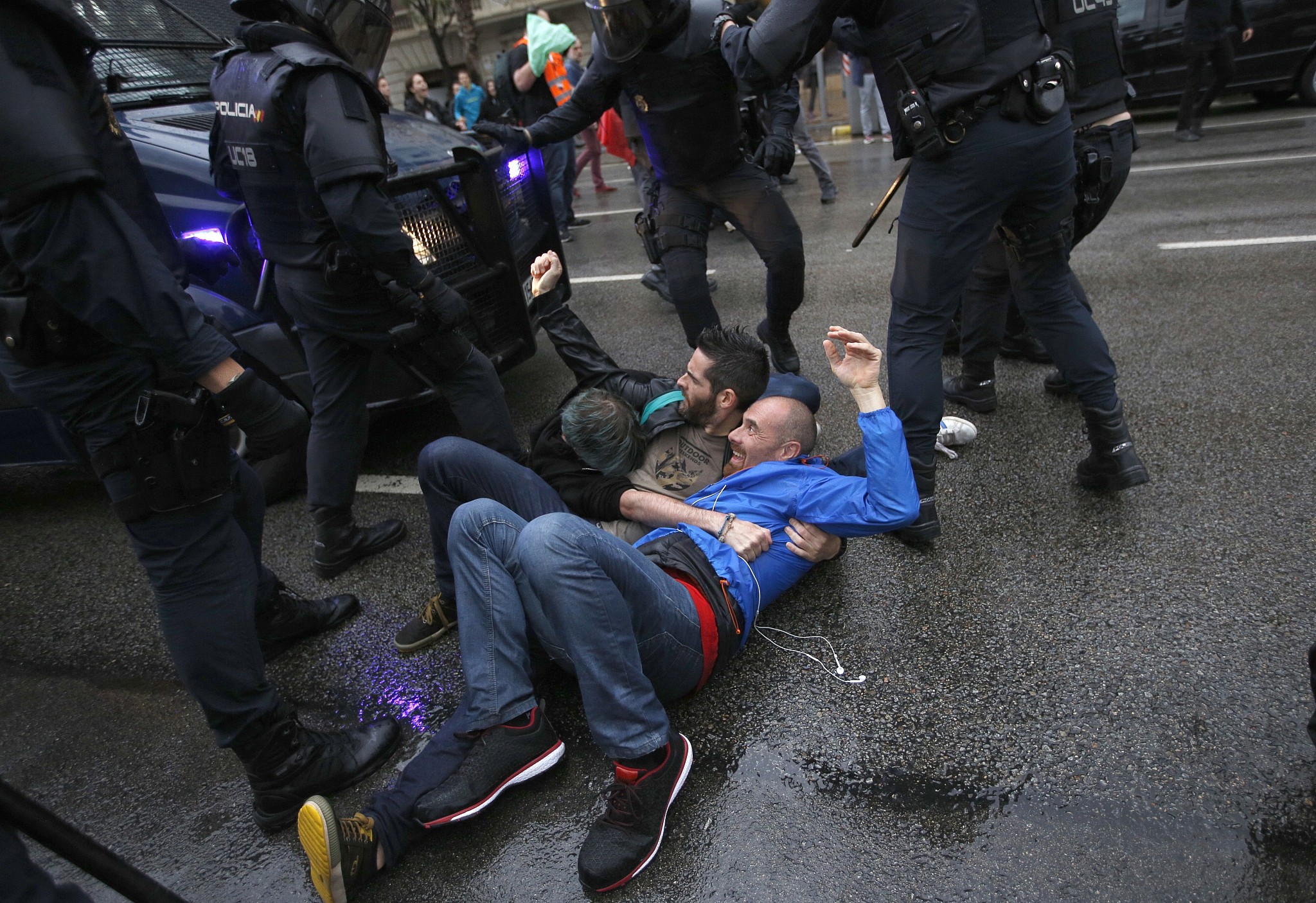
Clashes between police and potential voters in Barcelona and elsewhere in the Catalonian region lead all three major Israeli dailies, with Israel Hayom and Yedioth Ahronoth both calling it Catalonia’s “war of independence.”
“The state of soccer, flamenco and bullfighting turned into a battlefield yesterday,” Yedioth’s correspondent in Barcelona writes.
The tabloid also features columns for and against Catalan independence.
In one, Magdalena Correa Villa of Barcelona says she is a proud Catalonian but respects Spanish law, which forbade the vote, and so she did not participate in the banned referendum. The other, fellow Barcelonan Maya Ferrera says it’s the Spanish government that pushed them into wanting independence.
“We live in a hidden dictatorship: Every demand and every request we make to Madrid is rejected,” she writes. “The Madrid government trampled on our dignity, preventing my right to vote as a free citizen of the world. What we have seen in recent days, the Madrid government’s harsh response against the Catalans, is proof of the oppression we are going through.”
Haaretz puts the figure of 800 injured in its top headline, and reports that it may all have been for naught. “In the wake of police attempts to mess up the vote, there were reports of disorganization, including double voting. In addition, there were reports that some who planned on voting for Spanish unity did not go to the polling stations for fear of breaking Spanish law, and so it’s expected that local authorities will call a new vote in a few weeks to actually determine the question of independence for the region,” the paper reports.
The paper also runs two columns that attempt to point out why the referendum was a bad idea, including one by Anshel Pfeffer, who links it to a recent vote in Kurdistan and who says all they ever do is boost dictators and hurt everyone else..
“The pros and cons of such a move for the Catalans, and the question of whether a majority of the region’s residents really want full independence, are beside the point. Unless they succeed in getting Spain’s parliament to grant them the right to hold an official referendum, these symbolic gestures will remain both divisive and meaningless,” he writes. “But referendums, even when held with the full authorization of parliament, are little more than a snapshot of public opinion and therefore are a very bad way to determine a nation’s fate. Of four major referendums held in recent years in three countries, none can be said to have settled the crucial issues at stake and arguably have left those nations in more of a muddle than before.”
In Israel Hayom, columnist Sal Amergi, a Barcelona native, also laments the tear in the social fabric caused by the vote, but also seems to see little point in Catalonia staying part of Spain.
“Like many of my friends, both for and against Catalan independence, I’m very sad. Sad because we’ve gotten to the point of violence, which despite the traditional tranquility of Catalonia, is not surprising,” he writes, accusing both Spain’s president and the Catalan leader of speaking in threats. “And when Spain announces it will not allow the vote, which is illegal, the pictures we saw yesterday are sad but no surprising. Even the terror attack in Barcelona in mid-August didn’t manage to bring unity, which seems as distant now as seeing Lionel Messi in a Real Madrid jersey. The opposite. The attack deepened the wound, as was seen in the rally in Barcelona afterward.”
Compared to the other two papers, Israel Hayom downplays news that Prime Minister Benjamin Netanyahu wants to expand a bill that would allow political appointments further down the chain of command within a ministry’s bureaucratic structure.
The paper puts the news in a small box below a slightly larger story on Netanyahu apologizing for the fact that not a single minister showed up to a state ceremony for those killed in the 1973 Yom Kippur War (because they were arguing over the political jobs). While noting the prime minister’s apology, the paper also includes the fact that no minister was technically required to be there, with president Reuven Rivlin, Knesset speaker Yuli Edelstein and opposition MK Hilik Bar as state representatives.
That’s not enough for Goel Beno, who writes in Yedioth of his anger at the government for not bothering to send a single representative.
“Only a government with no past, no present and no future can act with this disgrace. The condescension, arrogance and haughtiness, the moral and ethical decline that enveloped the commanders of that terrible war in 1973 has not disappeared,” he writes.
In Haaretz, Yossi Verter also has harsh brickbats to fling at the prime minister, but more over the actual bill he is trying to push than the lack of ministers at the ceremony.
“The bill, which would allow the political appointment of deputy directors-general in government ministries, was greeted with contempt by many ministers, including the prime minister, for whom it wasn’t enough; he demanded no less than a ‘revolution.’ After eight-and-a-half years in power he suddenly decides to be a revolutionary,” he writes. “Directors-general come and go according to the political winds. Deputy directors-general are veteran officials. They help the newly appointed director-general learn the ins and outs of the job, so that he can quickly grasp the issues before his minister is replaced, and he with him. There’s no point in also appointing a new deputy who will draw his power directly from the minister and essentially be another director-general with zero knowledge and zero experience, but with lots of political power, whose main job will be to help the minister when called upon.”





The Times of Israel Community.