

Unity, disunity, and opportunity
On Memorial Day, Haaretz points out the cracks in Israeli society, while Herzog’s attempts to forge a unity government only sow more discord
Marissa Newman is The Times of Israel political correspondent.
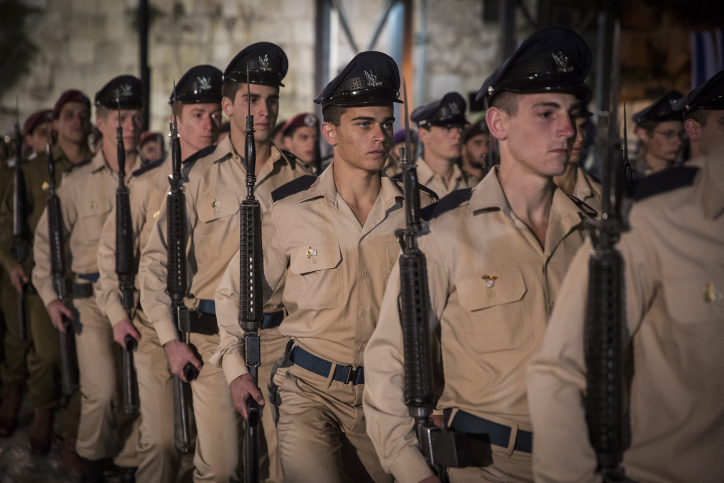
Every year, Israeli pundits dwell on the stark transition between the mourning of Memorial Day and celebrations of Independence Day, the narrative of sacrifice and statehood.
But with the newspapers not going to print on Thursday, the dissonance between the two days is as pronounced as ever in Wednesday’s dailies, and lumping together picnic plans and tales of brutal murders and bereavement turns a poignant link into a somewhat schizophrenic experience as the Israeli papers simultaneously mark 23,447 funerals and a birthday.
Oozing with patriotism, Israel Hayom and Yedioth Ahronoth paint their front pages blue, while Haaretz wonders in a prominent column whether — amid recent IDF-linked controversy — the people’s army is losing the people.
“Between sadness and joy,” reads Israel Hayom’s main headline. “In their merit,” reads Yedioth’s, next to a photo of military graves; “we are here” the headline continues, alongside a photo of three Ethiopian Israeli children proudly waving flags.
Israel Hayom waxes poetic and keeps its Memorial Day coverage surprisingly upbeat, focusing on a bereaved mother of a slain soldier who gave birth on Tuesday, the brother of IDF soldier Benaya Sarel donating bone marrow, and a US leadership program named in honor of a soldier killed in Lebanon. “A memorial day and a birthday,” the headline on the former story reads. “It’s an inexplicable coincidence, in which sadness is mingled with joy, and won’t leave a dry eye: In the Kaplan Medical Center in Rehovot yesterday, a baby girl was born to Sarit and Ilan Vanunu from Ashdod, the parents of the slain IDF soldier Ben Vanunu, may his memory be blessed, who was killed in Operation Protective Edge.”
Although Israel Hayom lands a “special interview” with presumptive Republican nominee Donald Trump, it buries it on page 9 — a move owner Sheldon Adelson, who has expressed support for Trump, would likely disapprove of.
In its Trump interview, the Republican candidate says reporter Boaz Bismuth is the first person to point out to him that there are Israelis who view him negatively, because, in his words, he has “massive” support in Israel. Trump also says he will visit the Jewish state soon. In the spirit of Independence Day, Bismuth asks if his new (Jewish) grandson was named Theodore for Theodor Herzl. Na, replies Trump, it was simply a name his daughter Ivanka and son-in-law Jared liked.
Over in Yedioth, the paper is peppered with columns by relatives of fallen soldiers and terror victims. It also features a piece by President Reuven Rivlin on the 68 things he loves most about Israel on its 68th birthday (Shoresh sandals, lemon ices, the Iron Dome, cherry tomatoes and singer Arik Einstein make the cut), and reprints the IDF chief of staff’s memorial address on “the army of unity” in full.
But over in Haaretz, military correspondent Amos Harel writes that this unity is being undermined amid the controversies over deputy chief of staff Yair Golan’s remarks last week and the indictment of Sgt. Elor Azaria on manslaughter charges for killing a disarmed Palestinian stabber.
“The IDF has always prided itself on being the people’s army. But the people have been moving rightward, as the past several elections show, and this seems to have been accompanied by changing views about the limits of the use of force in dealing with Palestinian terror. Or perhaps these were always the majority’s views, but they’re now being expressed more freely, thanks to the internet and social media. Either way, the soldiers, their parents and other civilians all have firm opinions about what the IDF should do and, together, they create a critical mass whose influence the army can no longer ignore.”
“The IDF can no longer control what news soldiers receive; they can access the media freely via their cellphones. Nor can it limit soldiers’ communication with the outside world to one call a week from a public phone; they can communicate with parents and friends at will. Thus the military can no longer isolate soldiers from outside influences that contradict the institution’s declared values, and it’s only just starting to address the implications of this change.”
In its editorial, Haaretz urges the government to mend the fabric of Israeli society.
“The poisonous vapors emanating from the windows of government ministries found their way into social media, television and radio studios and newspapers, and from there to the street. The fine stitching of the Israeli flag has been systematically ripped apart, and this symbol of constructive, inclusive Israeliness has become a weapon in the hands of racist, nationalist militias.”
“This Independence Day underscores the need to repair the rents in the blue-and-white flag and to bring under its protection all the groups that make up Israeliness – including those minorities that have trouble identifying with the Star of David in the flag’s center or the ‘yearning Jewish soul’ of the national anthem. Instead of continuing to foment strife, the time has come to once again create an Israeli nation that is proud of its country and its flag.”
Between the grief and triumph and rare national unity, the papers also serve up a side of consternation over the reports that opposition leader Isaac Herzog is ramping up efforts to join the coalition, dividing his Zionist Union party in the process.
Yedioth reports that just two of the party’s members — Herzog and Eitan Broshi — are in favor of joining the coalition in principle and will do so in practice. MK Eitan Cabel says he will join the coalition but hasn’t decided if he supports the move, while MK Hilik Bar says that while he opposes it, he would join the government. The remaining party lawmakers are against it in principle, but split on whether they would enter.
In a fairly scathing column, Sima Kadmon opines that the political saga is designed to save Herzog. “If it wasn’t so pathetic, it would certainly be funny. The man who in past months blasted any rumors of talks between him and Netanyahu, who presented bald-faced lies — there are no other words for it — to anyone who asked him about it, claiming that it was rumors, spin, utter nonsense. Who described, time and again, the rumors as designed to harm him — in recent days has launched a campaign to persuade his party members to enter the government.
“There isn’t a single politician who would say that having the Zionist Union enter the coalition is not political suicide,” she continues. “But what is suicide for the Zionist Union is a lifeline for Herzog.”




The Times of Israel Community.