

Flymageddon
Ben-Gurion International Airport has ground to a halt and the press sympathizes with the passengers, not the airlines
 Add ToI as a Preferred Source on Google
Ilan Ben Zion is an AFP reporter and a former news editor at The Times of Israel.
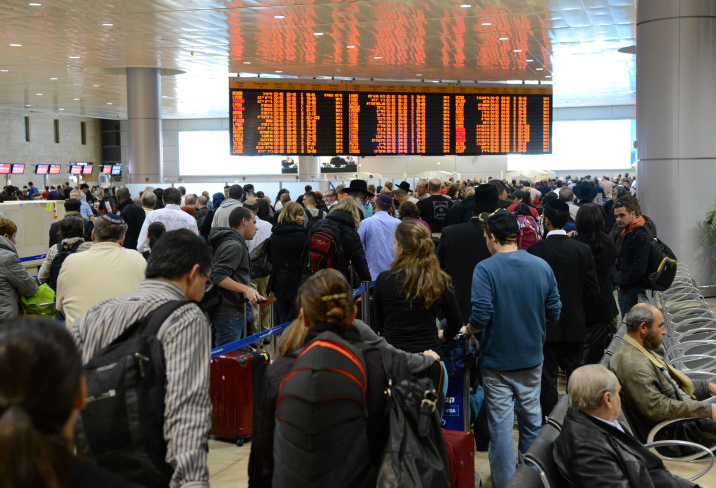
Israel’s Open Skies agreement with the European Union was cleared for takeoff on Sunday, sparking fierce protests by airline employees who went on strike, grounding planes and canceling flights. Monday marks day two of Skymageddon.
Haaretz reports that the Histadrut labor federation wishes to show solidarity with the airline workers and close Ben-Gurion International Airport for four hours Tuesday morning — crippling all travel to and from Lod, not just flights by Israeli carriers as on Sunday.
Israel Hayom duplicated this author’s media review headline from Sunday on its front page: “Open Skies, Ben-Gurion Airport closed.” It reports that of the 19 members of government who voted on the Open Skies deal, 16 voted in favor. Only Immigration and Absorption Minister Sofa Landver, Internal Security Minister Yitzhak Aharonovich, and Environmental Protection Minister Amir Peretz voted against the measure.
“The government’s decision to approve Open Skies is a slap in the face of the Israeli aviation [industry],” an outraged El Al employee union leader Asher Edri is quoted in Maariv saying.
“Transportation Minister Yisrael Katz, with his ‘bulldozer-ness’ [perhaps in reference to the minister’s ample girth] presented the government with a false impression, according to which Open Skies would foster competition and bring about reduced prices. The truth is that the Open Skies agreement may cause precisely the opposite result.”
The paper also quotes enraged, stranded passengers whose flights were canceled at the last minute because of the El Al strike. The headline quote for the reactions piece reads “From now on I’d rather fly Turkish [Airlines] and return on the [Mavi] Marmara — anything but El Al!”
Maariv reports that the national airline also gave 25 new immigrants from the United States a warm welcome at New York’s Kennedy Airport, when they arrived to find that their flight to Israel was canceled. “Some of them had nowhere to return to, after already selling or renting their homes,” it writes.
Yedioth Ahronoth sums up the catastrophrenzy with one word: “Grounded.” According to the paper’s account, all hell broke loose at Terminal 3 around 3 p.m. after an announcement came over the loudspeaker informing passengers that all flights through 9 p.m. were canceled.
“Within seconds, hundreds of enraged travelers massed before the El Al counters on the third floor,” the report says. “The airport turned into a battlefield.”
But don’t worry, the paper assures its readers, the airlines will reimburse some luckless travelers whose flights were canceled. But “whether or not the strike [is deemed] justified, one thing is certain: It’s going to hurt travelers — and their pockets, too.” It provides detailed information about who gets their money back and how.
Merav Arlozorov writes in Haaretz that the Open Skies deal is the way to improve and strengthen the Israeli airline industry. “No one today has any doubt, after the lessons of 2008, that [economically] competitive states are strong, stable and more productive states, and that competition is therefore the only way to improve the condition of the citizen over the years,” she writes.
She calls on Katz to take the next step in breaking open Israel to foreign markets: establishing a privately owned port which would “break the monopoly of the two existing ports.”
Meir Bleich contends in a Maariv column that while reforms like Open Skies always come late for Israeli consumers, “there is no reason for exaggerated hope that the cost of tickets will drop in the same fashion as the price of cellphone [plans].”
“Airlines have set costs that are possible to calculate in advance, and none of the foreign airlines will land here in order to offer unprofitable prices,” he writes. Bleich nonetheless praises the government’s decision to push forward with the Open Skies deal, which will increase tourism and tourism revenue.
“The government behaved properly when it preferred the consideration of the general economy over those of the Israeli airline workers and their employers, who enjoyed the protective walls granted them by the state until now.”
Dan Margalit opens his half-page Israel Hayom column with a cloying blue-and-white streak about how much he loves El Al. Despite this, he plays Mark Antony to his readers: “I come to bury Caesar, not to praise him.” He says the time has come for Open Skies to run its course, even at the cost of hurting his beloved El Al, for it benefits Israel by further integrating it with the EU. Such a measure will boost the Israeli economy and force El Al to streamline its business, he says.
“Unfortunately, El Al will not become more efficient unless the sword of fiscal crisis is laid upon its nape,” he muses.
As if anyone cared about anything but the airlines, Haaretz reports on how Israeli highways are becoming death traps that are killing furry little creatures and preventing their migration, and Maariv reports that the past five months have seen a resurgance of rocket fire from the Gaza Strip. In the case of Haaretz’s exposé, most Israelis didn’t even know there were badgers, hyenas and otters in the country until now (they still don’t, considering the paper’s readership of less than 6% of the country).









The Times of Israel Community.