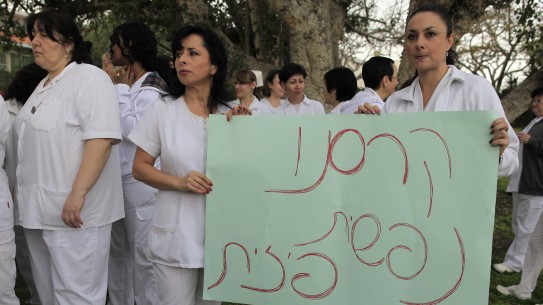
Nurses from Barzilai hospital hold a sign reading "we've collapsed mentally and physically" (photo credit: Tsafrir Abayov/Flash90)
Nurses in Israel began a one-day strike on Monday, after their union was unable to come to an agreement with the Finance Ministry in 11th hour talks late Sunday night.
The strike began at 7:00 a.m. and will affect some hospitals, the Clalit and Leumit HMOs as well as public health clinics. Non-crucial services will be limited in hospitals, which will run on a Shabbat schedule.
Weeks of negotiations between union leaders and Finance Ministry representatives yielded no results, the nurses said.
The nurses have been complaining for months that they are understaffed, and that there is a lack of equipment, mainly rooms and beds for patients, resulting in overcrowding of up to 140 percent at hospitals throughout the country.
There is a shortage of some 2,400 nurses and the number grows by over 400 every year, Tami Zamir, a nurse at Ichilov Medical Center in Tel Aviv, told Ynet News. Zamir noted that with a nurse’s wages starting at just NIS 4,500 a month, comparable with that of a waitress, the number of nursing students is dwindling.
Get The Times of Israel's Daily Editionby email and never miss our top stories
Shmulik Bental, Chairman of the Nurses’ Committee at the Sheba Medical Center Tel Hashomer, told Ynet that although the regulations allow for 36 beds per ward at the center, there are on average 60 beds filled each day.
“The truth is that even the manpower required for 36 beds is missing,” he said. “This kind of medical practice is full of dangers first and foremost to the patients.”
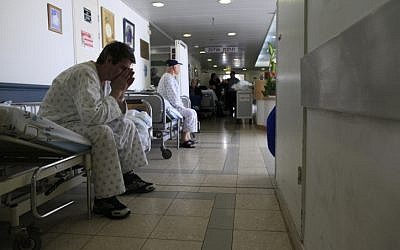
Nurses have warned that this is a life-threatening situation. “There are patients sleeping in hallways, and sometimes people can wait for hours before they receive medical attention,” they said in a statement.
Advertisement
An Israeli patient waits in the corridor of the Barzlai Medical Center. Nurses from Barzilai Hospital in Ashkelon and Soroka hospital in Beersheva left their stations for two hours to protest an excessive work burden. February 15, 2012. (photo credit:Tsafrir Abayov/Flash90
On February 15 nurses at the Soroka hospital in Beersheba and the Barzilai hospital in Ashkelon left their posts for two hours, in protest of massive overcrowding and under-staffing.
We can't do this work alone.
The war with Iran has been draining for all of us in Israel. But when I heard about a high casualty incident – ballistic missile impacts in Arad and Dimona that left nearly 200 people wounded – I drank a cup of coffee, packed a bag, and headed south.
There, I spoke with Shilgit, the head of an after-school program for underprivileged youth. Standing outside her destroyed center, Shilgit said it was a miracle that no children were hurt and spoke about the community coming together in the hours since.
As a Times of Israel reporter, I’m committed to telling stories of resilience like Shilgit’s. But my colleagues and I can't do this alone. If you value work like this,please consider joining our reader support group, The Times of Israel Community. Your financial support is essential to keep real human reporting like this going.
We’re really pleased that you’ve read X Times of Israel articles in the past month.
That’s why we started the Times of Israel - to provide discerning readers like you with must-read coverage of Israel and the Jewish world.
So now we have a request. Unlike other news outlets, we haven’t put up a paywall. But as the journalism we do is costly, we invite readers for whom The Times of Israel has become important to help support our work by joining The Times of Israel Community.
For as little as $6 a month you can help support our quality journalism while enjoying The Times of Israel AD-FREE, as well as accessing exclusive content available only to Times of Israel Community members.
Thank you, David Horovitz, Founding Editor of The Times of Israel