

It’s time to go fly a kite
A new exhibit at the Eretz Israel Museum embodies freedom and escapism
 Add ToI as a Preferred Source on Google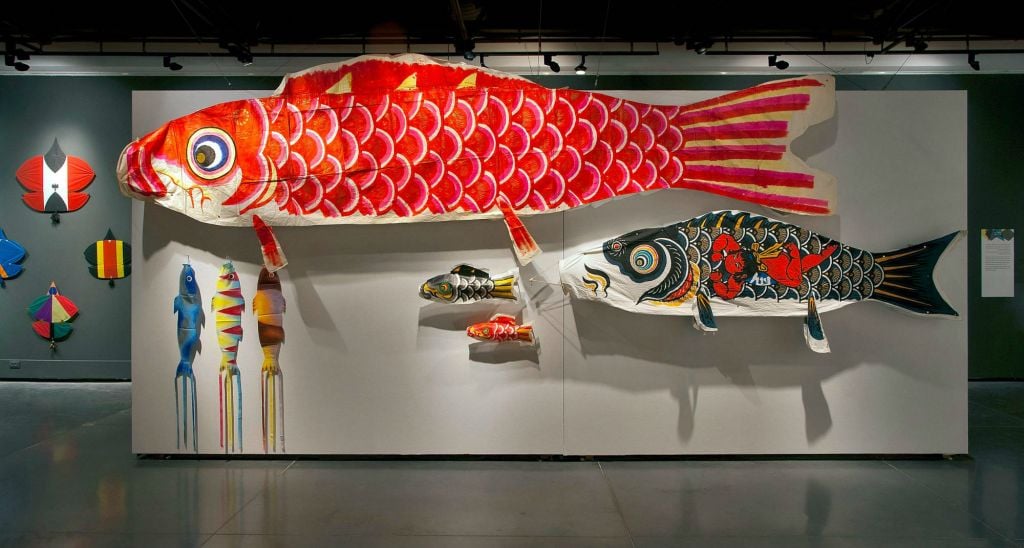
Now may be the best time to go fly a kite.
Symbolizing freedom and flight, these simple constructions offer a form of temporary escape, a respite from the worries and concerns of life down below.
They’re the subject of “Playing with the Wind,” a recently opened exhibit at the Eretz Israel Museum in Tel Aviv.
More than 230 kites are displayed in the show, curated by Christine Armengaud, a passionate collector of kites from around the world. There are kites representing ancient, Eastern traditions, and more contemporary versions, seeking to convey a feeling of abandon.
The kites are placed facing each other, creating a dialogue between various times and places, said Hagit Sorek, one of the exhibit’s producers. None, however, date back more than a hundred years, given that kites are generally made of organic materials that degrade over time. (There’s even a kite made of cinnamon that wafts a spicy scent as it flies in the air.)
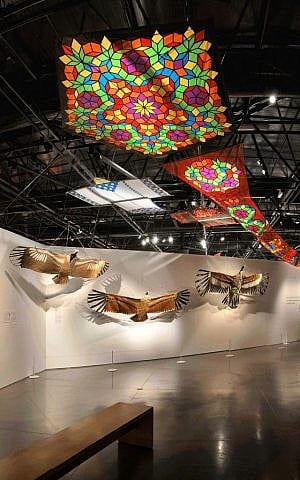
One section of the exhibit that isn’t part of Armengaud’s collection is an entire hall dedicated to locally-made kites. Among the specimens is “Quasi,” dedicated to Nobel Prize winner Daniel Shechtman for his theory of quasicrystals, and two kites representing the Israeli and Palestinian flags, nearly touching each other as they hang from the ceiling.
“Some of these kites are symbols of specific moments of Israeli history,” said Sorek. One of the kites was presented at the signing of the peace treaty between Israel and Jordan.
There are foldable bird-shaped kites from China, elaborate crows from Sri Lanka, an eagle from Vietnam, and Japanese amulets embodying holy figures that protect the samurais.
There is a distinct contrast between the Eastern and Western kites. In the East, kites are created as forms of art, culture and tradition, while in the West, they are often produced for practical uses, such as radar and flight. In Brazil, kites are used by drug smugglers to warn each other of the presence of the police.
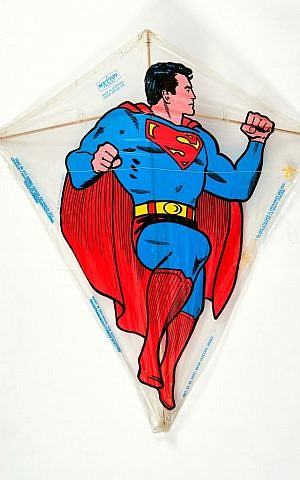
They can also be used for battle. Fight kites from Thailand, India and Japan are used for aerial games and battles, in which the goal is to damage each other’s kites through sharp pieces of glass placed on the wires.
The focus, however, is on kites as a way to let one’s imagination soar. There is a space dedicated to games and workshops where children can play a virtual game imitating the flight of a kite as well as build and decorate their own kite using a set given to them by the museum.
And while there isn’t much room at the museum to fly the kite once it’s completed, Yarkon Park right next door is the perfect location for letting a kite sail high in the sky.
“Playing with the Wind,” at the Eretz Israel Museum through November 8, NIS 25 entry fee.







The Times of Israel Community.