

Olmert pleads for leniency in Talansky sentence
Prosecution urges up to 18 months in prison, to be added to six-year term in Holyland case; Blair and Dagan write letters of support for ex-PM
 Add ToI as a Preferred Source on Google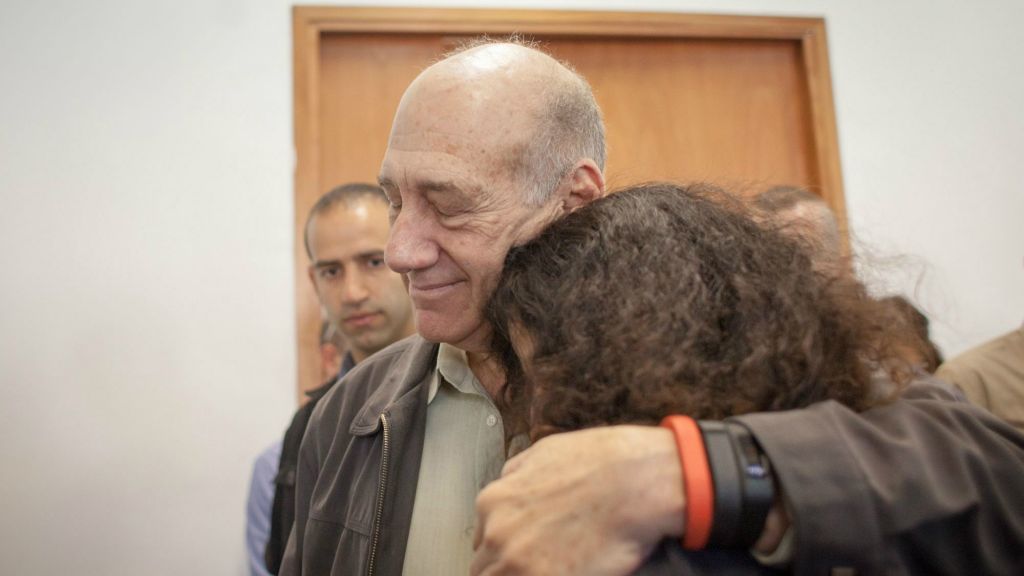
Former prime minister Ehud Olmert asked the Jerusalem District Court on Tuesday to be lenient in his sentencing for a graft conviction, telling judges he had suffered during trials over the last seven years.
Olmert was convicted of accepting envelopes full of cash from American businessman and fundraiser Morris Talansky in exchange for favors. The conviction earlier this year carries a maximum sentence of five years’ imprisonment.
On Tuesday, state prosecutor Uri Korb asked the court to send Olmert to prison for eight to 18 months, and requested that this sentence not be served simultaneously with the six-year sentence Olmert was given last year in a separate real estate bribery trial known as the Holyland affair. Korb also asked the court to fine Olmert by an amount exceeding the bribes he is believed to have received from Talansky.
Olmert, dressed in a light teal shirt and gray jacket, told the court on Tuesday he was confident that the sentence would reflect “the whole picture.” He accepted the court’s guilty verdict and hopes “with all my heart that the weight of my mistakes will be weighed against my contribution to the country,” he said.
Olmert spoke shortly after the testimony of character witnesses brought in his defense, including former security officials such as ex-Mossad chief — and a business partner of Olmert’s — Meir Dagan and Olmert’s adopted daughter. Dagan wrote to the judges asserting Olmert’s many “courageous decisions” and actions for the good of Israel; former British prime minister Tony Blair also wrote a letter on Olmert’s behalf, highlighting his efforts at peace-making and citing the “friendship and trust” between them.
Olmert also said the years in which the case had been going through various levels of the legal system were a punishment in themselves.
“I feel that there is no punishment heavier than the one I’ve lived with for seven long years,” he said, apparently including other corruption investigations in the period. “Almost one-seventh of my life [Olmert is 69] I’ve spent as a punching bag… I’ve had to find the will to survive and to defend my wife, children and grandchildren. What do you tell a grandchild who tells you that in kindergarten they’re saying bad things about grandpa?
“Any punishment you choose to impose will only be added to the unending string of [painful] moments I have been grappling with in recent years. Who notices the magnitude of this punishment, this suffering?”
The prosecutor Korb acknowledged to the court on Tuesday that “people have many sides to them,” and that the defendant had “contributed much to society over the years,” but insisted that this was often true in white-collar crime cases.
The sentence in the case is expected to be handed down on May 25.
The March guilty verdict in the Talansky case came some six months after the Supreme Court ordered a retrial sought by prosecutors after they obtained new testimony from Olmert’s former assistant Shula Zaken, including recordings of conversations between Olmert and Zaken. Zaken provided the new information last spring as part of a plea bargain.
Overturning its earlier decision from 2012, the three-member court unanimously found the former premier guilty of fraud, breach of trust and aggravated fraud.
The legal battle over the Talansky money was focused on whether the funds were personal gifts or a political exchange.
In their verdict in March, the judges wrote that in light of Zaken’s diaries and recordings, which they ruled were reliable, “we change our conclusion.”
Judge Rivka Friedman-Feldman, one of the three judges on the panel, insisted that even without Zaken’s testimony, there had been sufficient evidence to convict Olmert for these crimes in the original trial.
Yet the audio recordings by Zaken buttressed the allegation that Olmert had accepted the “cash envelopes” from Talansky while mayor of Jerusalem, and failed to report the bank account in which the funds were held to the proper authorities. The court found that Olmert made personal use of the money, including paying tens of thousands of dollars to Zaken.










The Times of Israel Community.