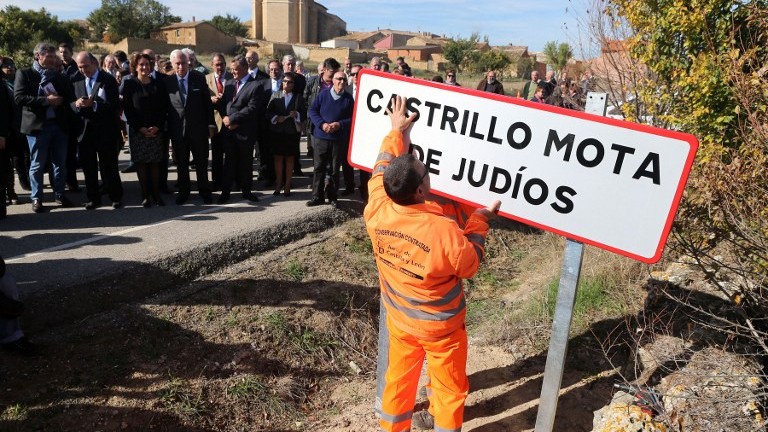
Officials look at an employee setting up a road sign reading the new name of Spanish village 'Castrillo Mota de Judios' which means 'Castrillo Mound of Jews' at the entrance of Castrillo Mota de Judios, near Burgos on October 23, 2015. (AFP PHOTO/ CESAR MANSO)
CASTRILLO MOTA DE JUDIOS, Spain — Israel’s ambassador joined Spanish officials Friday in celebrating the name change of the ancient Spanish town of Castrillo Matajudios (“Camp Kill Jews”) to Castrillo Mota de Judios (“Jews’ Hill Camp”).
The event came a year after the north-central village of some 50 inhabitants voted to change the name after the mayor argued it was offensive and the village should honor its Jewish origins.
Documents show the village’s original name was “Jews’ Hill Camp” and that the “Kill Jews” name dates from 1627, after a 1492 Spanish edict ordering Jews to convert to Catholicism or flee the country. Those who remained faced the Spanish Inquisition, with many burned at the stake.
Ambassador Daniel Kutner said the town’s decision to celebrate its Jewish past was to be praised. “It must be remembered that the expulsion from Spain was for Jews a traumatic event of historical dimensions and set out the trajectory for the Jewish people from there on,” he said at a brief ceremony before a road sign bearing the new name was placed at the town’s entrance.
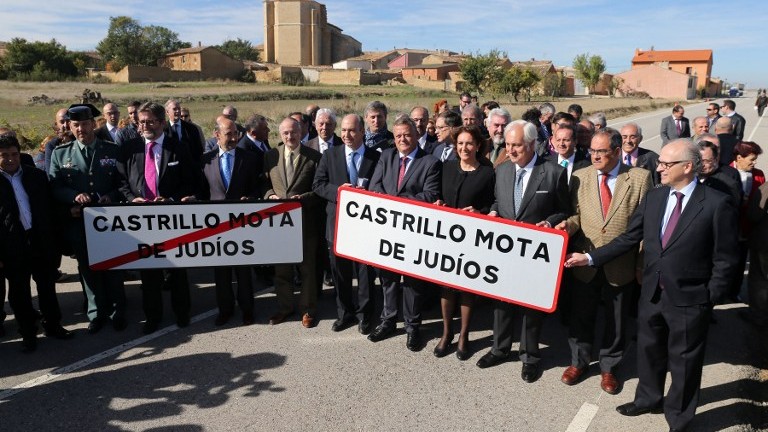
Israeli Ambassador to Spain Daniel Kutner (5thL), Mayor of Castrillo Mota de Judio Lorenzo Rodriguez (7thL), Spanish Councillor of Culture and Tourism of the Junta de Castilla y Leon Maria Josefa Garcia Cirac (8thL) and officials hold two signs reading the new name of Spanish village “Castrillo Mound of Jews” in Castrillo Mota de Judios, near Burgos on October 23, 2015. (AFP PHOTO/ CESAR MANSO)
The name change was formally approved by the regional government of Castilla y Leon in June.
Get The Times of Israel's Daily Editionby email and never miss our top stories
Researchers believe the village got its previous name from Jewish residents who converted to Catholicism and wanted to reinforce their repudiation of Judaism to convince Spanish authorities of their loyalty. Others suspect the change may have come from a slip of the pen.
No Jews live in the village today but many residents have Jewish roots and the town’s official shield includes the Star of David.
Advertisement
Copyright 2015 The Associated Press.
Help us report truthfully on social media
As a multimedia journalist, my job is to take the quality, fact-based journalism produced by The Times of Israel newsroom and make it accessible across every platform — from Instagram posts to podcasts to short-form videos.
This is how many, especially young people, consume news these days. But misinformation is rampant on social media. Our team at ToI produces accurate, responsible short-form reporting on Israel and the Jewish world.
If you believe in the importance of factual social media journalism, please consider joining our reader support group, The Times of Israel Community. Your financial support is essential to sustain responsible multimedia reporting.
We’re really pleased that you’ve read X Times of Israel articles in the past month.
That’s why we started the Times of Israel - to provide discerning readers like you with must-read coverage of Israel and the Jewish world.
So now we have a request. Unlike other news outlets, we haven’t put up a paywall. But as the journalism we do is costly, we invite readers for whom The Times of Israel has become important to help support our work by joining The Times of Israel Community.
For as little as $6 a month you can help support our quality journalism while enjoying The Times of Israel AD-FREE, as well as accessing exclusive content available only to Times of Israel Community members.
Thank you, David Horovitz, Founding Editor of The Times of Israel


 Add ToI as a Preferred Source on Google