

Throwing the book at Netanyahu
A dust-up over political meddling in the Israel Prize judging committee deepens and a dust storm leaves a nation gasping for air
 Add ToI as a Preferred Source on Google
Joshua Davidovich is The Times of Israel's Deputy Editor
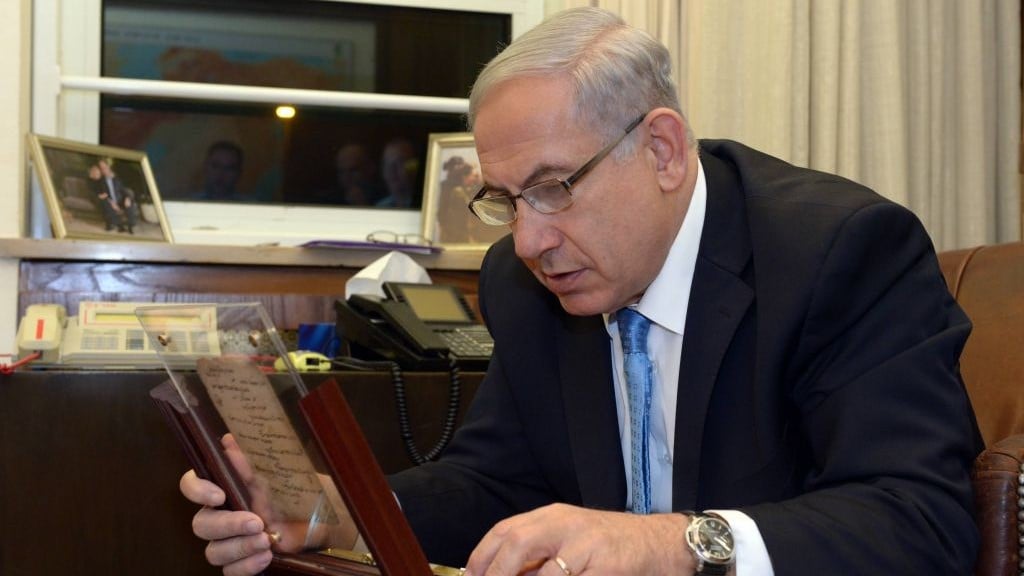
Like Israel being buffeted by heavy winds, Prime Minister Benjamin Netanyahu is buffeted on all sides by criticism in the press Thursday morning.
While Yedioth Ahronoth notes growing criticism of Netanyahu’s planned Congressional speech, Haaretz reports that the prime minister’s attempts to control the makeup of the panel of judges that awards the Israel Prize for literature are only the beginning, as he is also trying to tip the scales on who the kangaroo committee will choose for the prestigious award.
Even Israel Hayom only provides Netanyahu with a modicum of succor, burying his defense of the prize committee meddling and giving major play to the weather and electoral tales instead.
Haaretz’s “scoop” is based on one unnamed person close to the now non-existent Israel Prize panel openly surmising that the meddling in the makeup of the committee by Netanyahu’s office had less to do with the deciders and more to do with the decision they will make.
“The Israel Prize has become the prime minister’s prize,” the source is quoted saying in the paper. “There were different attempts to influence the judges in several ways, not just via changing the panel’s makeup. The goal of this is clear: To try to signal to the judges who to pick.”
The paper also attempts to poke a hole in the PMO’s defense that it didn’t want draft refusers on the panel by pointing out that last year’s judging committee included one Prof. Eliav Schochtman, who in the past called for soldiers to refuse orders to evacuate settlements.
While the paper writes that it seems Netanyahu’s objections “depend on which side of the political map you come from,” it fails to note that last year Netanyahu did not have control over the Education Ministry that hands out the prize.
While given front page treatment elsewhere, Israel Hayom runs the story on page 17 and leads it off with Netanyahu’s defense of his moves, running as a headline the prime minister’s accusation that the prizes are given out based on favoritism and not merit, and printing in full his Facebook post, in which he said the panel needed to represent more strata of Israel’s political map.
On its op-ed page, the paper has two columnists weigh in on whether Netanyahu was right to meddle in the prize panel. Defending the prime minister by pointing out the hypocrisy of the other side, Smadar Bat Adam writes that blackballing people over political views is something the left knows how to do quite well, recalling an outcry a year ago over the awarding of a lifetime achievement prize to singer-songwriter Ariel Zilber, who has joined the far right.
“This is about the insufferable calls by which it’s still possible to disqualify somebody who has ‘rightist’ views, and to turn him into a racist whose views constitute a danger to the public, and should not be given importance to. But to speak out for refusal and to disqualify works from rightist artists, as Prof. Herschfeld did – that’s truly politically correct,” she writes sarcastically.
On the other side of the fence (barely), Galit Dahan Carlebach writes that Netanyahu’s goal of a more inclusive prize committee was correct, but his method was all wrong.
“I don’t think that we need to confuse politics and literature, and for me a writer has no better understanding of reality than a high-tech person. Because pure art is ruled by imagination and not didactic elements,” she writes. “But I think a dangerous line was crossed this week when professors Hirschfeld and Holtzman were disqualified from the prize panel.”
‘Negative momentum’
Yedioth Ahronoth gives major play to a preview for a weekend piece in which five out of six former Israeli envoys to the US polled call for Netanyahu to cancel his upcoming speech to Congress.
“The issue is not leaving the headlines, and is creating negative momentum against Israel,” Danny Ayalon is quoted telling the paper. “This is the first time that Israel has become a political issue in the US media. Right now, Netanyahu is forcing the Democrats to choose between their president and a foreign prime minister. Truthfully, even the Republicans don’t feel comfortable.”
While Ayalon, Sallai Meridor, Michael Oren, Itamar Rabinovich and Moshe Arad are all against, the one dentist envoy who does support Netanyahu is Moshe Arens. “It’s good that he’s going, he has to go,” Arens tells the paper. “The agreement that’s coming together with Iran is bad for Israel and needs to be stopped.”
In Haaretz, Ari Shavit argues that the Iran deal is bad, but Netanyahu’s speech is worse, meaning the time is ripe for Isaac Herzog to put on his big boy underwear and become the Superboojie we’ve been waiting for.
“Reasonable Israel has a face now – Isaac Herzog. This is the moment, Herzog. This is the hour to seize leadership, display leadership and leave the Boojie behind,” he writes. “In a place where there are no men, Herzog must be the man. He must make the appropriate, seminal speech about the Iranian nuclear threat in Jerusalem. He must call on Obama not to make an irrevocable move that will undermine world order.”
Dust in the wind
Israelis might be forgiven for thinking Iran had already detonated one of its nukes by looking outside at the sandpocalypse that overtook the country Wednesday, and front pages Thursday.
Yedioth calls the storm an “air attack,” but gets gooey in its fabulous non sequitur of a lede, hearkening back to a classic Gidi Gov song:
“If you are a typical romantic, you could have called a forgotten love yesterday and sang to them in a full voice, ‘Where you stand only air remains, without oxygen.” If you were asthmatic, though, you could only curl up and hope that the storm would pass.”
Israel Hayom, which uses the nonsensical headline “General Dust,” reports that with the orange skies came massive winds, with gusts up to 120 kilometers an hour in the north and 12 meter waves on the coast, causing widespread damage.
Victor Novick, the head of the clinical research department at Tel Aviv’s Soroka hospital, writes in the tabloid that the dust particles in the air were 60 times the normal amount, and warns that with climate change, these events may get worse.
“Israel is in what’s called the ‘dust belt,’ areas in the Middle East that have a high concentration of dust that comes from the Sahara,” he writes. “The Sahara Desert grows each year by dozens of kilometers because of climate change, so there is more and more dust every year.”






The Times of Israel Community.