

Guns and butter
The Hebrew press wonders if the Hezbollah blasts will start a war, and responds to Israeli expats touting inexpensive food products
 Add ToI as a Preferred Source on Google
Marissa Newman is The Times of Israel political correspondent.

An attack on Israel’s northern border on Tuesday that injured two IDF soldiers prompts near-panic in Wednesday’s Hebrew papers, as pundits evaluate the significance of the event and anticipate a possible escalation with Hezbollah.
“Deterrence is Dead,” Yedioth Ahronoth’s headline dramatically reads. The paper’s Yossi Yehoshua notes that this is the first attack to be claimed by the Lebanese terror group since the 2006 Second Lebanon War, and says that contrary to recent assurances by the IDF chief of staff, Hezbollah is no longer afraid of “the strongest army in the Middle East.”
“If there were still officers in the General Staff who thought that deterrence since the Second Lebanon War is still in place, the explosions in Har Dov yesterday by Hezbollah proves that this theory has crumbled. The deterrence, in fact, is dead. Hezbollah head [Hassan Nasrallah] continues to fashion the rules of the game on the northern border,” he writes.
Yedioth’s Alex Fishman argues that the situation on the northern border could swiftly spiral out of control.
Lebanon, Hezbollah, and Israel are all opposed to a war at this time, he writes, as “Hezbollah is more troubled by the advance of the al-Nusra front” on its other border. “But as happened in Operation Protective Edge, the loss of control over the events sometimes happens quickly. One shell or one bomb too many, and we’re likely to be in a different movie.”
Both writers interpret the incident, which occurred on the anniversary of the abduction of three IDF soldiers in 2000, in the same spot, as a intentional reminder by Hezbollah of its military capabilities and animosity toward the Jewish state.
Israel Hayom, which also points out this connection, is more skeptical: “It’s not clear whether Hezbollah planned this attack for this specific date, but the explosion on Har Dov certainly came at a symbolic time.”
Like Fishman, Israel Hayom’s Dan Margalit is similarly wary that war may erupt on the northern front with little warning, much like the Gaza summer conflict. Israel estimates Hezbollah is avoiding confrontation with Israel, he writes: “Nasrallah isn’t interested [Israel maintains], but in July they assessed that Ismail Haniyeh or Khaled Mashaal are not up for an extended provocation, and the fire spun out of control.”
“Moreover, in the Middle East, the words ‘quiet will be met with quiet’ are not seen as a practical, conciliatory suggestion as much as a sign of weakness for those that raise it,” he writes.
But lest Israelis fear that Hezbollah will ruin their holiday plans, both Yedioth and Israel Hayom feature a statement from an unnamed military officer that it remains safe for residents to hike in the Golan Heights.
Meanwhile, a call by Israeli expats on residents to relocate to Berlin and enjoy cheaper dairy products also dominates headlines on Friday. And the dailies refuse to take the boasts of expats in Berlin, who urge Israelis to join them in the land of inexpensive milk and honey, lying down.
Haaretz dedicates its editorial to the issue, casting the blame for the high cost of living on the Israeli government and proposing alternatives to cut prices.
“The government should reduce the high duties (55 percent to 212 percent) imposed on imported basic food products, deal with monopolies and cartels controlling all areas of life and create competition. It begins with the public sector – the Israel Electric Corporation, the ports, the Israel Airports Authority, Israel Railways, the Egged and Dan bus cooperatives and the postal service – and continues into the private sector with firms that have monopolistic powers in the food, banking, insurance, gas and cement industries and other areas,” it writes.
“The government should also deal with exclusive importers who raise prices, the Israel Standards Institute that blocks imports, the agricultural production boards as well as the high cost of kashrut certificates. Finally, the serpentine Israeli bureaucracy must be dealt with and the moderation of regulations examined.”
The editorial attacks the government for failing to act: “it prefers to talk and criticize those who leave. That alone will certainly not lower the cost of living.”
According to an analysis by Yedioth of Milky, the contested pudding treat that sparked the debate, some 49% of its costs stem from production, and the paper argues that these prices can be cut by lowering taxes on the food products. One percent of costs are due to kashrut certification, it reports.
In the op-eds, Israel Hayom continues to play the Jewish mother, crying abandonment and disloyalty. Haaretz laments that those leaving are draining the pool of Israel’s dwindling left wing, leaving behind “the supporters of Yariv Levin, those applauding Miri Regev, Gideon Sa’ar’s Hasidim, and Naftali Bennett’s soldiers,” in reference to various right-wing MKs. And a Yedioth writer just wants the whiny expats to shut up already.
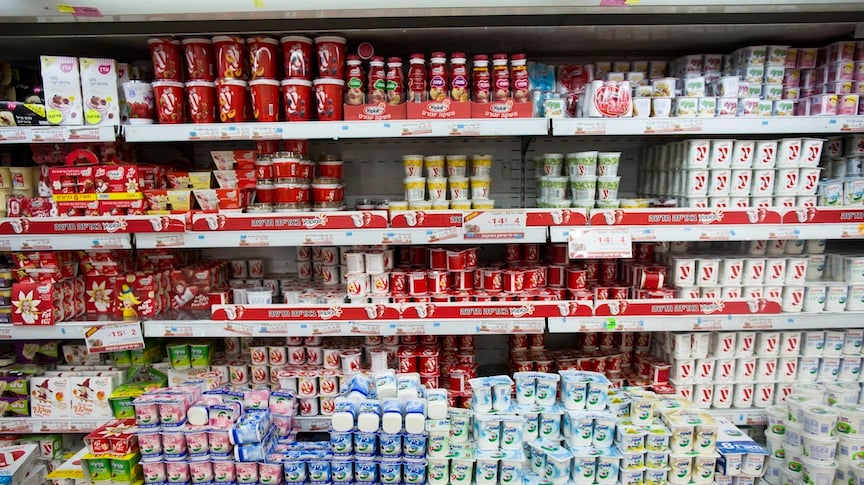
In an op-ed in Yedioth, Ra’anan Shaked highlights the undeniable “Israeliness” of the debate, and criticizes the expats for failing to fully cut their ties to the culture they have willingly left behind.
“It seems you can take the Israeli out of Israel, but not always vice versa,” he writes. “What those furious Israelis leaving now don’t take into account is that with their leaving, they are cutting themselves off from the emotional ties about which they are now shouting: the fury. Because if you have already left, why continue to fume? It seems that if they leave without a word, without casting aspersions, without blame, without preaching, without calling on others to follow in their footsteps and to prove repeatedly – seemingly to us, primarily to themselves – that they made the right decision, they are nothing more than a tree that fell in the forest without anyone hearing.”
Those initiating this debate from abroad are clinging desparately to their Israeliness “defined by the right to view everyone as total suckers,” he writes.
“Guys, let’s all agree that we’re jealous of you. You managed to get away. Your Milky is cheaper than my Milky, okay? Now can you let it go and go on with your new lives?”









The Times of Israel Community.