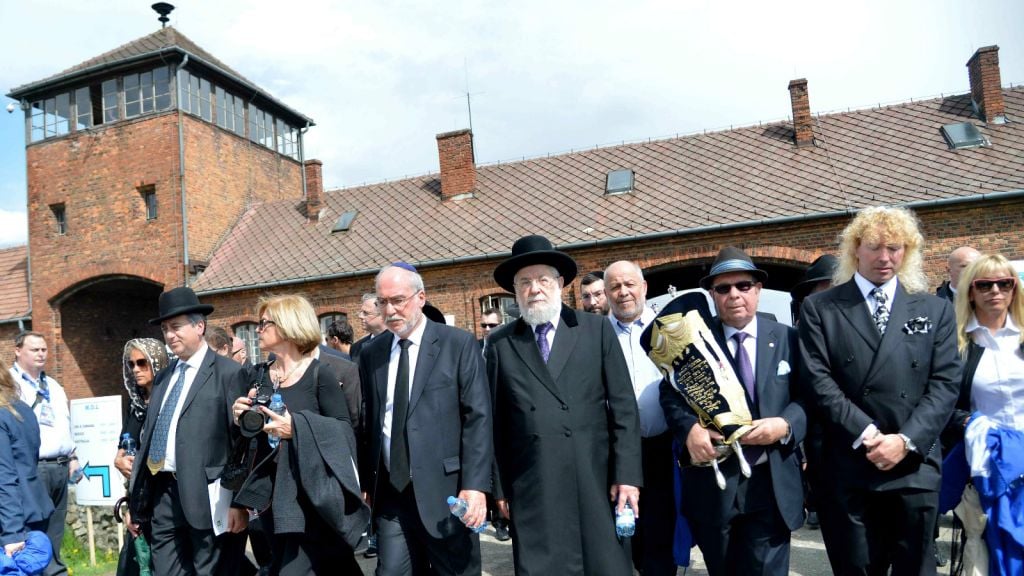
Thousands of young Jews from Israel and around the world marched on Monday between the two parts of the Auschwitz-Birkenau Nazi German death camp in Poland in memory of Holocaust victims, notably some 430,000 Hungarian Jews who perished there.
The silent annual “March of the Living” began when the shofar, a ram’s horn used for Jewish religious ceremonies, sounded by the former camp’s notorious “Arbeit Macht Frei” (Work Makes You Free) gate.
With Israeli white and blue flags and dressed in blue rain jackets, the participants walked three kilometers (two miles) from the gate to a memorial in Birkenau, to hear an address by Hungary’s President Janos Ader in memory of the victims. They were accompanied by some survivors, Israel’s Ambassador to Poland Zvi Rav-Ner, and by Polish youths.
In 1944, some 430,000 Jews were brought to the concentration camp by train from Hungary. Most were immediately put to death in the gas chambers, while the others shared the fate of all of the camp’s inmates: forced labor, hunger and disease that most often led to death.
During World War II, the Nazis killed some 1.1 million people at the camp, mostly Jews, but also Russians, Roma, Poles and members of other nationalities.
Get The Times of Israel's Daily Edition
by email and never miss our top stories
By signing up, you agree to the
terms
The march began in 1988 as a biennial event, but was soon staged yearly.
So far, almost 200,000 Jewish youths have taken part in the march, according to the International March of the Living organizers, who intend it to be an element of education for new generations.
Help us report truthfully on social media

As a multimedia journalist, my job is to take the quality, fact-based journalism produced by The Times of Israel newsroom and make it accessible across every platform — from Instagram posts to podcasts to short-form videos.
This is how many, especially young people, consume news these days. But misinformation is rampant on social media. Our team at ToI produces accurate, responsible short-form reporting on Israel and the Jewish world.
If you believe in the importance of factual social media journalism, please consider joining our reader support group, The Times of Israel Community. Your financial support is essential to sustain responsible multimedia reporting.
— Gabriella Jacobs, multimedia journalist
Support our work
Support our work
Already a member? Sign in to stop seeing this
You're a dedicated reader

We’re really pleased that you’ve read X Times of Israel articles in the past month.
That’s why we started the Times of Israel - to provide discerning readers like you with must-read coverage of Israel and the Jewish world.
So now we have a request. Unlike other news outlets, we haven’t put up a paywall. But as the journalism we do is costly, we invite readers for whom The Times of Israel has become important to help support our work by joining The Times of Israel Community.
For as little as $6 a month you can help support our quality journalism while enjoying The Times of Israel AD-FREE, as well as accessing exclusive content available only to Times of Israel Community members.
Thank you,
David Horovitz, Founding Editor of The Times of Israel
Join Our Community
Join Our Community
Already a member? Sign in to stop seeing this


 Add ToI as a Preferred Source on Google