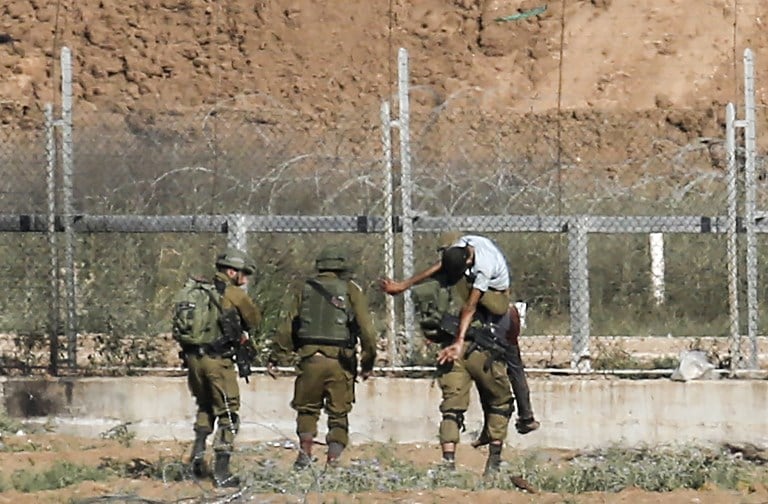
Illustrative: Israeli soldiers carry away an injured Palestinian who the army says tried to breach the border fence east of Jabaliya in the northern Gaza Strip on June 27, 2018. (Said Khatib/AFP)
The Israel Defense Forces early Thursday morning apprehended five Palestinians who crossed the border from Gaza into the country.
The men were arrested at around 2 a.m. after breaching the fence in the south of the Gaza Strip and taken in for questioning, the military said.
In its brief statement, the army did not say that the men were armed.
In recent years, as the humanitarian conditions in the coastal enclave have worsened, Israeli security forces have arrested a number of Palestinians who have fled Gaza in favor of Israeli prisons.
In many cases, these Gazans enter Israeli territory with knives and explosives in order to make it more likely that they will be imprisoned for longer terms than if they had come unarmed.
Get The Times of Israel's Daily Editionby email and never miss our top stories
In such cases, the Israeli military generally returns the Palestinians to the Gaza Strip.
Palestinians climb the border fence with Israel during clashes near the fence along the border with Israel, east of Gaza City, on March 8, 2019. (Mahmud Hams/AFP)
Since last March, the Gaza border has seen large-scale weekly clashes on Fridays, smaller protests along the northern Gaza border on Tuesdays, as well as periodic flareups between the Israeli military and Palestinian terror organizations.
Israel accuses the Gaza Strip’s Islamist Hamas rulers, who openly seek the Jewish state’s destruction, of orchestrating the protests.
Advertisement
Israel says its actions are necessary to defend the border and stop mass incursions into its territory.
It accuses the Hamas terror group, with which it has fought three wars since 2008, of seeking to use the protests as cover to carry out violence.
Judah Ari Gross and agencies contributed to this report.
Help us report truthfully on social media
As a multimedia journalist, my job is to take the quality, fact-based journalism produced by The Times of Israel newsroom and make it accessible across every platform — from Instagram posts to podcasts to short-form videos.
This is how many, especially young people, consume news these days. But misinformation is rampant on social media. Our team at ToI produces accurate, responsible short-form reporting on Israel and the Jewish world.
If you believe in the importance of factual social media journalism, please consider joining our reader support group, The Times of Israel Community. Your financial support is essential to sustain responsible multimedia reporting.
We’re really pleased that you’ve read X Times of Israel articles in the past month.
That’s why we started the Times of Israel - to provide discerning readers like you with must-read coverage of Israel and the Jewish world.
So now we have a request. Unlike other news outlets, we haven’t put up a paywall. But as the journalism we do is costly, we invite readers for whom The Times of Israel has become important to help support our work by joining The Times of Israel Community.
For as little as $6 a month you can help support our quality journalism while enjoying The Times of Israel AD-FREE, as well as accessing exclusive content available only to Times of Israel Community members.
Thank you, David Horovitz, Founding Editor of The Times of Israel


 Add ToI as a Preferred Source on Google