

Amid crackdown on fake news, Netanyahu’s own Facebook posts rapped as misleading
The PM keeps citing a Hong Kong firm’s chart showing Israel atop a ‘safest countries’ list. A little digging shows why experts urge more skepticism before we share such claims

 Add ToI as a Preferred Source on Google
Simona Weinglass is an investigative reporter at The Times of Israel.

Over the past week, Israeli police have cracked down on citizens disseminating fake coronavirus-related news on social media.
At the same time, the prime minister himself has posted items on his Facebook page that critics have slammed as misleading, highlighting the uphill struggle to combat fake news online.
On Monday, Benjamin Netanyahu posted on his Facebook page that Israel is leading the world in combating the coronavirus. He posted a chart showing that for the past week, Israel had carried out the most tests per million people (782) of any country in the world.
What he failed to mention, critics pointed out, is that the chart applies to a specific snapshot in time. If one includes previous weeks in the calculation, Israel lags [Hebrew link] behind countries like Australia, Norway and Iceland in the number of tests per million people.
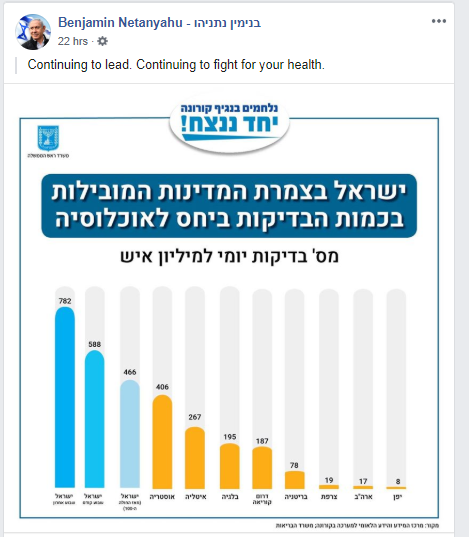
Days earlier, on March 31, Netanyahu posted a different ostensibly impressive statistic, this time on both his Facebook page and on the official website of the Prime Minister’s Office. It featured a bar chart entitled “Coronavirus Health Safety Countries Ranking,” and showed Israel leading the world in countries where an individual could feel most safe during the coronavirus pandemic.
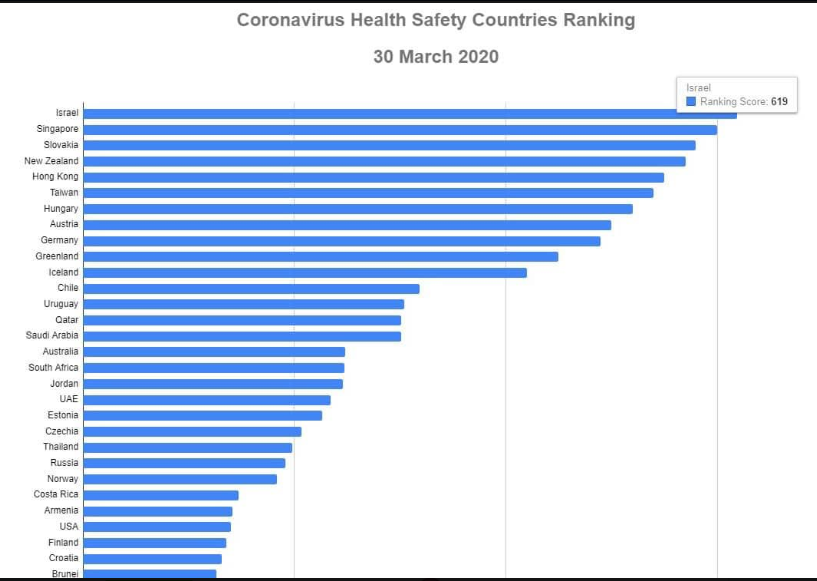
The only problem: the chart’s source. It comes from the website of a firm called “Deep Knowledge Group (dkv.global/covid) that few people had ever heard of.
“Who is Deep Knowledge Group?” Israeli journalist Neri Zilber asked on Twitter on April 2. “No one quite knows.”
In fact, Deep Knowledge Group is a Hong-Kong investment capital firm owned by a Moscow-based businessman named Dmitry Kaminsky with business interests in the fintech, blockchain and “longevity” industries.
A March 2016 article in the Russian business newspaper Kommersant reveals that Kaminsky is a major investor, alongside the Russian government, in Russia’s burgeoning longevity industry, which seeks to postpone or reverse the effects of human aging.
He also owned a bank, called iBank or Interactive Bank, but sold it in 2016 a few months before its license was revoked by the Bank of Russia for failing to “comply with the requirements of the legislation and regulations of the Central Bank,” according to the RIA Novosti news agency.
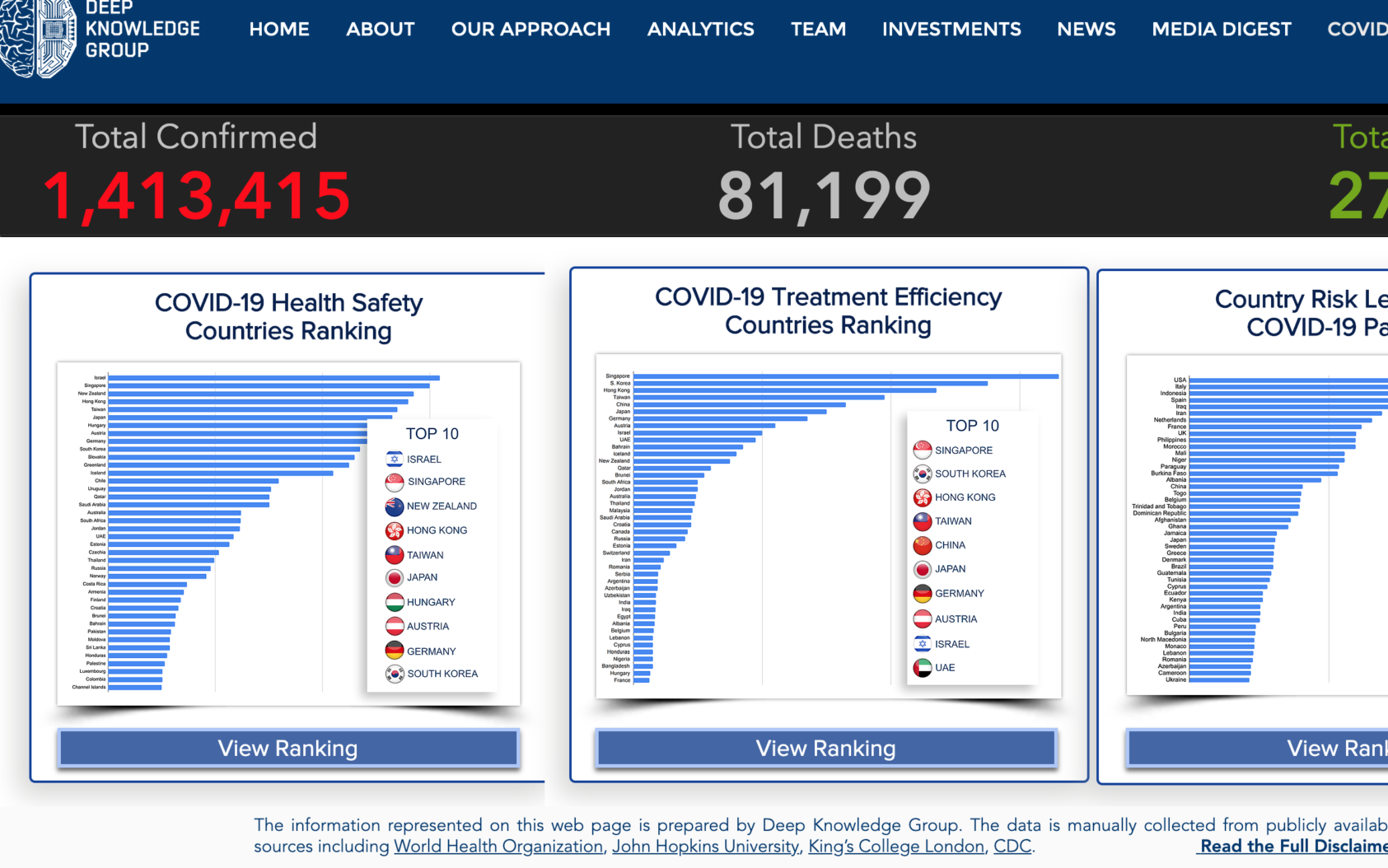
Meanwhile, an examination of websites linking to Deep Knowledge Group reveal that the site is extremely popular with entities that encourage investments in cryptocurrency, forex and other financial instruments. These sites include forexfinancenews.com, blockchainbully.org and redliontrading.com.
Some critics of the prime minister’s post questioned how Israel could be considered the world’s “safest” country when it already had over 5,000 cases of coronavirus on March 31, a higher figure than in many other countries at the time. The website did not explain its methodology. It merely said that “the data is collected from publicly available sources including World Health Organization, John Hopkins University [sic], King’s College London, CDC,” adding the caveat that it does not take responsibility for the accuracy of its chart.
“DKG makes no representation as to the accuracy or completeness of such information,” the website said.
The prime minister’s post of the Deep Knowledge Group chart’s claim was cheerfully reported as fact by dozens of Israeli news sites. Netanyahu also mentioned the “safest country” finding on primetime at least twice last week when broadcasting to the nation with new guidelines in the battle against the pandemic.
The importance of trusted sources
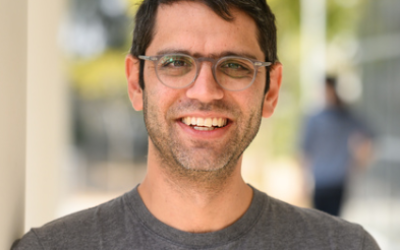
According to Nir Grinberg, a professor of information systems at Ben Gurion University of the Negev, the Internet makes us uniquely susceptible to consuming and spreading fake news because we can’t always identify the source of information we receive.
“This is an especially big problem during the period of the coronavirus pandemic,” he told The Times of Israel in a phone interview from his home in Tel Aviv, “when acting on the basis of wrong information can potentially have life-or-death consequences.”
In an ideal world, said Grinberg, every consumer of news would fact-check every claim they hear or read, but obviously, there isn’t time to do that. So we usually assume that if information comes from a trusted source, it is true.
In the offline world of newspapers or word-of-mouth communication, it is often clear what the source of information is, and we can assess whether we find it trustworthy or not.
All of this is upended by the Internet, he said.
“On social media like Facebook or WhatsApp, it’s hard to know who is behind a particular news report. The ability of anyone to create a website that looks like a reliable news site has greatly increased. In a few hours or a few days, a web developer can create a website that looks just as respectable as the website of the New York Times.”
Grinberg said that this puts consumers of information in a situation where they are overwhelmed by sources that look or seem reliable but that they lack the time or resources to vet. As a result, they can find themselves consuming or spreading fake news.
In a paper that Grinberg and several colleagues recently published in the journal “Science,” entitled “Fake news on Twitter during the 2016 U.S. presidential election,” they defined fake news outlets as “those that have the trappings of legitimately produced news but lack the news media’s editorial norms and processes for ensuring the accuracy and credibility of information.”
They found that on average, 5% of the political news people consumed on Twitter during the 2016 election campaign came from fake news sources, and 6.7% of the political news shared by users came from fake news sources.
Grinberg also found that political affinity played a role in the sharing of content from fake news sources. Fewer than 5% of study participants deemed to be on the left or in the center ever shared any fake news content, while 11 and 21% of people on the right and extreme right did, Grinberg found.
As to what people can do so that they don’t unwittingly share fake news, especially now, Grinberg advises news consumers to continually ask themselves about the source of a particular piece of information.
“You should ask yourself: What is the source? Is it a trustworthy source? If it’s a source you’ve never heard of, don’t assume it’s accurate. Look at it skeptically.”
Grinberg said that one tip-off that a source is not reliable is that it contains multiple spelling and grammatical errors. “If you look at the quality of the text, you’ll notice that often unreliable sources are full of basic mistakes.”
Grinberg’s study also found that a small number of “supersharers” had shared 80 percent of the fake news reports on Twitter.
“If you look at 16,000 users, only 16 of those might be responsible for 80 percent of fake news.”
This fact, he said, points to one possible remedy to the problem of fake news, albeit one that is controversial.
“If Twitter were to slow or limit people’s ability to publish political content beyond, say, 20 posts a day,” he said, “they could reduce the amount of fake news by 50 percent.”










The Times of Israel Community.