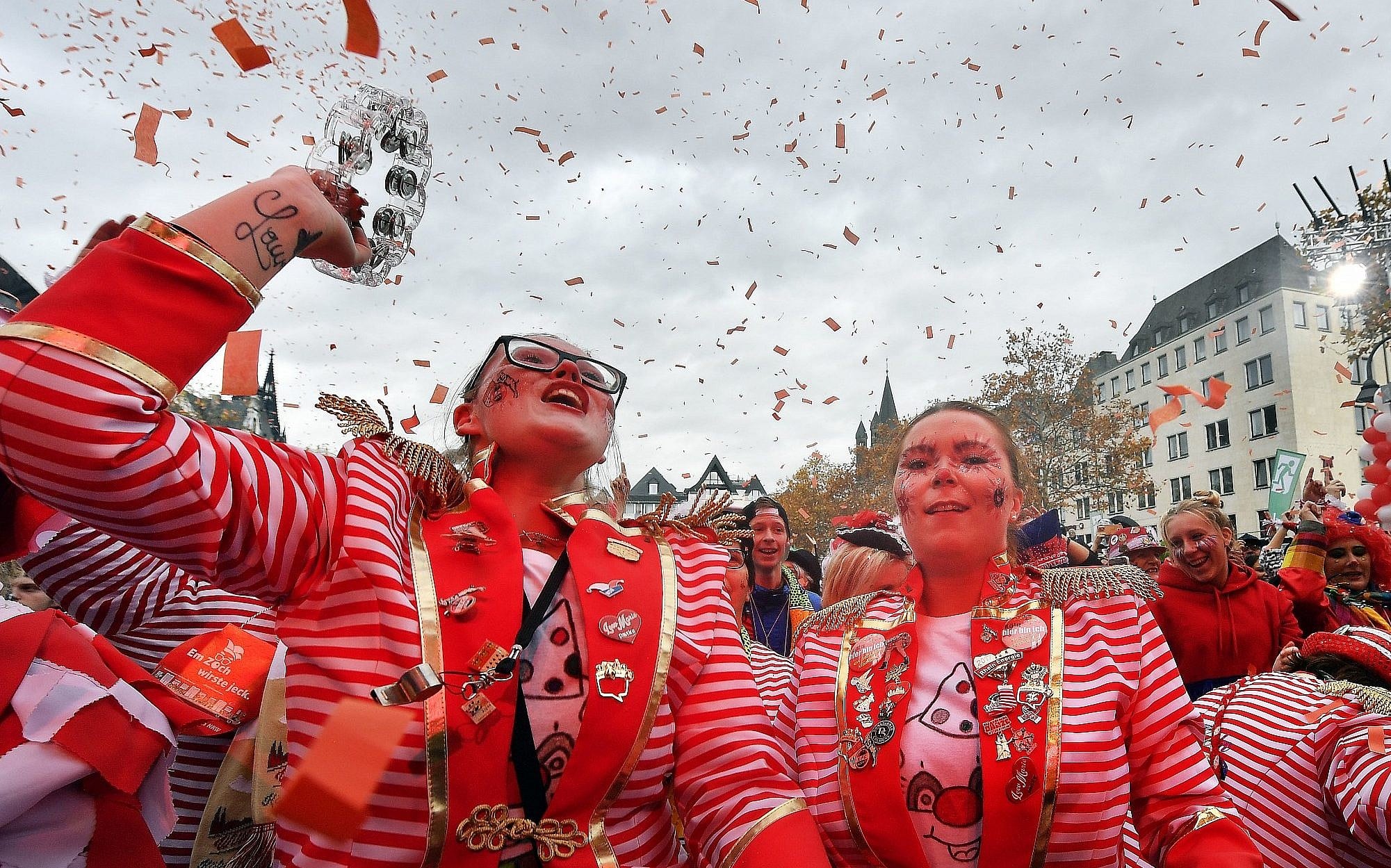
Revellers in a red spotlight celebrate the start of the carnival season in the streets of Cologne, Germany, Nov. 11, 2018. (AP Photo/Martin Meissner)
Seven decades ago, the Nazis banned Jews from participating in the famed festive costume party of the German city of Cologne.
This month, a Jewish group will again be an official participant at the Cologne Carnival in what it says is the first such occurrence since World War II.
The Cologne event had its first Jewish group in the 1920s, the Swiss-Jewish newspaper Tachles reported Tuesday. Called the Kleines Kolner Klub, or “small Cologne club,” the group was known then by its initials, KKK, which the new group headed by Knappstein took over despite its use by Ku Klux Klan white supremacists in the United States.
The new group is called Kolsch Kippa Kopp, Cologne-dialect German for “Cologne kippah head,” and its establishment “brings back the festivities to the Jewish community,” Aaron Knappstein, the president of the new Jewish group, wrote in a statement.
“Cologne Jews have always been part of the diverse Carnival life, but not visible for a long time,” he added.
Get The Times of Israel's Daily Editionby email and never miss our top stories
Revelers kiss in the city center when thousands of revelers dressed in carnival costumes celebrate the start of the street carnival in Cologne, Germany, Feb. 8, 2018. (AP Photo/Martin Meissner)
The Cologne Carnival is one of many costume parties that are held in parts of Europe and Latin America in February and March. Carnival, or Carnaval, is a Catholic tradition with pagan roots that grew out of the need to consume winter larders.
The events feature dance groups or floats comprising members who enter as official participants. They practice their moves and prepare flashy outfits for months ahead of the celebration, which this year will begin in Cologne on Feb. 28.
Advertisement
Help us report truthfully on social media
As a multimedia journalist, my job is to take the quality, fact-based journalism produced by The Times of Israel newsroom and make it accessible across every platform — from Instagram posts to podcasts to short-form videos.
This is how many, especially young people, consume news these days. But misinformation is rampant on social media. Our team at ToI produces accurate, responsible short-form reporting on Israel and the Jewish world.
If you believe in the importance of factual social media journalism, please consider joining our reader support group, The Times of Israel Community. Your financial support is essential to sustain responsible multimedia reporting.
We’re really pleased that you’ve read X Times of Israel articles in the past month.
That’s why we started the Times of Israel - to provide discerning readers like you with must-read coverage of Israel and the Jewish world.
So now we have a request. Unlike other news outlets, we haven’t put up a paywall. But as the journalism we do is costly, we invite readers for whom The Times of Israel has become important to help support our work by joining The Times of Israel Community.
For as little as $6 a month you can help support our quality journalism while enjoying The Times of Israel AD-FREE, as well as accessing exclusive content available only to Times of Israel Community members.
Thank you, David Horovitz, Founding Editor of The Times of Israel


 Add ToI as a Preferred Source on Google