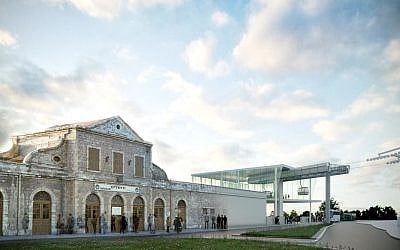
The planned cable car to Jerusalem's Old City. (Screenshot/Emek Shaveh)
A controversial plan to build a cable car to Jerusalem’s historic Old City passed a major hurdle Monday when the National Infrastructure Committee rejected a battery of petitions against the contentious tourism project.
The estimated $55 million project, which is being advanced by the Tourism Ministry, now requires approval by Prime Minister Benjamin Netanyahu’s government in order to proceed.
The cable car would ferry tourists from the renovated First Station Complex on the site of the former train station in Jerusalem’s western half to the Old City in the east. The proposed route, which spans several verdant valleys and runs past the city’s iconic walls, faced vocal protestations from environmentalists, urban planners, architects, Palestinian residents, religious minority groups and others.
The Tourism Ministry has touted the cable car scheme as an attraction as well as a solution to traffic congestion and pollution around the Old City walls, as visitors to the capital break records, reaching the four million mark.
Architect’s impression of the First Station cultural complex in Jerusalem and the cable station being planned next to it. (From plans submitted to the National Planning Council).
Boosters argue that the car will attract tourists and is the greenest, least disruptive, and most financially feasible way to get up to 3,000 visitors per hour from West Jerusalem to the the Western Wall, the most venerated site where Jews may pray.
Get The Times of Israel's Daily Editionby email and never miss our top stories
Opponents, however, say that the plan is obtrusive and culturally and politically irresponsible, and that rather than solving the traffic problem it will simply shift it to the area of the First Station.
Advertisement
Help us report truthfully on social media
As a multimedia journalist, my job is to take the quality, fact-based journalism produced by The Times of Israel newsroom and make it accessible across every platform — from Instagram posts to podcasts to short-form videos.
This is how many, especially young people, consume news these days. But misinformation is rampant on social media. Our team at ToI produces accurate, responsible short-form reporting on Israel and the Jewish world.
If you believe in the importance of factual social media journalism, please consider joining our reader support group, The Times of Israel Community. Your financial support is essential to sustain responsible multimedia reporting.
We’re really pleased that you’ve read X Times of Israel articles in the past month.
That’s why we started the Times of Israel - to provide discerning readers like you with must-read coverage of Israel and the Jewish world.
So now we have a request. Unlike other news outlets, we haven’t put up a paywall. But as the journalism we do is costly, we invite readers for whom The Times of Israel has become important to help support our work by joining The Times of Israel Community.
For as little as $6 a month you can help support our quality journalism while enjoying The Times of Israel AD-FREE, as well as accessing exclusive content available only to Times of Israel Community members.
Thank you, David Horovitz, Founding Editor of The Times of Israel


 Add ToI as a Preferred Source on Google