

Ex-minister: Israel halted Syria strikes at Putin’s behest
Efraim Sneh says this shows Israel has lost its freedom of operation; PM’s office refuses to comment on claim
 Add ToI as a Preferred Source on Google
Judah Ari Gross is The Times of Israel's religions and Diaspora affairs correspondent.
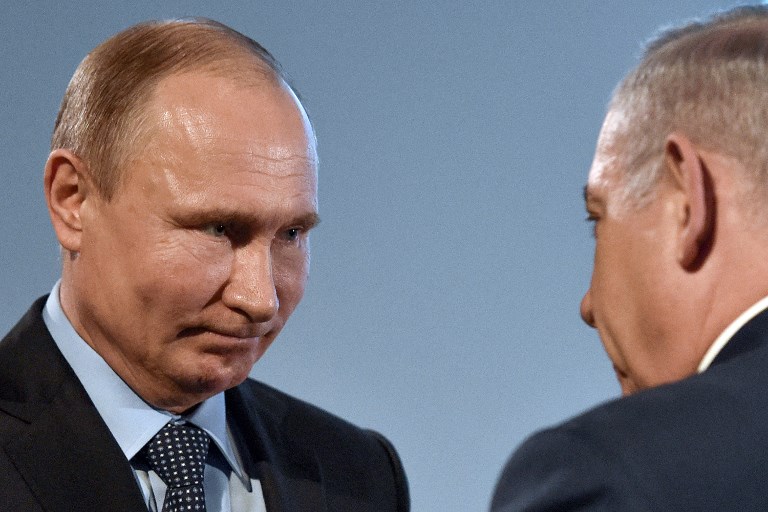
A former deputy defense minister on Wednesday claimed Israel ended its attacks on Syrian air defenses last month because Russian President Vladmir Putin called Prime Minister Benjamin Netanyahu and told him, “That’s enough.”
Brig. Gen. (res.) Efraim Sneh, who served as transportation minister in 2001, did not reveal his source for the information concerning the aerial clashes, during which Israel says it destroyed up to half of Syria’s anti-aircraft capabilities and lost, in the process, an F-16 fighter jet.
The Prime Minister’s Office refused to comment on the claim.

“The battle on Shabbat, February 10 — why did Israel stop? A call from Putin to Netanyahu. Putin said, ‘That’s enough,'” Sneh said during a conference in memory of former Mossad chief Meir Dagan, who died in 2016.
According to Sneh, a former Labor party member, that conversation proved that Israel has lost its ability to act freely in the region.
“This is called the limitation of Israel’s ability to operate in the Middle East. It has no other name,” he said.
Israel has long maintained that it will not accept restrictions on its freedom of operation.
In the early hours of February 10, an Iranian drone entered northern Israeli airspace near the Jordanian border, where it was promptly shot down by an Apache attack helicopter, according to the Israeli army.
Israeli jets then conducted a series of reprisal raids against military positions in Syria, during which one F-16 was hit by Syrian anti-aircraft fire and crashed in northern Israel. The two airmen inside it ejected from the plane. One of them was seriously injured.
In response to the downing of the F-16, the Israeli Air Force carried out a second round of strikes, destroying between one-third and one-half of Syria’s air defenses, according to the Israeli military.
“More would have been better,” Sneh told The Times of Israel on the sidelines of the conference.








The Times of Israel Community.