

Extremist party that backs booting non-Jews seen by PM as vital for his victory
Jewish Home leaders had been wary of scaring off moderate supporters by merging with the Kahanist Otzma Yehudit, but PM’s warning of ‘leftist’ threat appears to have won them over

 Add ToI as a Preferred Source on Google
When Meir Kahane served in the Knesset in the mid 1980s, fellow lawmakers made a habit of leaving the chamber when the far-right activist-rabbi rose to address the plenum.
Among those protesting were Knesset members from Likud and the National Religious Party (a precursor to today’s Jewish Home). Members of those right-wing factions were also among those who voted in favor of modifying a Basic Law in 1985, which was used to bar Kahane’s Kach party from running in the subsequent elections.
Fast forward nearly 35 years to Wednesday when a faction of leaders presenting themselves as disciples of that very same Kahane announced that they had reached an agreement to join Jewish Home in an alliance that Likud Prime Minister Benjamin Netanyahu spent immense efforts trying to bring about.
A flank of the far-right that was once too taboo even for the most ideological representatives of the national religious camp is now slated to have representation in the Knesset in the form of Otzma Yehudit, or the “Jewish power” party.
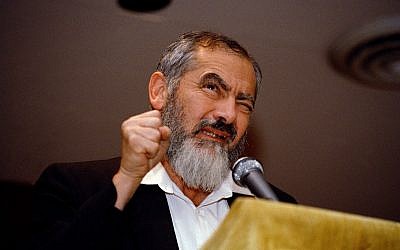
What is this Otzma Yehudit party and how has it evolved from foe to friend in the eyes of the Israeli right?
Established in 2012 as Otzma Leyisrael by former National Union MK Michael Ben Ari and Ayreh Eldad, many of the views espoused by the party are akin to those backed by some of the Knesset’s most hardline MKs — annexation of the entire West Bank and unrestricted settlement construction; opposition to a Palestinian state and punitive military operations in response to terror attacks; further emphasis on Israel’s Jewish character in the education, social, and judicial systems.
However, the ultra-nationalist party adds to those positions a host of more overtly racist ones.
It supports encouraging emigration of non-Jews from Israel, and expelling Palestinians and Israeli Arabs who refuse to declare loyalty and accept sub-equal status in an expanded Jewish state whose sovereignty extends throughout the West Bank — the biblical Judea and Samaria. It also calls for a termination of the fragile status quo on the Temple Mount.
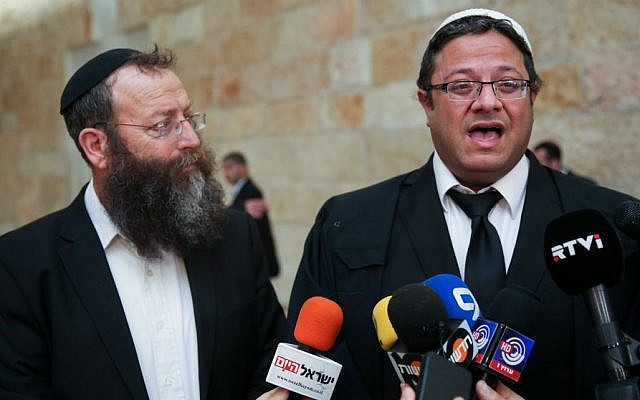
In addition to Ben Ari, Otzma Yehudit’s current leadership is made up of far-right activists Itamar Ben Gvir, Baruch Marzel and Benzi Gopstein.
As a teen, Ben Gvir was active in Kahane’s Kach movement and enjoyed brief notoriety from a TV interview in which he proudly held up the emblem that he managed to rip off prime minister Yitzhak Rabin’s Cadillac. “We got the car. We’ll get to Rabin too,” Ben Gvir said into the camera weeks before the premier’s 1995 assassination. The ultra-nationalist went on to obtain a law degree and has since made a practice of representing Jewish terror suspects.
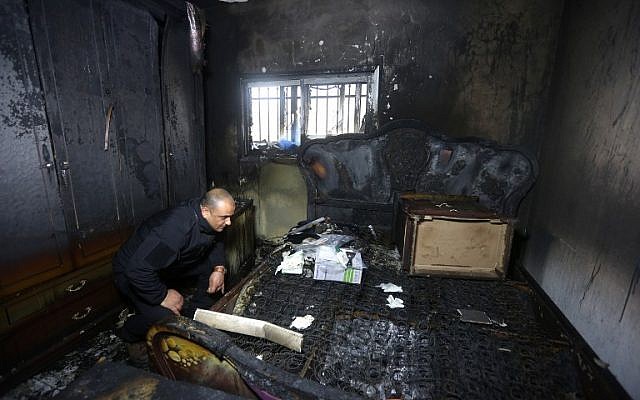
Marzel was a close confidant of Kahane, and served as the secretary of his Kach party when the Kach leader entered the Knesset in 1984. The faction went on to be banned from the Knesset under a Basic Law barring incitement to violence and was later outlawed entirely in Israel under anti-terror laws. In the most recent elections, Marzel was a candidate on the Yachad slate run by Eli Yishai, which did not manage to pass the electoral threshold.
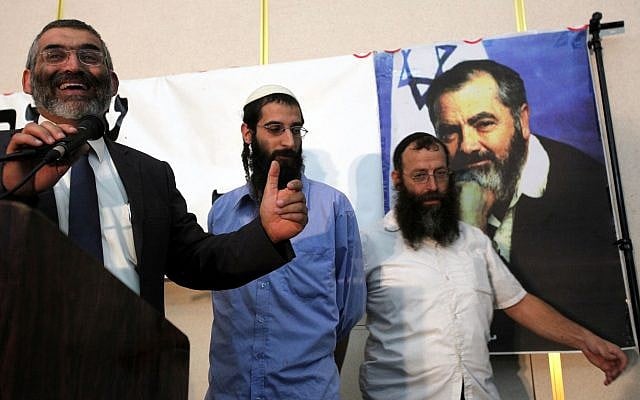
Gopstein, a student of the late Kahane, who was assassinated in 1990, is the chairman of the far-right Lehava group, which opposes intermarriage and the assimilation of Jews and tries to stifle any public activity by non-Jews in Israel. Gopstein himself faces charges of incitement to violence, racism and terrorism in an ongoing case against him.
Also a student of Kahane, Ben Ari was denied a visa into the US in 2012 due to his ties to Kahane’s movement, which the Americans also consider a terror organization.
In a video last month launching their election campaign, Ben Ari, Ben Gvir, Gopstein and Marzel presented their platform. This included a plan to “remove enemies from the State of Israel,” a vow to ensure that the High Court of Justice acts both “Jewishly and nationalistically,” and a law requiring Israelis to kill anyone who carries out an attack against them.
“A thousand of our enemies will die and not a hair will be touched on our soldiers’ heads,” Gopstein declares in the video.
So why bring them in?
Both Jewish Home and Likud leaders appear aware of Otzma Yehudit’s toxicity, which is why the two parties had been playing a game of hot potato over who would be stuck merging with the far-right faction, which would likely not cross the electoral threshold if it ran on its own.
Netanyahu asserted that the responsibility lay with the Jewish Home party, which polls show that even after merging with the Bezalel Smotrich-led National Union last week is still flirting with the electoral threshold, the 3.25 percent of the national vote required to enter the Knesset. The premier has also suggested that Otzma Yehudit lawmakers would be a more natural fit among the uniformly head-covered members of the national religious party.
But Jewish Home leaders Rafi Peretz and Smotrich have retorted that they have far fewer spots at their disposal and that it would be much easier for Netanyahu to take in the Otzma Yehudit leaders, particularly with spots on Likud’s much larger list reserved for candidates of his choosing.

Ultimately, Jewish Home, which its former leaders, Naftali Bennett and Ayelet Shaked, claim is “in Netanyahu’s pocket,” appears to have been brought to its knees by the premier.
The prime minister’s argument — that an inability to unite would lead to Jewish Home failing to cross the electoral threshold and thus could help pave the rise of a “leftist” government led by Israel Resilience party chairman Benny Gantz — resonated not just with Jewish Home leadership but with large swaths of their supporters, who joined Netanyahu in urging Peretz and Smotrich to make room for Otzma Yehudit.
Settlers leaders such as Samaria Regional Council chairman Yossi Dagan warned of a “repeat of 1992” in which infighting among right wing parties brought down then prime minister Yitzhak Shamir’s coalition, allowing for the rise of Yitzhak Rabin, who ushered in the “disastrous” Oslo process.
The Jewish Home’s central committee will convene Wednesday evening in Petah Tikva to grant final approval on the merger, which will give Otzma Yehudit the 5th and 8th spots on the expanded national religious list.
If the internal body acts in consonance with its leadership, it will certify the deal which places the “prevention of a left-wing government” ahead of maintaining the party’s more moderate supporters and orientation.





The Times of Israel Community.