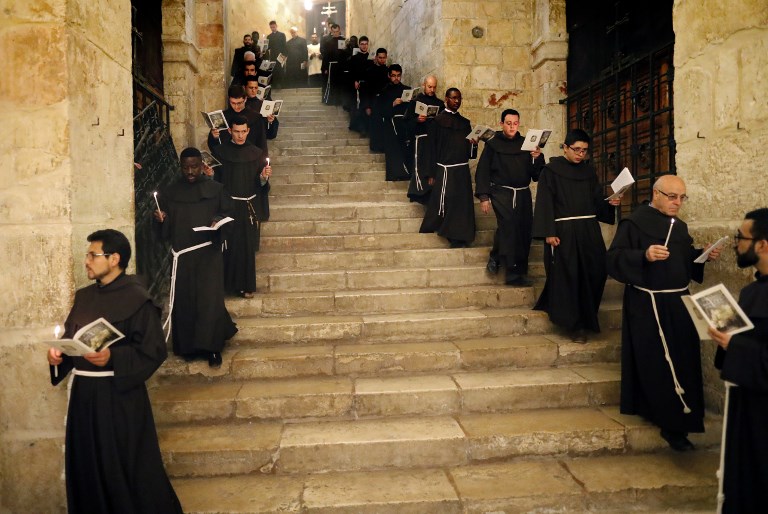
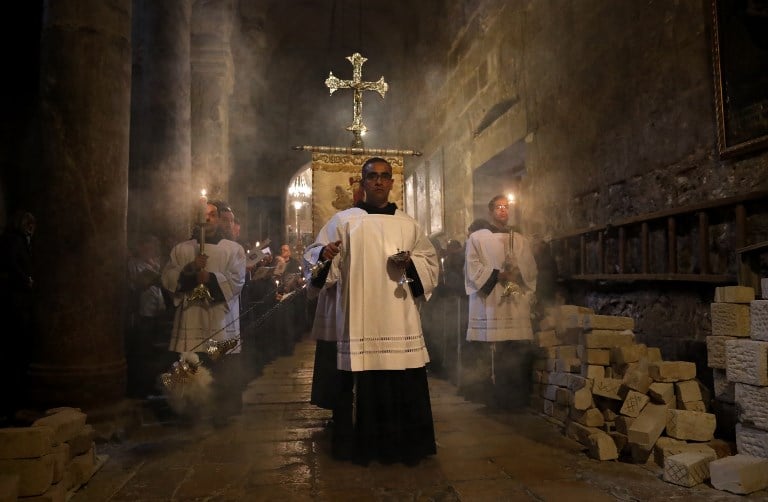
Franciscan friars pray and sing during the Lenten procession inside the Church of the Holy Sepulchre in the Old City of Jerusalem, on February 17, 2018. (AFP PHOTO / Thomas COEX)
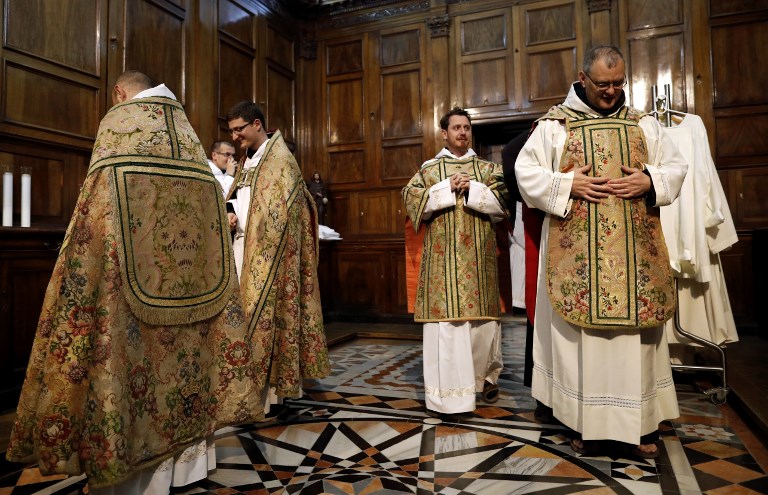
Franciscan friars dressed in liturgical ornaments offered by the French king Louis XV prepare to celebrate a mass at the Church of the Saint Saviour Convent, the headquarters of the Franciscans in the Holy Land, in the Old City of Jerusalem, on February 23, 2018. (AFP PHOTO / Thomas COEX)
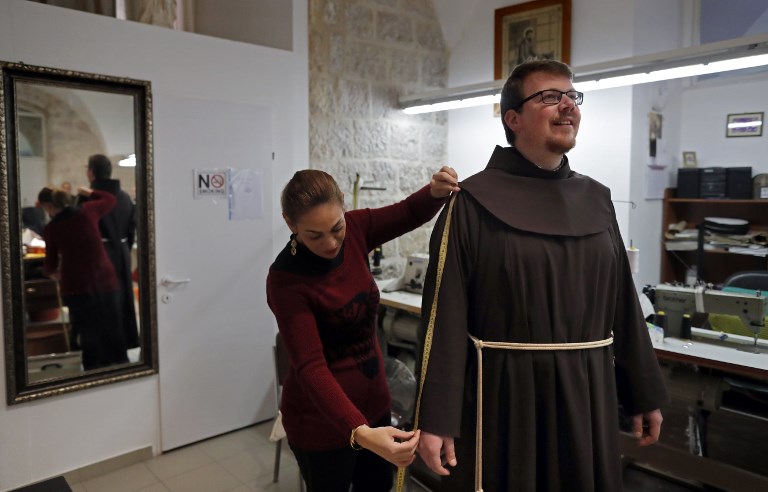
A Palestinian Christian tailor measures a Franciscan friar for a new penitent robe at a sewing workshop inside the Saint Saviour Convent, the Franciscan headquarters in the Old City of Jerusalem, on February 2, 2018. (AFP PHOTO / Thomas COEX)
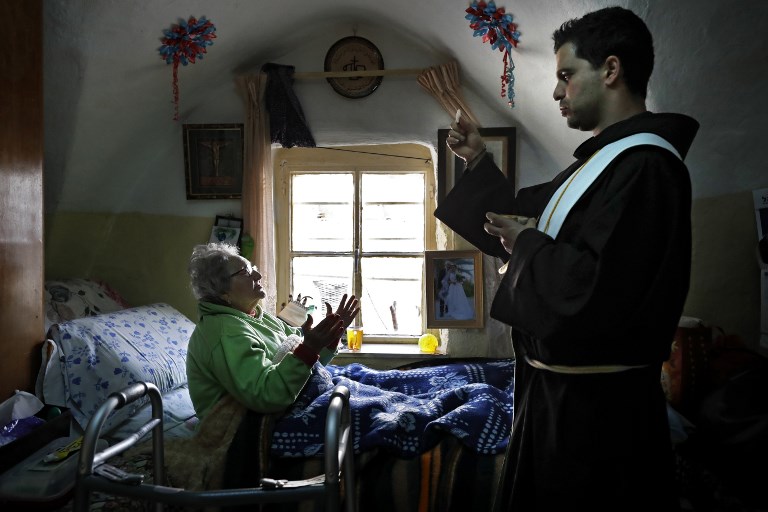
Franciscan friar Ayman Bathesh (R) gives communion to an elderly ill Christian woman at her home in the Old City of Jerusalem, on February 12, 2018. (AFP PHOTO / Thomas COEX)
Franciscan friars pray during the Lenten procession inside the Church of the Holy Sepulchre in the Old City of Jerusalem, on February 17, 2018. (AFP PHOTO / Thomas COEX)
Wearing traditional brown robes held in place by a white belt with three knots symbolizing vows of “poverty, chastity and obedience,” Franciscan friars have long been a part of Jerusalem’s landscape.
Dispatched to the city 800 years ago by the Catholic order’s founder, Saint Francis of Assisi, the Franciscans have for centuries ensured a permanent Christian presence in the Holy Land.
Pilgrims know them primarily as the Guardians of the Holy Sepulchre, protecting the site where Jesus is believed to have been crucified and buried.
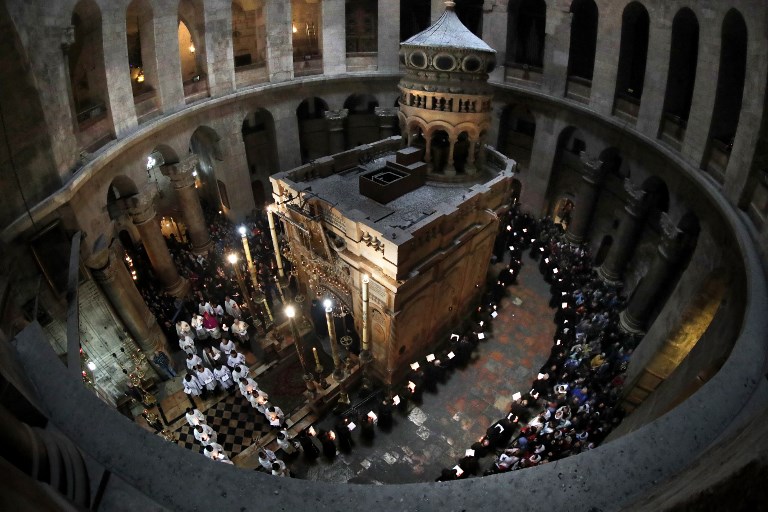
Each year, hundreds of thousands of people visit the Church of the Holy Sepulchre, considered by many to be Christianity’s holiest site.
Franciscan friars pray and sing during the Lenten procession around the Tomb believed to the be site where Jesus Christ is buried in the Church of the Holy Sepulchre in the Old City of Jerusalem, on February 17, 2018. (AFP PHOTO / Thomas COEX)
But the Franciscans, who are also responsible for the Church of the Nativity in Bethlehem where Jesus is traditionally considered to have been born, are not limited to only symbolic roles.
Get The Times of Israel's Daily Editionby email and never miss our top stories
Based in the monastery of Saint Saviour in Jerusalem’s Old City, the order also runs schools for 10,000 students, half of whom are Muslim.
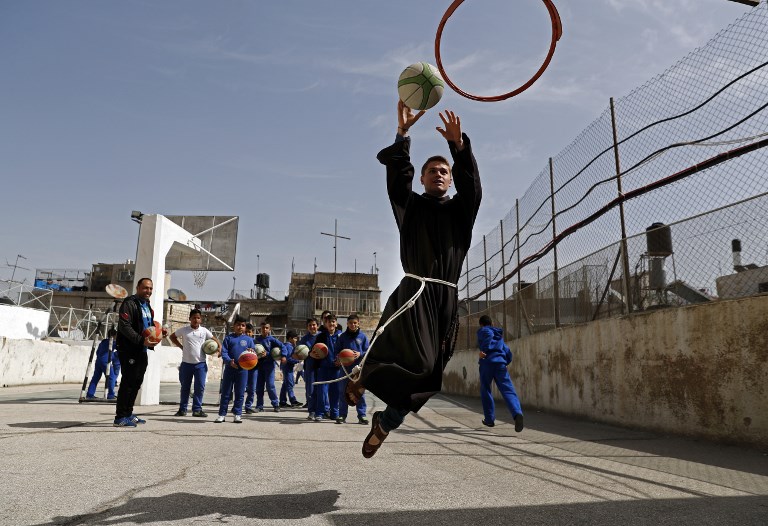
Brother Paulo, a young Brazilian seminarian, teaches and coaches basketball to Palestinian students at the Terra Santa school, which is supported by the monastery.
A Franciscan friar plays basketball with children from the Terra Sancta school during a sport session in the Old City of Jerusalem, on March 1, 2018. (AFP PHOTO / Thomas COEX)
The friars also manage hundreds of apartments in the old city, hostels for pilgrims, and a series of charities for Jerusalem’s shrinking Christian community.
Advertisement
Of the Old City’s 40,000 residents, 6,000 are Christian, with 3,000 of those Catholics, a number three times lower than it was 70 years ago.
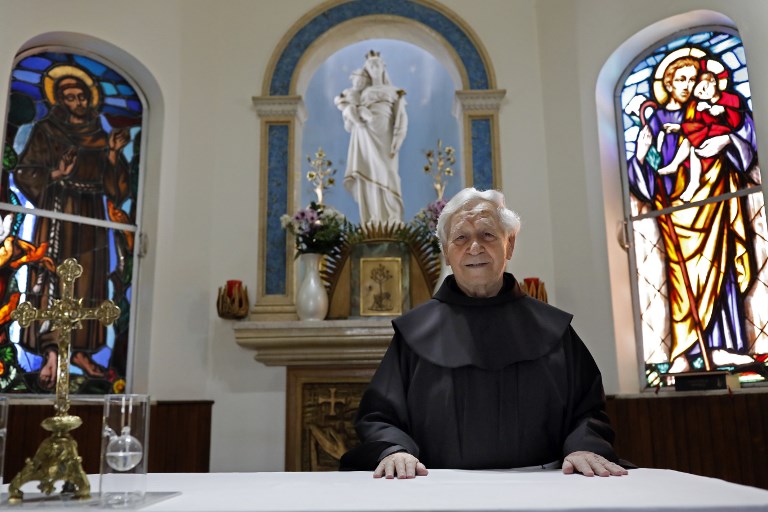
94-year-old Italian Franciscan friar Father Mario, poses for a picture at a chapel in the infirmary, a whole floor dedicated to retired Friars or those on sick leave, at the Church of the Saint Saviour Convent, headquarters of the Franciscans in the Holy Land, in the Old City of Jerusalem, February 2, 2018. (AFP PHOTO / Thomas COEX)
As the friars grow old or are weakened by illness, the monastery provides care for them in an infirmary on its roof.
Aged 94, Brother Mario Tangorra cannot imagine ending his life elsewhere.
“When anxiety gets the best of me, it’s enough for me to contemplate the Holy Sepulchre’s bell tower to find peace,” he says.
Help us report truthfully on social media
As a multimedia journalist, my job is to take the quality, fact-based journalism produced by The Times of Israel newsroom and make it accessible across every platform — from Instagram posts to podcasts to short-form videos.
This is how many, especially young people, consume news these days. But misinformation is rampant on social media. Our team at ToI produces accurate, responsible short-form reporting on Israel and the Jewish world.
If you believe in the importance of factual social media journalism, please consider joining our reader support group, The Times of Israel Community. Your financial support is essential to sustain responsible multimedia reporting.
We’re really pleased that you’ve read X Times of Israel articles in the past month.
That’s why we started the Times of Israel - to provide discerning readers like you with must-read coverage of Israel and the Jewish world.
So now we have a request. Unlike other news outlets, we haven’t put up a paywall. But as the journalism we do is costly, we invite readers for whom The Times of Israel has become important to help support our work by joining The Times of Israel Community.
For as little as $6 a month you can help support our quality journalism while enjoying The Times of Israel AD-FREE, as well as accessing exclusive content available only to Times of Israel Community members.
Thank you, David Horovitz, Founding Editor of The Times of Israel


 Add ToI as a Preferred Source on Google