

Halle synagogue attacker briefly takes prison officers hostage at German jail
Far-right assailant Stephan Balliet, jailed for life over Yom Kippur attack in which he killed 2 passersby, is overpowered by other guards
 Add ToI as a Preferred Source on Google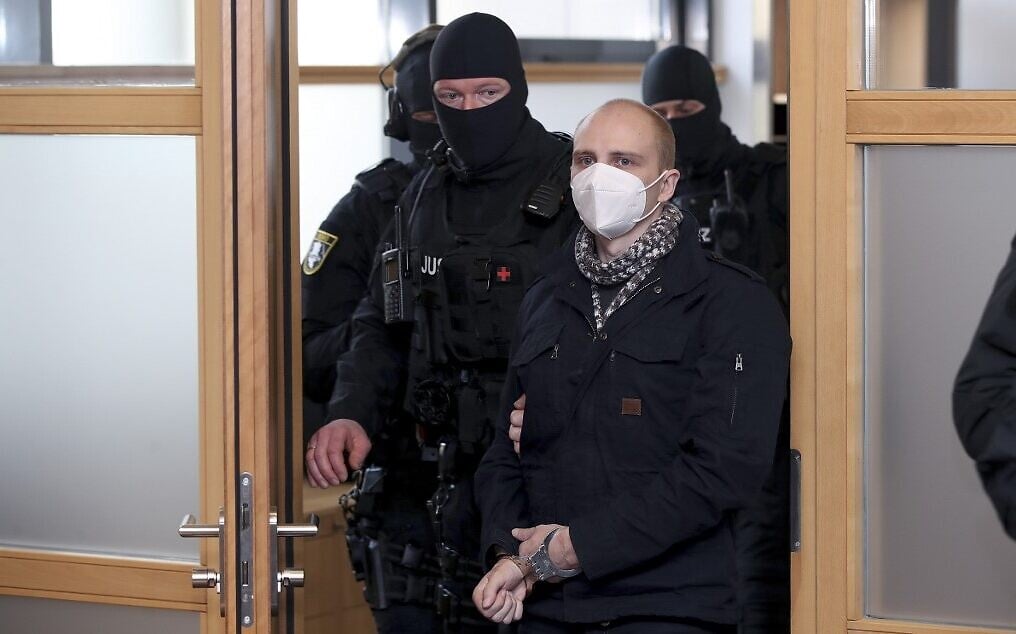
BERLIN — The assailant behind a deadly far-right attack in Germany in 2019 briefly took two prison officers hostage in the jail where he is being held, a justice ministry spokesman said Tuesday.
Stephan Balliet, now 30, was sentenced to life in prison for trying to storm a packed synagogue in the eastern city of Halle on Yom Kippur, the holiest day of the Jewish year, then killing two people.
The justice ministry said on Twitter that two prison officers had been temporarily held at the Burg prison, near the city of Magdeburg, on Monday.
The situation was successfully diffused when other prison officers overpowered the assailant, the ministry said.
The attack in Halle almost became Germany’s worst antisemitic atrocity since World War II, with only a bolted door preventing Balliet from reaching the 52 worshippers inside the synagogue.
After failing to storm the temple on October 9, 2019, he shot dead a female passerby and a man at a kebab shop, using a weapon made with 3D-printed parts.

Dressed in military garb, he filmed the attack and broadcast it on the internet, prefacing it with a manifesto espousing his misogynist, neo-fascist ideology.
During his five-month trial, Balliet denied the Holocaust in open court — a crime in Germany — and expressed no remorse to those targeted, many of whom were co-plaintiffs in the case.
During the trial, Balliet insisted that “attacking the synagogue was not a mistake, they are my enemies.”










The Times of Israel Community.