

Hanging in the balance: 5 things to know for May 4
As country watches, High Court of Justice debates whether Netanyahu may form government and whether unity deal with Blue and White is legal, as possibility of 4th elections looms
 Add ToI as a Preferred Source on Google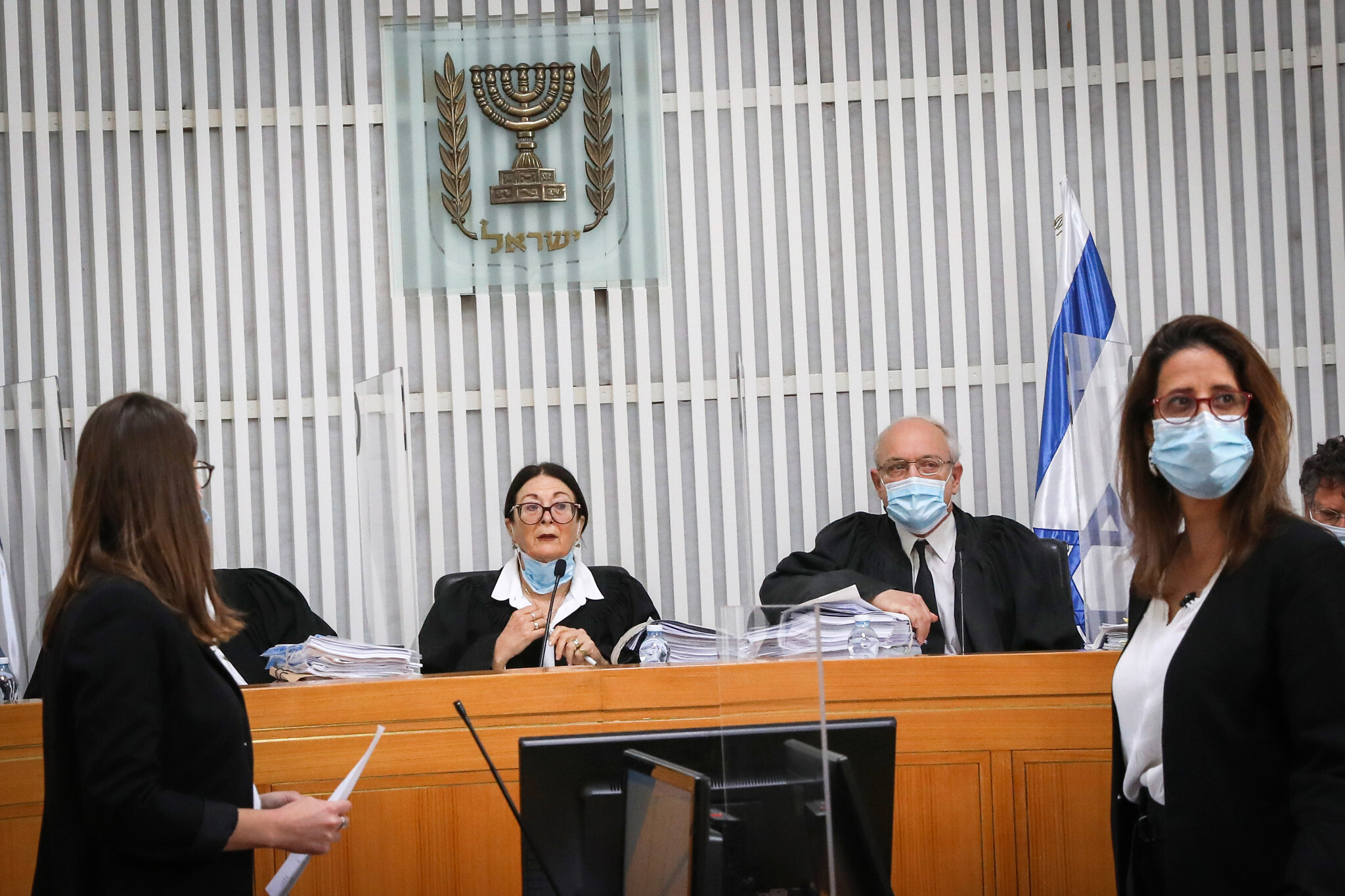
1. Robe, gavel, mask: In a live courtroom drama, the High Court of Justice on Sunday and Monday was debating whether Prime Minister Benjamin Netanyahu can legally form a government while under criminal indictment and whether his unity government deal with Blue and White’s Benny Gantz, which includes an overhaul of quasi-constitutional Basic Laws, passes legal muster.
- As Sunday’s hearing on Netanyahu wrapped up, the expanded panel of 11 justices indicated they were unpersuaded by the petitioners’ arguments. They are set to release their ruling later in the week.
- Monday’s hearing on the unity deal is also being closely watched, since if the agreement that brought an end to a year of political deadlock is disqualified, Israel could find itself facing a much dreaded fourth round of elections.
- The hearings are all being streamed live.
- “The decision on [Netanyahu’s] rule,” reads Yedioth Ahronoth’s front-page headline, though no ruling is expected just yet. The Netanyahu-backing Israel Hayom, referring to the hearing on the unity deal, says Monday’s talks are a “fateful debate that may bring fourth elections closer.”
- In its reporting, the papers sidestep predictions on which way the justices will rule on Netanyahu’s candidacy, but all play up a reprimand by Supreme Court President Esther Hayut to the petitioners opposing him, after a lawyer invoked a warning by former Likud leader Menachem Begin that “if the tower of justice falls” there is no savior for mankind. That was a reference to right-wing efforts in recent years to weaken the High Court of Justice.
- “This claim is inappropriate. No tower is falling. We spoke about populism earlier, this is populism of the same measure. It cannot be that one side will stand here and say that if we don’t accept its position, the tower will fall,” chided Hayut.
2. Court of public opinion: In Haaretz, Mordechai Kremnitzer accuses Netanyahu of willfully misleading the public with his allegations that the courts are out to get him with trumped-up criminal charges.
- “In this case, the Israeli voter was subjected to an unprecedented campaign of lies, in which it was claimed that the legal authorities ‘stitched up’ charges, which he did not commit, to bring him down and that he retains the presumption in innocence in the public sphere. Many were deceived and led astray. This campaign was organized by a suspect and accused, who, due to his position and actions managed to gain real control over parts of the media and marked influence over the rest of it. In a proper country, he should have left his position much earlier, as he himself demanded from Ehud Olmert, and then he wouldn’t have been able to mislead a large part of the public.
- “The original sin of his continued rule under these circumstances allowed him to be reelected (after the elections were moved up in order to preempt the publication of the charges, for naught). We’ve never had anything like this here, and it seems to be a rare sight in the world as well. ‘The desire of the voter,’ which is at the heart [of the court discussion], what is its weight?”
- The pro-Netanyahu Israel Hayom, likely the swayed media that Kremnitzer was referring to, underlines his point strongly by launching an attack on the judiciary and alluding to conspiracies by legal officials to oust the long-time premier from office.
- Writes analyst Haim Shine: “The legal system, including the Supreme Court, the attorney general, and the prosecution, is at one of its low points in the history of the state. When the legal system continues to lose public trust every day, a red warning light is issued for democracy, the rule of law… One of the main culprits for the loss of this trust is Dr. Avichai Mandelblit. The publication of the recommendation for charges against Netanyahu by the attorney general, very close to elections, made many citizens uneasy. The prevailing feeling was that it’s an attempt to sway the outcome of the elections in favor of Blue and White and … specifically to benefit [Blue and White MK Gabi Ashkenazi].
- This last point is hinting at the so-called Harpaz Affair that linked Mandelblit and Ashkenazi, from which the attorney general was exonerated by the Supreme Court. Netanyahu’s backers have recently revived the case in an attempt to discredit Mandelblit.
- “The public cannot rule for exoneration or conviction, that’s what the courts are for,” continues Shine. “But the millions of voters who voted Likud led by Netanyahu and for the right-wing parties, who said before elections they would go with Netanyahu, in their votes issued a vote of no-confidence in the decisions of the attorney general and prosecution. Not only was this based on the presumption of innocence but on the issues themselves. Most of the public does not believe Netanyahu is a criminal and is convinced he’ll be exonerated in court because these cases were stitched together for political reasons.”
- Shine’s indictment of Mandelblit goes on to accuse him of having a conflict of interest due to his past ties to Ashkenazi in the Harpaz Affair, going as far as hinting that the attorney general — who was appointed by Netanyahu in 2016 — filed charges to put the former IDF chief — who was not at the helm of Blue and White — in office. He claims “there was no doubt a strong conflict of interest in Mandelblit’s decisions on Netanyahu, since Gabi Ashkenazi was one of the leading candidates against Netanyahu. What real value can you attribute in light of this to Mandelblit’s decisions on Netanyahu?!”
- Mandelblit’s office, in its opinion to the High Court of Justice, said there was no legal impediment to Netanyahu forming a government.
3. Disappointed demonstrators: Outside the courthouse, with a screen set up broadcasting Sunday’s hearing, Haaretz’s Nir Hasson speaks to protesters who have been demonstrating against Netanyahu for years — outside the attorney general’s house in Petah Tikva, in Tel Aviv, and around the country.
- “Few of the protesters are pinning their hopes on the legal proceedings and are already discussing their continued street protests,” he reports, quoting protester Yishai Hadas, who says the rallies will be harder to keep up should a Likud-Blue and White government be formed.
- “There is no reference to the moral issue, they’re dissipating that in a sea of legal sophistry. It would be better if Netanyahu would just come to court and say he wants to be a dictator and they should just stop bothering him,” Hadas complains.
4. Knesset gears up: When a movie is ultimately made on Israel’s nail-biting political saga, the Hollywood edition won’t require tweaks to the real-life storyline to build up the tension: Even as the High Court discusses the unity deal, Israel faces the prospect of another election in 72 hours if no government is formed. Likud and Blue and White are gearing up to advance legislation anchoring their unity deal in law, including amendments to two Basic Laws — provided the High Court doesn’t knock them down.
- They must become law by Thursday, because that’s the deadline for the Knesset to name a prime minister from among its ranks or call new elections. The Knesset is unlikely to approve the new government if the legislation ensuring the rotation deal between Netanyahu and Gantz hasn’t become law.
- “In the event that Blue and White doesn’t manage to approve all the amendments by Thursday and swear in a government, there are two possible scenarios,” write Moran Azulay and Yuval Karni in Yedioth Ahronoth. “The first: The prime minister will have to approach President Reuven Rivlin and ask for another extension to build a government — on condition that 61 MKs are signed on to the request. This prospect is problematic for Blue and White, since it will have to provide the signatures for Netanyahu and, in practice, hand over the reins of power. The second scenario seems unfathomable: If 61 MKs don’t sign such a request, the Knesset will dissolve automatically en route to a fourth round of elections.”
- They report: “On the backdrop of the political uncertainty and while they wait for the High Court ruling, the sides are continuing to negotiate over the health portfolio. Blue and White is demanding the portfolio, but Likud has asked for three others in exchange. As of now, there is no agreement: Blue and White offered two small portfolios and the position of deputy minister… but there has been no agreement on which offices. The assessment: The negotiations on the health portfolio will be kicked into high gear only after it’s clarified whether the High Court will disqualify parts of the agreement, and if yes, which parts.”
- Blue and White is also refusing to allow Likud’s Yuli Edelstein to return as Knesset speaker, a position currently held by Gantz after Edelstein defied the High Court last month, they report, making it likely that Likud minister Yariv Levin will get the job.
5. Corona, we hardly knew ye: It’s not all legal doom and political gloom in Israel, though, with the country seeing a sharp downturn in the number of virus cases.
- Just 23 new cases of the coronavirus were diagnosed in the previous 24 hours according to Health Ministry figures released Sunday evening, the lowest daily rise in the last six weeks, continuing a trend indicating the outbreak in Israel is largely under control.
- The number of patients on ventilators also continues to drop and was at 76. The death toll is 234.
- The sharp decrease has allowed Israel to begin opening up and considering ending a raft of restrictions.
- Haaretz reports that the Health Ministry, which has dominated decision-making on the virus restrictions, is not ruling out the Finance Ministry’s four-stage plan, which would see the economy fully reopened by June 14, with malls and gyms possibly resuming operations this week.
- At the same time, a 45-year-old woman was reportedly hospitalized on Saturday at Hillel Yaffe Medical Center in Hadera with a fever and chest pain and tested positive for the coronavirus — a month after she contracted the virus and was discharged from the same hospital after she recovered. Despite many similar reports of reinfections, primarily in South Korea, and the World Health Organization (WHO) saying last month that there was no evidence that people who have recovered from COVID-19 and have antibodies are protected against a second infection, the consensus among most experts is that these reports are due to problems with coronavirus tests.




The Times of Israel Community.