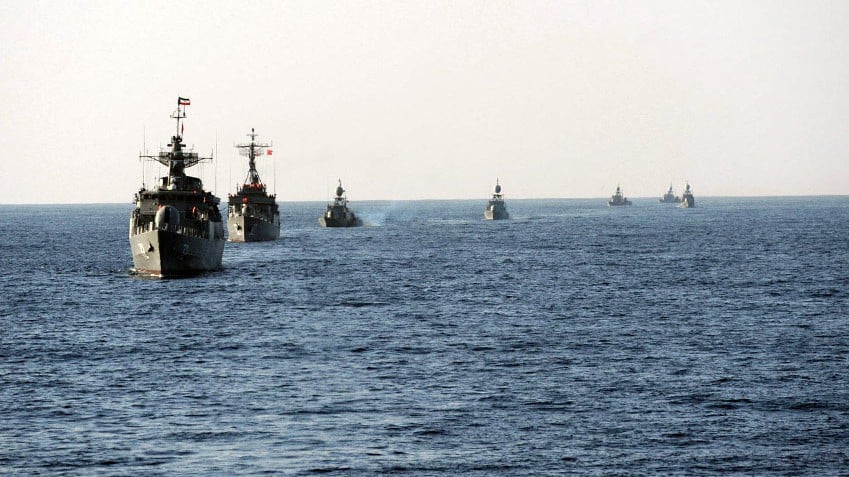
Illustrative: Iranian Navy exercise in 2011. (CC BY, Mohammad Sadegh Heydari, Wikimedia Commons)
WASHINGTON — The general overseeing US military operations in the Middle East said Wednesday that an Iranian naval exercise around the Strait of Hormuz was meant to send a message to Washington before it reimposed sanctions on Tehran.
Iran launched the exercise in the Gulf last week, sending dozens of small attack boats out into the Strait of Hormuz — a vital, oil-shipping waterway that Iranian President Hassan Rouhani last month threatened to shut down.
“It’s pretty clear to us that they were trying to use that exercise to send a message to us that as we approach the period of the sanctions here that they had some capabilities,” US Central Command head General Joseph Votel told Pentagon reporters.
US Central Command chief Gen. Joseph Votel speaks to reporters at the Pentagon, Tuesday, Aug. 30, 2016. (AP Photo/Manuel Balce Ceneta)
The capabilities include ocean mines, explosive boats, coastal defense missiles and radars, he said.
Votel said he saw Qassem Soleimani, who heads the external operations Quds Force for Iran’s Revolutionary Guards, as being responsible for the exercise.
Get The Times of Israel's Daily Editionby email and never miss our top stories
“He is an individual who is perpetrating a lot of this destabilizing activity,” Votel said.
“Wherever you see Iranian activity, you see Qassem Soleimani.”
The United States on Tuesday reimposed sanctions on Iran, after President Donald Trump pulled out of the 2015 multilateral nuclear deal with Tehran.
Advertisement
Help us report truthfully on social media
As a multimedia journalist, my job is to take the quality, fact-based journalism produced by The Times of Israel newsroom and make it accessible across every platform — from Instagram posts to podcasts to short-form videos.
This is how many, especially young people, consume news these days. But misinformation is rampant on social media. Our team at ToI produces accurate, responsible short-form reporting on Israel and the Jewish world.
If you believe in the importance of factual social media journalism, please consider joining our reader support group, The Times of Israel Community. Your financial support is essential to sustain responsible multimedia reporting.
We’re really pleased that you’ve read X Times of Israel articles in the past month.
That’s why we started the Times of Israel - to provide discerning readers like you with must-read coverage of Israel and the Jewish world.
So now we have a request. Unlike other news outlets, we haven’t put up a paywall. But as the journalism we do is costly, we invite readers for whom The Times of Israel has become important to help support our work by joining The Times of Israel Community.
For as little as $6 a month you can help support our quality journalism while enjoying The Times of Israel AD-FREE, as well as accessing exclusive content available only to Times of Israel Community members.
Thank you, David Horovitz, Founding Editor of The Times of Israel


 Add ToI as a Preferred Source on Google