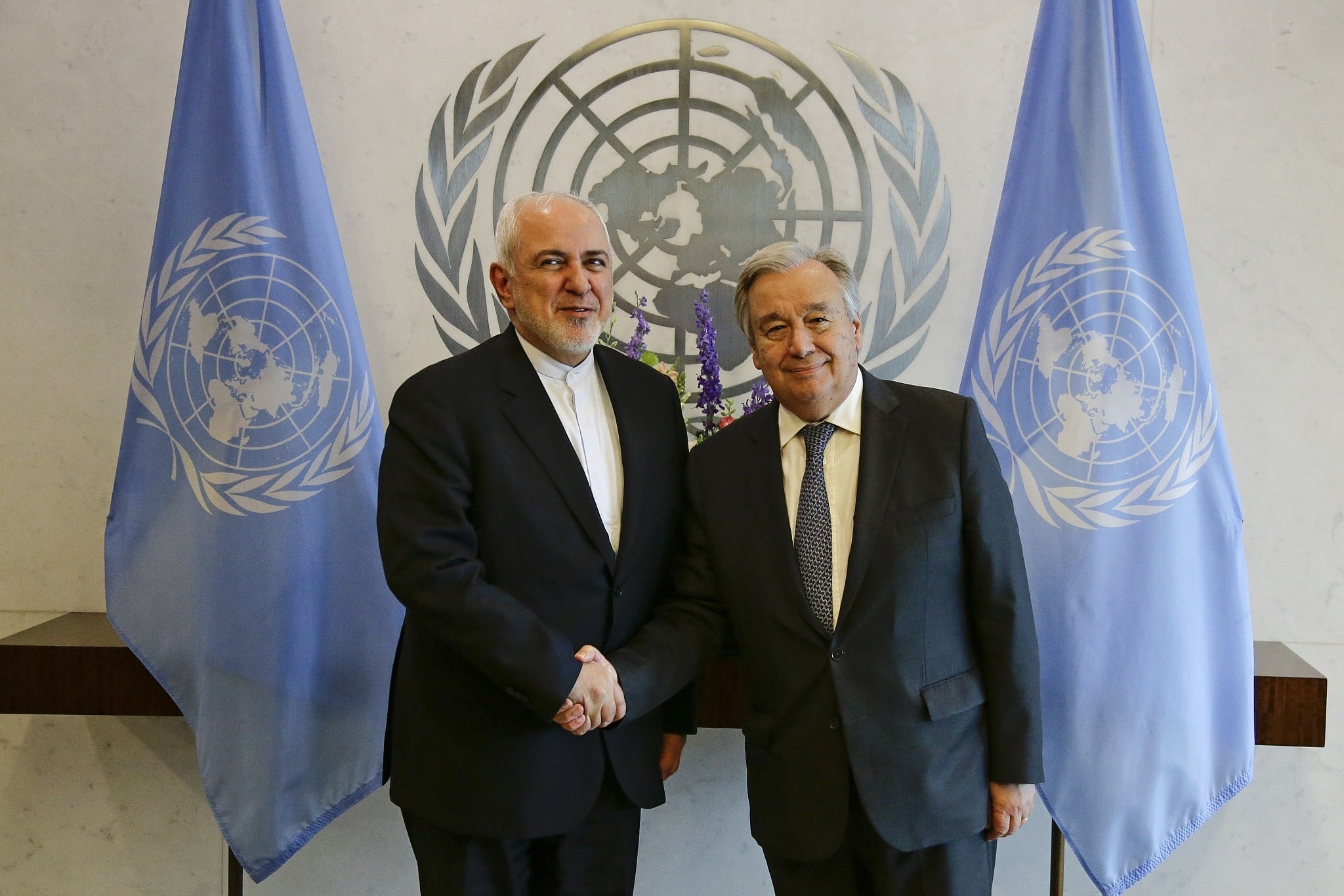
Iranian Foreign Minister Mohammad Javad Zarif, left, shakes hands with UN Secretary General Antonio Guterres at United Nations headquarters July 18, 2019. (AP Photo/Frank Franklin II)
TEHRAN, Iran — Iran’s Foreign Minister Mohammad Javad Zarif is to leave for New York early Friday to attend the UN General Assembly, his ministry said, after reports he may not be granted a visa.
“Foreign Minister, @JZarif is leaving for New York early on Friday morning to attend the 74th session of UNGA,” ministry spokesman Abbas Mousavi wrote in a tweet on Thursday.
“The minister usually departs a day or two before the President,” he added, seemingly confirming that both had received visas from the United States.
State media had reported the day before that Iran’s President Hassan Rouhani and his delegation could be forced into skipping the assembly if US visas were not issued.
As the host government, the United States is generally obliged to issue visas to diplomats who serve at UN headquarters.
Get The Times of Israel's Daily Editionby email and never miss our top stories
But as Iran’s top diplomat, Zarif was sanctioned by the US on July 31 — ahead of the UN General Assembly debate due to begin on Tuesday.
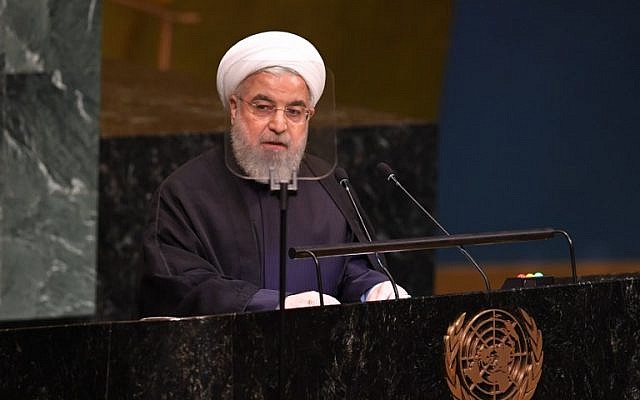
Iranian President Hassan Rouhani addresses the Nelson Mandela Peace Summit on September 24, 2018, one day before the start of General Debate of the 73rd session of the General Assembly at the United Nations in New York. (AFP Photo/Don Emmert)
UN Secretary-General Antonio Guterres said the world body had been in contact with the US “to solve all outstanding visa problems in relation to delegations.”
Iran and the United States have been at loggerheads since May last year when Trump abandoned a 2015 nuclear deal and began reimposing sanctions in its campaign of “maximum pressure.”
Advertisement
Iran responded by scaling back its commitments under the landmark accord, which gave it the promise of sanctions relief in return for limiting the scope of its nuclear program.
The latest escalation had the US blaming Iran for Saturday attacks on two Saudi oil installations as well as a string of recent assaults on shipping in sensitive Gulf waters, all denied by Iran.
The UN General Assembly debate is due to begin on Tuesday.
We can't do this work alone.
The war with Iran has been draining for all of us in Israel. But when I heard about a high casualty incident – ballistic missile impacts in Arad and Dimona that left nearly 200 people wounded – I drank a cup of coffee, packed a bag, and headed south.
There, I spoke with Shilgit, the head of an after-school program for underprivileged youth. Standing outside her destroyed center, Shilgit said it was a miracle that no children were hurt and spoke about the community coming together in the hours since.
As a Times of Israel reporter, I’m committed to telling stories of resilience like Shilgit’s. But my colleagues and I can't do this alone. If you value work like this,please consider joining our reader support group, The Times of Israel Community. Your financial support is essential to keep real human reporting like this going.
We’re really pleased that you’ve read X Times of Israel articles in the past month.
That’s why we started the Times of Israel - to provide discerning readers like you with must-read coverage of Israel and the Jewish world.
So now we have a request. Unlike other news outlets, we haven’t put up a paywall. But as the journalism we do is costly, we invite readers for whom The Times of Israel has become important to help support our work by joining The Times of Israel Community.
For as little as $6 a month you can help support our quality journalism while enjoying The Times of Israel AD-FREE, as well as accessing exclusive content available only to Times of Israel Community members.
Thank you, David Horovitz, Founding Editor of The Times of Israel