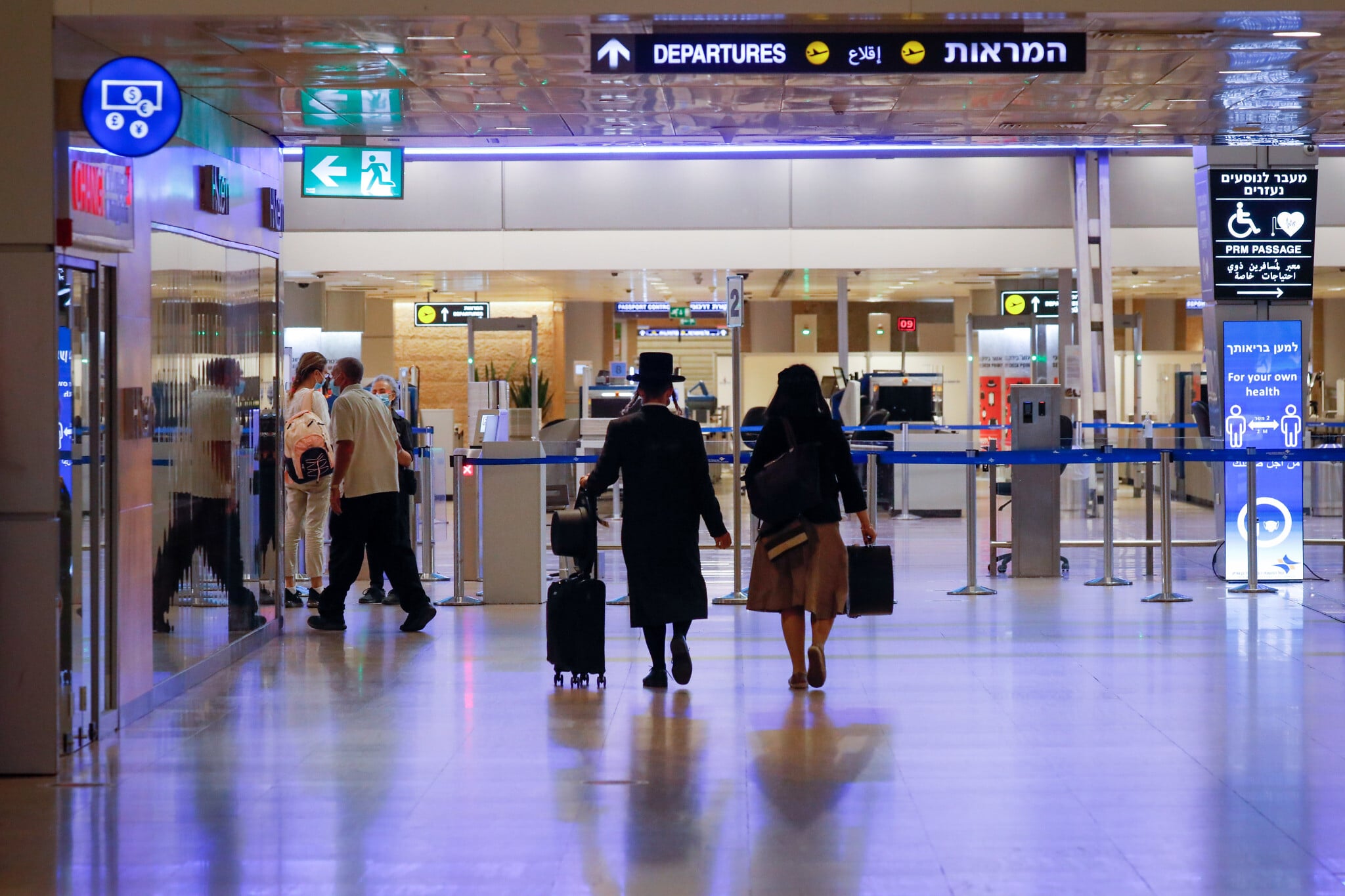
Travelers at Ben Gurion International Airport, during a nationwide lockdown, October 12, 2020. (Olivier Fitoussi/FLASH90)
Israel announced Thursday that it was lifting an unpopular ban on citizens flying out of the country, in an initial easing of the nationwide coronavirus lockdown.
“As of Friday, October 16, 2020, the emergency ordinance restricting entry to the airport for those who have not met the defined criteria will be canceled,” a government statement said.
The flight ban was part of a slew of restrictions added on September 25 to reinforce a lockdown that began a week earlier.
The government has since allowed access to flights only to those who had bought their tickets prior to September 25.
Israelis and foreigners with a residency visa are allowed to fly into the country, but those landing from so-called “red countries” — those with high coronavirus rates — must observe a 14-day quarantine.
Get The Times of Israel's Daily Editionby email and never miss our top stories
The nationwide COVID-19 lockdown, the Jewish state’s second since March, limited public prayer and placed strict curbs on demonstrations.
Prime Minister Benjamin Netanyahu, left, chairs an emergency meeting of senior ministers to decide on measures to curb the spread of the coronavirus, July 16, 2020. (Chaim Tzach/GPO)
A meeting of the so-called coronavirus cabinet was expected Thursday to discuss a possible further easing of lockdown measures.
Israel has recorded close to 300,000 coronavirus infections and over 2,000 deaths, out of a population of nine million.
Advertisement
The rate of new infections, however, is easing, with 2,000 new cases reported on Wednesday, compared to more than 7,500 the day before the flight ban was introduced.
We can't do this work alone.
The war with Iran has been draining for all of us in Israel. But when I heard about a high casualty incident – ballistic missile impacts in Arad and Dimona that left nearly 200 people wounded – I drank a cup of coffee, packed a bag, and headed south.
There, I spoke with Shilgit, the head of an after-school program for underprivileged youth. Standing outside her destroyed center, Shilgit said it was a miracle that no children were hurt and spoke about the community coming together in the hours since.
As a Times of Israel reporter, I’m committed to telling stories of resilience like Shilgit’s. But my colleagues and I can't do this alone. If you value work like this,please consider joining our reader support group, The Times of Israel Community. Your financial support is essential to keep real human reporting like this going.
We’re really pleased that you’ve read X Times of Israel articles in the past month.
That’s why we started the Times of Israel - to provide discerning readers like you with must-read coverage of Israel and the Jewish world.
So now we have a request. Unlike other news outlets, we haven’t put up a paywall. But as the journalism we do is costly, we invite readers for whom The Times of Israel has become important to help support our work by joining The Times of Israel Community.
For as little as $6 a month you can help support our quality journalism while enjoying The Times of Israel AD-FREE, as well as accessing exclusive content available only to Times of Israel Community members.
Thank you, David Horovitz, Founding Editor of The Times of Israel