An illustrative image of AI (artificial intelligence) and facial recognition technologies (KENGKAT; iStock by Getty Images)
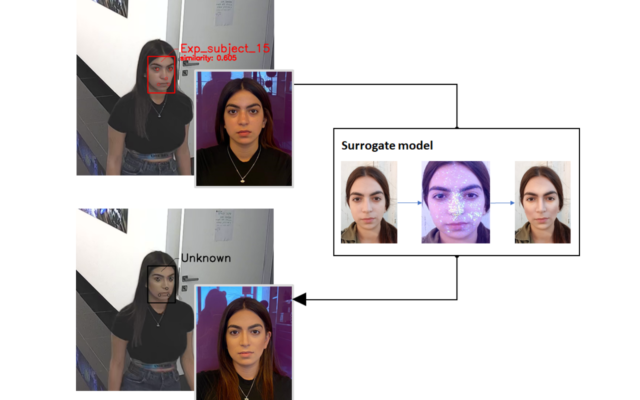
Israeli researchers have found an apparently straightforward method to fool facial recognition software — by applying conventional makeup to specific areas of the face according to a pattern determined by an artificial intelligence program.
The study, conducted at Beersheba’s Ben-Gurion University, found that when applying the computer-generated makeup pattern to test subjects, the systems were bypassed at a near 100% success rate.
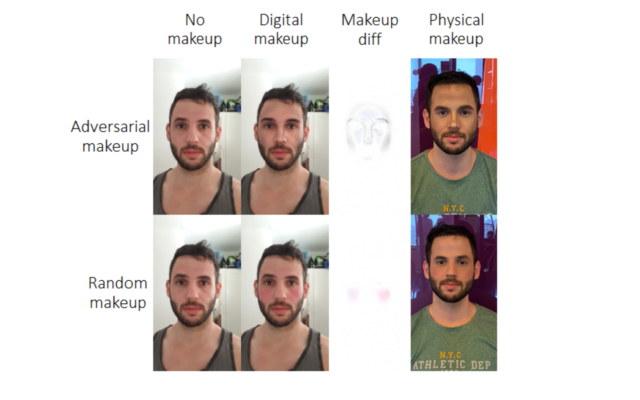
Twenty volunteers (10 men and 10 women) either had makeup applied to the most identifiable areas of the face according to the heatmap generated by the software, or random makeup applied, and finally no makeup at all.
The test subjects then faced a real-world environment by walking down a hallway equipped with two cameras and a variety of lighting conditions.
With the software-designed makeup pattern, subjects were correctly identified just 1.22% of the time, compared to 33.73% with random makeup and 47.57% without any makeup applied.
Sign up for the Tech Israel Dailyand never miss Israel's top tech stories
“I was surprised by the results of this study,” Nitzan Guetta, a lead author of the study, told Vice’s Motherboard website.
Facial recognition system is unable to identify the subject once the AI-generated makeup is applied. (Courtesy/Ben Gurion University/Cornell University)
“[The makeup artist] didn’t do too much tricks, just see the makeup in the image and then she tried to copy it into the physical world. It’s not a perfect copy there. There are differences but it still worked,” she added.
The study was conducted using neutral color palettes to achieve a natural look and conventional makeup techniques, which means it can be technically replicated by anyone. However, the downside to the method is that one is still very much recognizable to other humans.
Advertisement
A participant with makeup recommended by the AI program was able to fool the facial recognition system. (Courtesy/Ben Gurion University/Cornell University)
Help us report truthfully on social media
As a multimedia journalist, my job is to take the quality, fact-based journalism produced by The Times of Israel newsroom and make it accessible across every platform — from Instagram posts to podcasts to short-form videos.
This is how many, especially young people, consume news these days. But misinformation is rampant on social media. Our team at ToI produces accurate, responsible short-form reporting on Israel and the Jewish world.
If you believe in the importance of factual social media journalism, please consider joining our reader support group, The Times of Israel Community. Your financial support is essential to sustain responsible multimedia reporting.
We’re really pleased that you’ve read X Times of Israel articles in the past month.
That’s why we started the Times of Israel - to provide discerning readers like you with must-read coverage of Israel and the Jewish world.
So now we have a request. Unlike other news outlets, we haven’t put up a paywall. But as the journalism we do is costly, we invite readers for whom The Times of Israel has become important to help support our work by joining The Times of Israel Community.
For as little as $6 a month you can help support our quality journalism while enjoying The Times of Israel AD-FREE, as well as accessing exclusive content available only to Times of Israel Community members.
Thank you, David Horovitz, Founding Editor of The Times of Israel


 Add ToI as a Preferred Source on Google