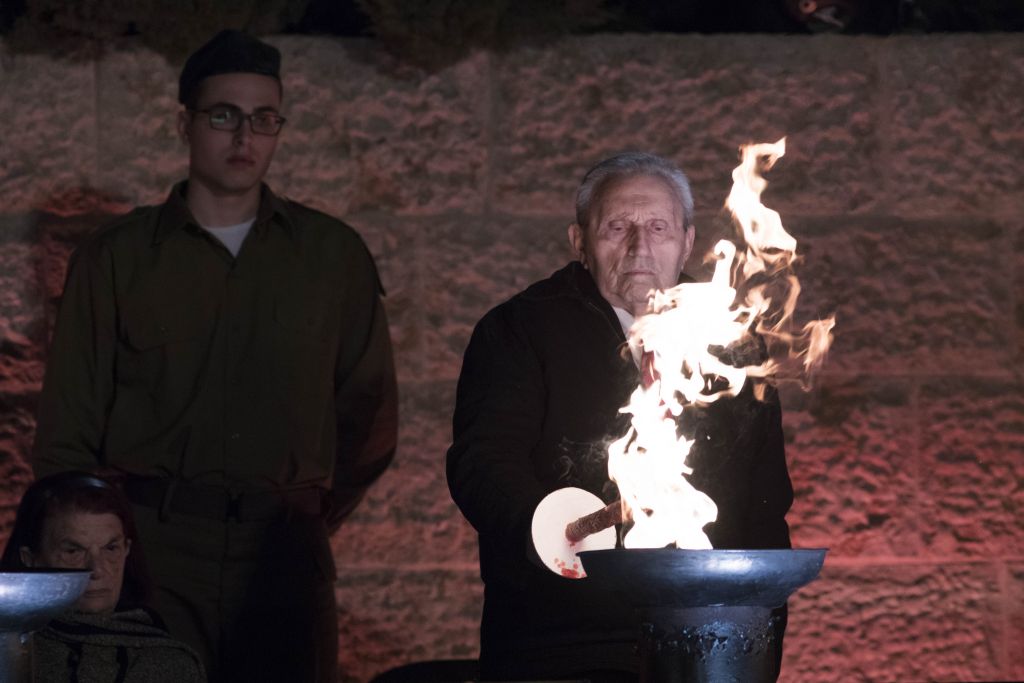
Nearly 700 Israeli teens studying in science and technology schools in Israel are teaching Holocaust survivors to use computers and the internet.
The students meet weekly in pairs with survivors in 22 cities across Israel through a program called Mechubarim, “connected.”
Students have helped the survivors to search for family members lost during the Holocaust and research other aspects of their lives in Europe. Many of the students and survivors have typed the survivors’ stories into the program’s website as part of their work together.
The program, which will start with new pairings this month, has nearly doubled since last year, which organizers attribute to the students learning more about the importance of honoring elderly Holocaust survivors. Many of the students continue to visit their survivor partners even after they graduate from high school and go on to the army and higher education.
“I am writing my own story,” said Dov Zorni, a Holocaust survivor living in Ramat Gan. “And I’ve learned to read the newspaper and play games on the computer. The internet helps me to search for my family that was spread out during and following the Holocaust. My (student) friend Eldar has helped me learn how to do all of this.”
Get The Times of Israel's Daily Edition
by email and never miss our top stories
By signing up, you agree to the
terms
The program was established by the Israel Sci-Tech Schools, a network of 206 science and technology educational institutions in Israel educating 100,000 students.
Help us report truthfully on social media

As a multimedia journalist, my job is to take the quality, fact-based journalism produced by The Times of Israel newsroom and make it accessible across every platform — from Instagram posts to podcasts to short-form videos.
This is how many, especially young people, consume news these days. But misinformation is rampant on social media. Our team at ToI produces accurate, responsible short-form reporting on Israel and the Jewish world.
If you believe in the importance of factual social media journalism, please consider joining our reader support group, The Times of Israel Community. Your financial support is essential to sustain responsible multimedia reporting.
— Gabriella Jacobs, multimedia journalist
Support our work
Support our work
Already a member? Sign in to stop seeing this
You're a dedicated reader

We’re really pleased that you’ve read X Times of Israel articles in the past month.
That’s why we started the Times of Israel - to provide discerning readers like you with must-read coverage of Israel and the Jewish world.
So now we have a request. Unlike other news outlets, we haven’t put up a paywall. But as the journalism we do is costly, we invite readers for whom The Times of Israel has become important to help support our work by joining The Times of Israel Community.
For as little as $6 a month you can help support our quality journalism while enjoying The Times of Israel AD-FREE, as well as accessing exclusive content available only to Times of Israel Community members.
Thank you,
David Horovitz, Founding Editor of The Times of Israel
Join Our Community
Join Our Community
Already a member? Sign in to stop seeing this


 Add ToI as a Preferred Source on Google