Izzy Young, who produced Bob Dylan’s first major concert, dies at 90
Son of Polish immigrants opened the Folklore Center in New York’s Greenwich Village in 1957 which became a hub for folk musicians, as immortalized in Dylan song
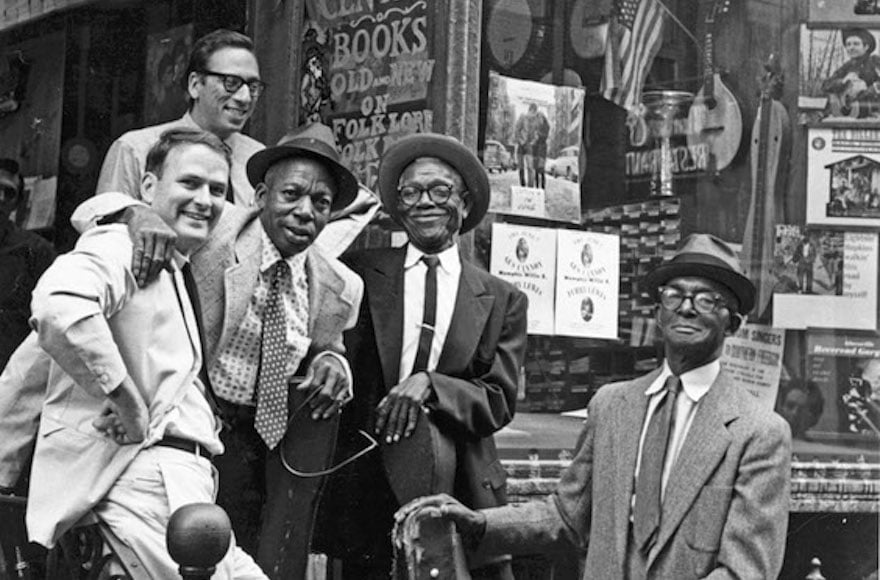
Izzy Young (at back) poses at his Folklore Center in Greenwich Village with, from left, music historian Sam Charters and blues musicians Memphis Willie B., Furry Lewis, and Gus Cannon. (Photo by Ann Charters via JTA)
Izzy Young, the folk music promoter and archivist who produced Bob Dylan’s first major concert at Carnegie Chapter Hall in 1961, has died.
Young died Monday at his home in Stockholm. He was 90.
Israel Young was born in 1928 to Polish immigrants on the Lower East Side. His mother inspired him with Yiddish songs and he worked at his father’s bakery in Brooklyn.
When Izzy opened the Folklore Center in New York’s Greenwich Village in 1957, he wanted it to be a combination of all his passions. It was a music store, a bookstore, an archive, a place where artists could sit for hours listening to old recordings, writing or schmoozing. Young became a mentor to many of the most renowned beat poets and folk musicians of that era.
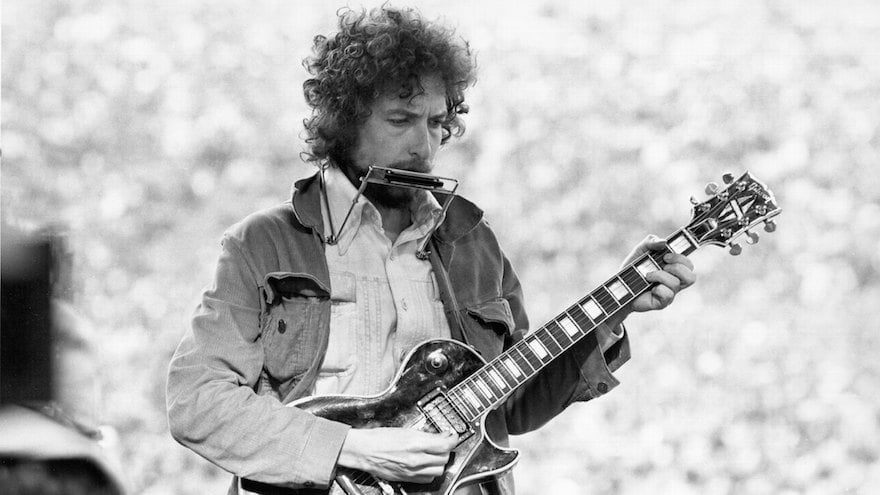
Bob Dylan performing at the Kezar Stadium in San Francisco, March 23, 1975. (Alvan Meyerowitz/Michael Ochs Archives/Getty Images via JTA)
Dylan immortalized Young in the 1969 song “Talking Folklore Center”:
Get The Times of Israel's Daily Editionby email and never miss our top stories
“On MacDougal Street I saw a cubby hole,
I went in to get out of the cold,
Found out after I’d entered
The place was called the Folklore Center —
Owned by Israel Young —
He’s always in back —
Of the center.”
Young closed the Greenwich Village shop in 1973 and moved to Stockholm, where he started a similar enterprise, the Folklore Centrum.
https://www.youtube.com/watch?v=1Q1w_3pGjhs
Advertisement
In 2016, Young shipped 20 boxes to the American Folklife Center in Washington, DC. Inside were journals, manuscripts, photographs and recordings of some of America’s greatest musicians, including Pete Seeger and Dylan.
Help us report truthfully on social media
As a multimedia journalist, my job is to take the quality, fact-based journalism produced by The Times of Israel newsroom and make it accessible across every platform — from Instagram posts to podcasts to short-form videos.
This is how many, especially young people, consume news these days. But misinformation is rampant on social media. Our team at ToI produces accurate, responsible short-form reporting on Israel and the Jewish world.
If you believe in the importance of factual social media journalism, please consider joining our reader support group, The Times of Israel Community. Your financial support is essential to sustain responsible multimedia reporting.
We’re really pleased that you’ve read X Times of Israel articles in the past month.
That’s why we started the Times of Israel - to provide discerning readers like you with must-read coverage of Israel and the Jewish world.
So now we have a request. Unlike other news outlets, we haven’t put up a paywall. But as the journalism we do is costly, we invite readers for whom The Times of Israel has become important to help support our work by joining The Times of Israel Community.
For as little as $6 a month you can help support our quality journalism while enjoying The Times of Israel AD-FREE, as well as accessing exclusive content available only to Times of Israel Community members.
Thank you, David Horovitz, Founding Editor of The Times of Israel


 Add ToI as a Preferred Source on Google