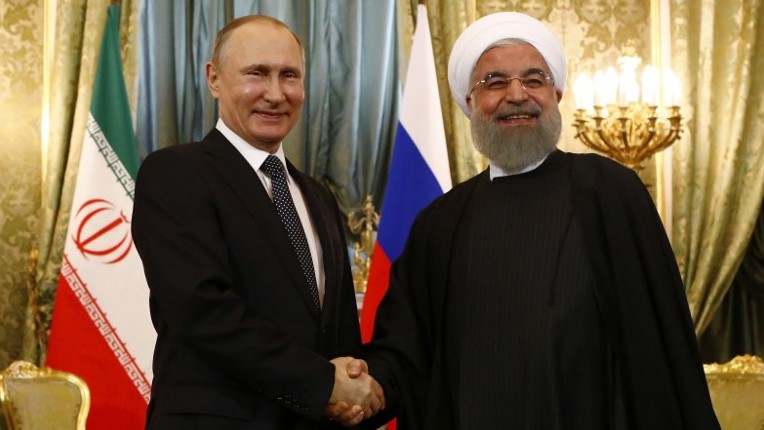
Russian President Vladimir Putin (L) shakes hands with his Iranian counterpart Hassan Rouhani during their meeting at the Kremlin in Moscow on March 28, 2017. (Sergei Karpukhin/AFP)
MOSCOW — Moscow warned on Monday there would be “negative consequences” if US President Donald Trump pulls out of the landmark Iran nuclear deal negotiated by his predecessor.
Trump is a fierce critic of the 2015 accord, which he has called “the worst deal ever” and US officials say he intends to tell Congress next week that Tehran is not honoring its side of the bargain.
“Obviously if one country leaves the deal, especially such a key country as the US, then that will have negative consequences,” Russian President Vladimir Putin’s spokesman said.
Russian President Vladimir Putin’s spokesman Dmitry Peskov in Moscow, Russia, April 6, 2017. (AP Photo/Pavel Golovkin)
“We can only try to predict the nature of these consequences, which we are doing now,” Dmitry Peskov told journalists.
Putin has repeatedly hailed the importance of the existing deal, he added.
Get The Times of Israel's Daily Editionby email and never miss our top stories
Trump is expected to announce that he is “decertifying” Iran’s compliance with the agreement it signed to limit its nuclear program in exchange for sanctions relief.
US officials insist this will not sink the deal itself but open the way for Congress to possibly develop new measures to punish other aspects of Iran’s behavior.
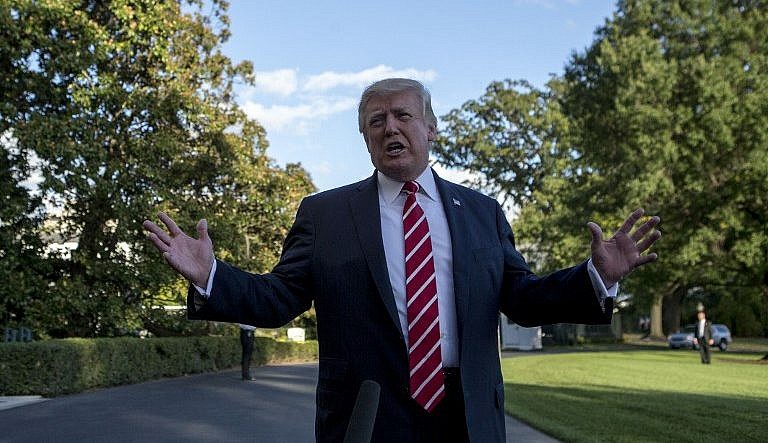
US President Donald Trump speaks with reporters outside the White House prior to his departure aboard Marine One on October 7, 2017. (AFP Photo/Alex Edelman)
Resumed sanctions could derail the accord negotiated with Tehran by former US president Barack Obama and other major world powers.
Advertisement
Congress requires the president to certify Iranian compliance with the deal every 90 days. The next certification date is October 15.
Under the law, Congress would then have 60 days to decide whether to reimpose sanctions lifted by the deal.
Help us report truthfully on social media
As a multimedia journalist, my job is to take the quality, fact-based journalism produced by The Times of Israel newsroom and make it accessible across every platform — from Instagram posts to podcasts to short-form videos.
This is how many, especially young people, consume news these days. But misinformation is rampant on social media. Our team at ToI produces accurate, responsible short-form reporting on Israel and the Jewish world.
If you believe in the importance of factual social media journalism, please consider joining our reader support group, The Times of Israel Community. Your financial support is essential to sustain responsible multimedia reporting.
We’re really pleased that you’ve read X Times of Israel articles in the past month.
That’s why we started the Times of Israel - to provide discerning readers like you with must-read coverage of Israel and the Jewish world.
So now we have a request. Unlike other news outlets, we haven’t put up a paywall. But as the journalism we do is costly, we invite readers for whom The Times of Israel has become important to help support our work by joining The Times of Israel Community.
For as little as $6 a month you can help support our quality journalism while enjoying The Times of Israel AD-FREE, as well as accessing exclusive content available only to Times of Israel Community members.
Thank you, David Horovitz, Founding Editor of The Times of Israel


 Add ToI as a Preferred Source on Google