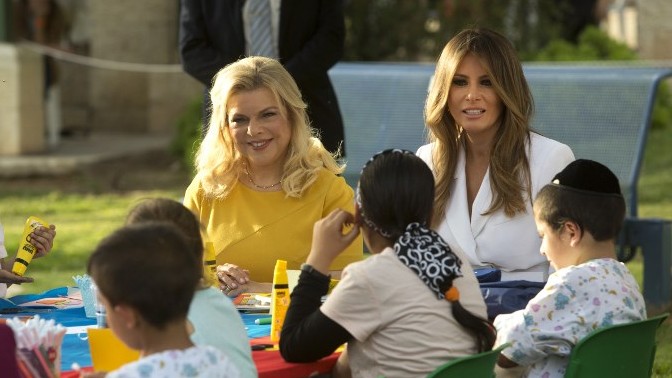
US First Lady Melania Trump (R) and Sara Netanyahu talk with children during a visit to the Hadassah hospital in Jerusalem on May 22, 2017. (AFP PHOTO / POOL / Sebastian Scheiner)
US First Lady Melania Trump on Monday visited a leading Israeli hospital that is also known as a center of coexistence between Arabs and Jews, as a guest of Sara Netanyahu, the wife of Prime Minister Benjamin Netanyahu.
Mrs. Trump was in Jerusalem with President Donald Trump, who is on a two-day visit to Israel and the West Bank.
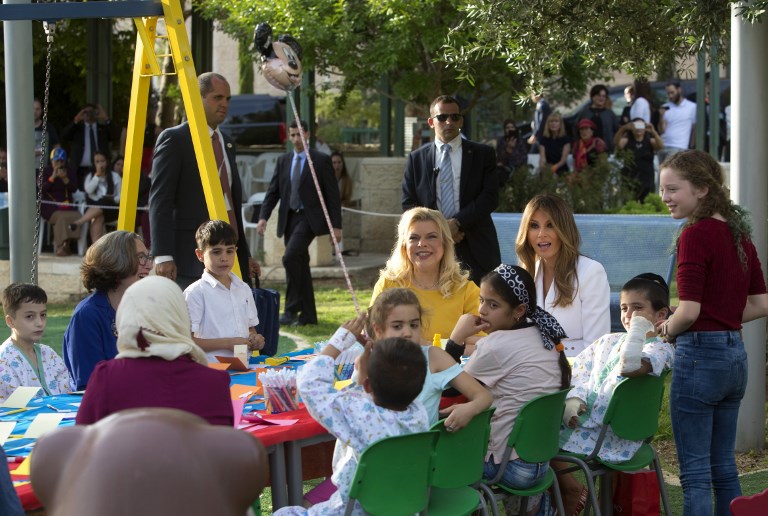
The women met with a group of young Jewish and Arab patients, some in hospital pajamas, who sat around a table and presented their guests with pictures they had drawn. Children milled about with one swinging on an adjacent swing, as the two woman exchanged pleasantries with the children.
“Hi, how are you?” Trump asked. “What are you doing here? Are you making a project?”
She then turned to a boy with a Mickey Mouse balloon and said “I like your Mickey Mouse.”
Get The Times of Israel's Daily Editionby email and never miss our top stories
The first lady also handed out White House backpacks stuffed with puzzles, games and toys.
“You can do a lot of projects, color and read and write letters,” Trump said. Her comments were then translated into Hebrew and Arabic for the children to understand.
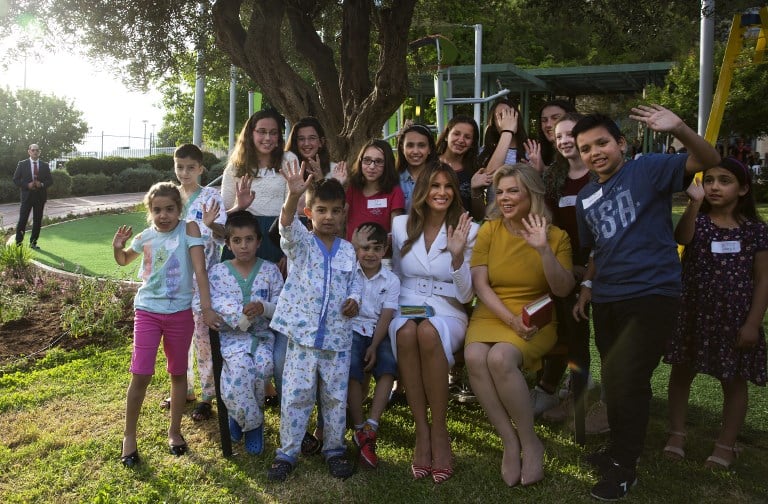
US First Lady Melania Trump (L) and Sara Netanyahu pose with children during a visit to the Hadassah hospital in Jerusalem on May 22, 2017. (AFP PHOTO / POOL / Sebastian Scheiner)
Advertisement
Like many Israeli hospitals, Hadassah’s Ein Kerem campus is considered a model of co-existence in deeply divided Jerusalem, with a mixed Jewish-Arab medical team working together to treat the city’s wounded and infirm.
The hospital also dedicated a bench with both women’s names in honor of their visit.
Mrs. Trump said it’s “beautiful to be here,” but refrained from answering any other questions.
US First Lady Melania Trump (R) and Sara Netanyahu talk with children during a visit to the Hadassah hospital in Jerusalem on May 22, 2017. (AFP PHOTO / POOL / Sebastian Scheiner)
Help us report truthfully on social media
As a multimedia journalist, my job is to take the quality, fact-based journalism produced by The Times of Israel newsroom and make it accessible across every platform — from Instagram posts to podcasts to short-form videos.
This is how many, especially young people, consume news these days. But misinformation is rampant on social media. Our team at ToI produces accurate, responsible short-form reporting on Israel and the Jewish world.
If you believe in the importance of factual social media journalism, please consider joining our reader support group, The Times of Israel Community. Your financial support is essential to sustain responsible multimedia reporting.
We’re really pleased that you’ve read X Times of Israel articles in the past month.
That’s why we started the Times of Israel - to provide discerning readers like you with must-read coverage of Israel and the Jewish world.
So now we have a request. Unlike other news outlets, we haven’t put up a paywall. But as the journalism we do is costly, we invite readers for whom The Times of Israel has become important to help support our work by joining The Times of Israel Community.
For as little as $6 a month you can help support our quality journalism while enjoying The Times of Israel AD-FREE, as well as accessing exclusive content available only to Times of Israel Community members.
Thank you, David Horovitz, Founding Editor of The Times of Israel


 Add ToI as a Preferred Source on Google