

Mislabeled epitaph turns out to be 1,700-year-old Jewish obituary
Limestone tablet found in Egypt and written in Greek pays tribute to ‘Helene,’ a 60-year-old woman ‘who loves the orphans’
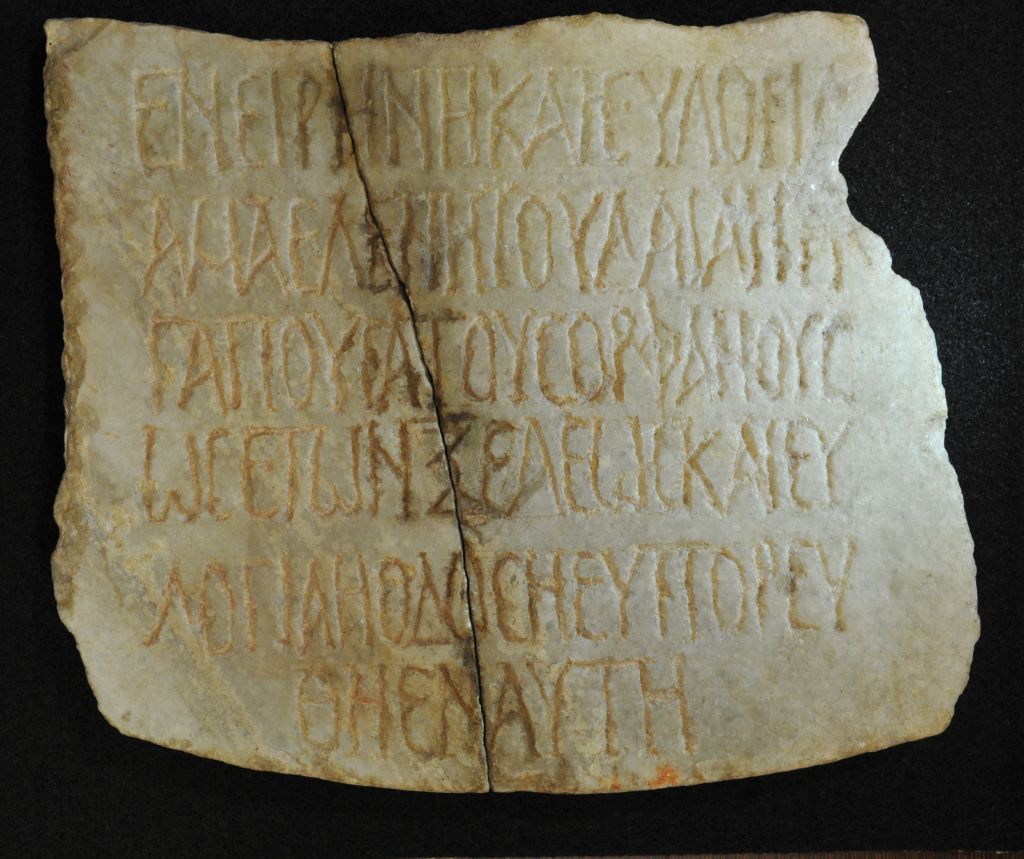
A third century epitaph for a Jewish woman living in Egypt has recently been translated, after its discovery in a Utah library.
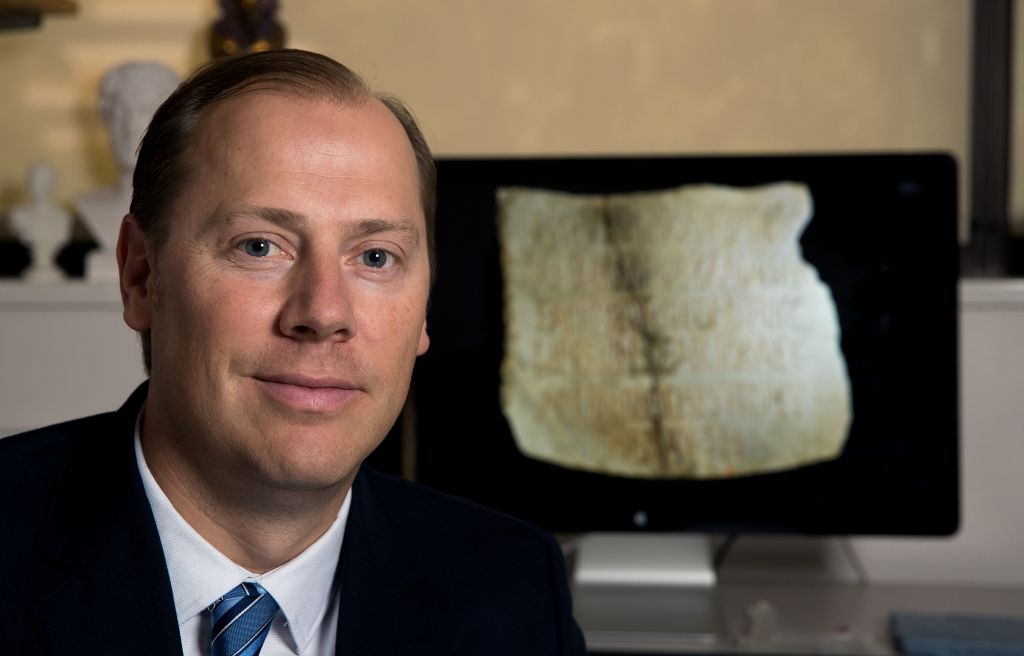
The limestone tablet had been labeled as a Coptic artifact for years until it was translated by Lincoln H. Blumell, an associate professor at Brigham Young University, who published his findings this month.
“In peace and blessing Ama Helene, a Jew, who loves the orphans, [died]. For about 60 years her path was one of mercy and blessing; on it she prospered,” the epitaph reads.
This document is unusual, because it describes the woman, Helene, as a Jew, but also uses the honorary title “Ama” which was normally only used to describe nuns and other distinguished Christian women in ancient Egypt, according to Blumell.
“I’ve looked at hundreds of ancient Jewish epitaphs,” Blumell said, “and there is nothing quite like this. This is a beautiful remembrance and tribute to this woman.”
Blumell found the tablet in a collection of Greek and Coptic artifacts, which had been donated to the University of Utah’s J. Willard Marriott Library, in 1989.
The epitaph has been dated to some time in the third century CE. Although older obituaries have been discovered, this one is unique in mentioning Helene’s religion, and in the use of the title “Ama.”
Another unusual feature of this document is Helene’s longevity. Based on other inscriptions from the period it seems that the average life expectancy of women at the time was about 25 years. Helene reached the age of 60.
According to census documents from that time, Helene was one of only 6 percent of Egyptian women from this period who lived to this age. More than half of men also died before the age of 30.
The description of Helene as one “who loves the orphans” may be related to the fact that she was a Jew. The Torah mentions several times that one may not mistreat orphans and widows.
The Marriott Library received the epitaph from Aziz S. Atiya but identified it as a “Coptic inscription, dating from the dawn of the use of the Greek alphabet, not earlier than the second century, but not later than the third.” However, it was not written in the Coptic language but in Greek.
“I remember when they pulled it out I was in shock because I immediately recognized it was Greek,” Blumell told CNN. “I spent the next couple of hours staring at it and started transcribing it.”
Luise Poulton, the library’s managing curator of rare books, said it was labeled as a Coptic inscription way for 27 years until Blumell came along.
“Professor Blumell’s work on this piece, then, is as satisfying as it is fascinating. Dr. Blumell not only brought fact to surmisal regarding the piece, he has given us a very personal story to put to cold stone,” Poulton said in a BYU press release.
Blumell, who specializes on Christianity in the Roman and Byzantine periods published his findings in the latest issue of the Journal for the Study of Judaism.
The third century followed a time of great upheaval for the Jewish people. The Second Temple was destroyed in 70 CE and was followed by rebellion in Judea beginning in 115, during the reign of the Roman Emperor Trajan. In Egyptian Alexandria, Jews set fire to the city and destroyed temples and the tomb of Pompey. The rebellion was quashed in 117 by Quintus Marcius Turbo.
Alexandria, once the largest Jewish community in the world, never fully recovered from the rebellion and ceased to be a major center of influence within the Jewish world, though some Jews remained until modern times.
The third century was also a formative but turbulent time for the Christian church. The theologian Origen was born in Alexandria at that time, and lived there until he was expelled in about 230 by Demetrius, the bishop of Alexandria.










The Times of Israel Community.