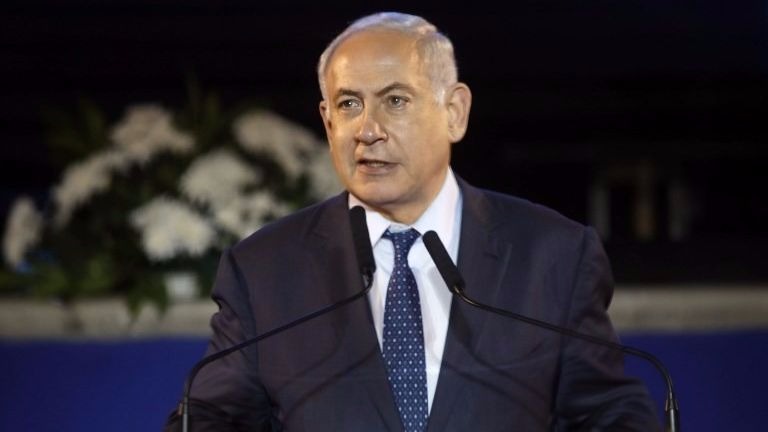
Prime Minister Benjamin Netanyahu delivers a speech during a ceremony marking the 50th anniversary of the Six Day War at the Latrun Armored Corps Memorial Site and Museum, between Jerusalem and Tel Aviv, on June 5 2017. (MENAHEM KAHANA / AFP)
Prime Minister Benjamin Netanyahu on Monday pledged that he would not cede military control of the West Bank’s Jordan Valley in any future peace agreement with the Palestinians.
Speaking at a ceremony marking 50 years since the outbreak of the 1967 Six-Day War, Netanyahu’s comments seemed likely to cast a pall over US President Donald Trump’s attempts to breathe life into long-stalled peace efforts.
“We seek peace with our neighbors, a real peace, a peace that will last for generations,” Netahyahu said at the event, held at the Israeli army’s Armored Corps Museum at Latrun, west of Jerusalem.
“That is why in any agreement — and without an agreement — we shall maintain security control over all the territory west of the Jordan Valley and because of that we insist that the Palestinians finally recognize Israel as the national home of the Jewish people.”
“That is the foundation for peace and refusal is what prevents achieving it,” he added.
Get The Times of Israel's Daily Editionby email and never miss our top stories
In the 1967 war, Israel took control of the West Bank from Jordan and the Gaza Strip from Egypt and subsequently annexed East Jerusalem, in a move never recognized by the international community.
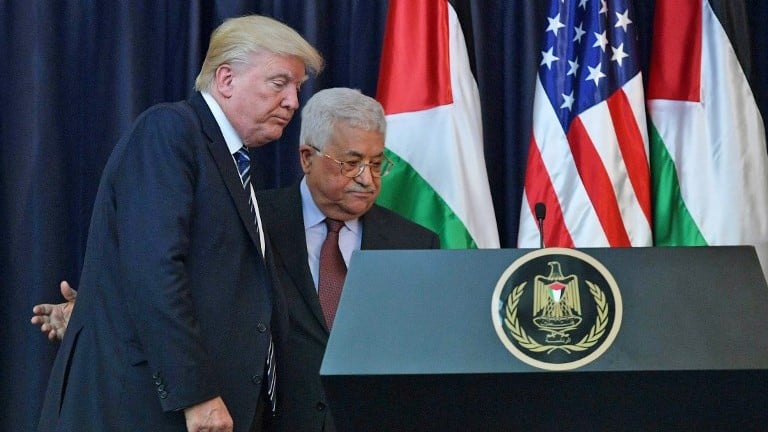
US President Donald Trump (L) and Palestinian leader Mahmoud Abbas depart, following a joint press conference at the presidential palace in the West Bank city of Bethlehem on May 23, 2017. (AFP/ MANDEL NGAN)
Trump visited Israel and the Palestinian territories last month, calling on Israelis and Palestinians to make compromises for peace, but offering no specifics on how to resolve the conflict.
He did not specifically mention the two-state solution, long the focus of international efforts and US Middle East diplomacy.
Advertisement
Palestinian Authority President Mahmoud Abbas, however, reiterated his call for a Palestinian state with East Jerusalem as its capital.
We can't do this work alone.
The war with Iran has been draining for all of us in Israel. But when I heard about a high casualty incident – ballistic missile impacts in Arad and Dimona that left nearly 200 people wounded – I drank a cup of coffee, packed a bag, and headed south.
There, I spoke with Shilgit, the head of an after-school program for underprivileged youth. Standing outside her destroyed center, Shilgit said it was a miracle that no children were hurt and spoke about the community coming together in the hours since.
As a Times of Israel reporter, I’m committed to telling stories of resilience like Shilgit’s. But my colleagues and I can't do this alone. If you value work like this,please consider joining our reader support group, The Times of Israel Community. Your financial support is essential to keep real human reporting like this going.
We’re really pleased that you’ve read X Times of Israel articles in the past month.
That’s why we started the Times of Israel - to provide discerning readers like you with must-read coverage of Israel and the Jewish world.
So now we have a request. Unlike other news outlets, we haven’t put up a paywall. But as the journalism we do is costly, we invite readers for whom The Times of Israel has become important to help support our work by joining The Times of Israel Community.
For as little as $6 a month you can help support our quality journalism while enjoying The Times of Israel AD-FREE, as well as accessing exclusive content available only to Times of Israel Community members.
Thank you, David Horovitz, Founding Editor of The Times of Israel