

Out of the Knesset, into the frying pan
Following a busy day in parliament, the Hebrew papers assess the decision to suspend 3 Arab MKs and efforts to ban them for good
Raoul Wootliff is a former Times of Israel political correspondent and Daily Briefing podcast producer.
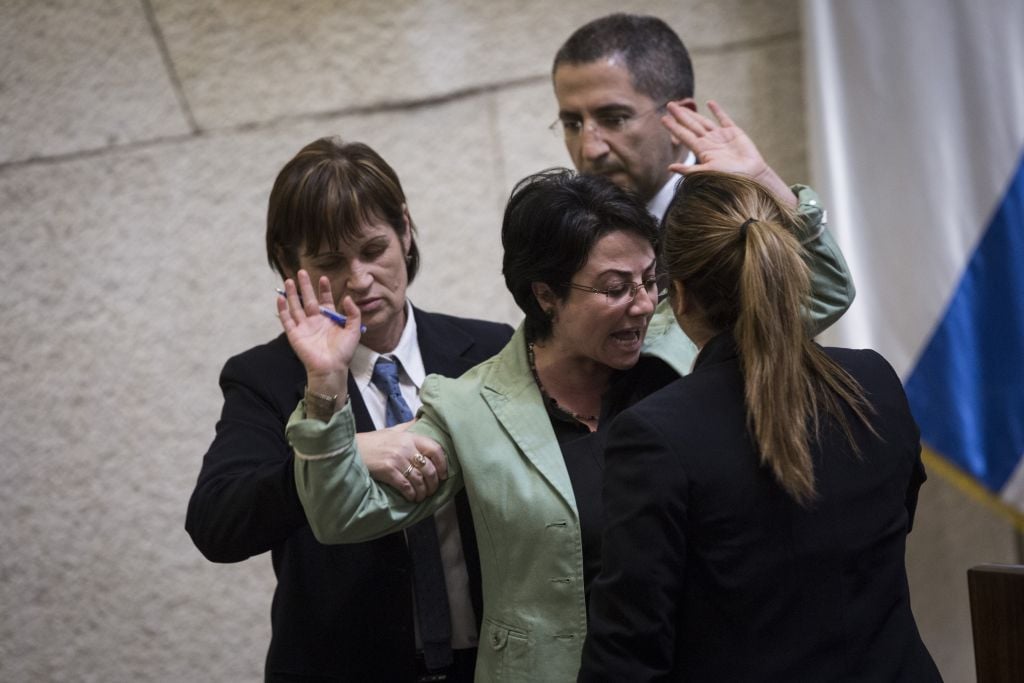
After much speculation in the Hebrew media, Tuesday papers are filled with details and analysis of a busy day in Israel’s parliament centering around moves to punish lawmakers who express sympathy for Palestinian terrorists.
The Knesset Ethics Committee on Monday banned three Arab MKs from parliamentary activity (though not from voting) for two-to-four months, following a controversial meeting they held last week with families of terrorists killed while carrying out attacks on Israelis. Earlier Monday the coalition unanimously approved new legislation by Prime Minister Benjamin Netanyahu that would allow a vote of 90 Knesset members — of the 120 in the House — to suspend colleagues for such “unseemly behavior.”
“Suspended from office” reads the stark headline on the front of Yedioth Ahronoth.
“The police are investigating, the Knesset plenary is reaching new deafening levels, the prime minister is advancing legislation, the Ethics Committee is reaching a decision: The meeting of Arab MKs with the families of terrorists continues to stay at the stop of the public agenda,” the paper’s lead sums up the issue as an introduction to a two-page spread on the various punishments awaiting the members of the Balad faction.
MKs Hanin Zoabi and Basel Ghattas were banned from Knesset debates for four months and their colleague Jamal Zahalka received a two-month suspension. All three are members of the Balad Party, which merged into the Joint (Arab) List before last year’s parliamentary election.
The paper’s Arab affairs correspondent Smadar Perry writes a cutting critique of Zoabi, Ghattas and Zahalka.
“Only in Israel can elected officials permit themselves to dance on blood. The trio, who recorded no achievement to date in favor of Israel’s Arab citizens, would not dare test the limits of democracy in one of the neighboring countries,” writes Perry. “The excuse that violence and terrorism are a legitimate fight against occupation, that it is allowed to attack civilians and murder in cold blood, is inconceivable when it comes to elected officials with immunity who insist on possessing an Israeli identity card.”
Israel Hayom, which also features the story on its front page, leads its two-page spread with the headline, “Yellow card,” suggesting further punishment to come.
Israel Hayom political correspondent Mati Tuchfeld defends that potential punishment — the proposed legislation allowing lawmakers to ban their colleagues — in an analysis-cum-op-ed titled “In a democracy the majority also has a right: To defend itself.”
Opposition leader Isaac Herzog has said the planned law constitutes “a breach of Knesset procedures” and the potential “start of a slippery slope” in which MKs “from left and right will be kicked out for purportedly inappropriate behavior.”
Tuchfeld asserts that despite that real risk, “this law comes at the right time, the right place, and for absolutely the right reasons.”
“Those who support terror — and in the eyes of Israelis there is no other way to explain the actions of these three Arab Knesset members — cannot be a Knesset member. It’s as simple as it sounds. The problem is that with all the philosophizing over and talk of rights of minority rights, we forget that in a democracy, the majority also has rights,” he writes.
In a hint at its position on the issue, Haaretz leads its front page with the headline, “The law to remove MKs: The government is trying to override the Attorney General.”
The paper reports that, “in a rare move, the government will advance the legislation through the Knesset [as a private member’s bill] and not through the Ministerial Committee for Legislation [as a government bill], meaning the attorney general will not be involved and cannot block the move.”
On the decision of the Ethics Committee, Haaretz is the only paper to include the official response of the Joint (Arab) List to the decision, beyond its members’ shouts in the plenary of “fascists” and “inciters” reported by Israel Hayom and Yedioth Aharonoth.
“The Joint (Arab) List blasted the committee’s decision. ‘The Joint List condemns the incitement and agitation campaign led by Netanyahu, which prompted to the committee’s miserable, anti-democratic and unethical decision. Even after the suspension we still demand the bodies held by the police to be released immediately,'” reports the paper’s political correspondent Jonathan Lis.
Haaretz contributor Revital Madar offers a counterpoint to the criticism of the Joint List MKs heard in the Knesset plenum, arguing in an op-ed that it is the only party in parliament standing up for democratic values.
“Following the wall-to-wall condemnation of the Balad MKs, clearly there is only one party that truly understands what democracy is. That party is the Joint Arab List – that Knesset alliance of Arab parties that few believed could last, considering the different positions of the factions that came together to form it,” Madar writes. “It is a party so radical that it really has internalized the demand of a democratic regime not to differentiate between human beings, not to condition rights on obligations, not to impose collective punishment. It is this belief that leads only one party to care for the mother whose nights have no peace until her son is buried according to her faith.”









The Times of Israel Community.