

Rocket fire from Gaza is a message, but it’s not clear who the audience is
Hamas, via proxies, may be warning Israel that Palestinian casualties in border clashes will provoke a response, but it’s also possible the salvoes are intended to embarrass Hamas

 Add ToI as a Preferred Source on Google
Avi Issacharoff, The Times of Israel's Middle East analyst, fills the same role for Walla, the leading portal in Israel. He is also a guest commentator on many different radio shows and current affairs programs on television. Until 2012, he was a reporter and commentator on Arab affairs for the Haaretz newspaper. He also lectures on modern Palestinian history at Tel Aviv University, and is currently writing a script for an action-drama series for the Israeli satellite Television "YES." Born in Jerusalem, he graduated cum laude from Ben Gurion University with a B.A. in Middle Eastern studies and then earned his M.A. from Tel Aviv University on the same subject, also cum laude. A fluent Arabic speaker, Avi was the Middle East Affairs correspondent for Israeli Public Radio covering the Israeli-Palestinian conflict, the war in Iraq and the Arab countries between the years 2003-2006. Avi directed and edited short documentary films on Israeli television programs dealing with the Middle East. In 2002 he won the "best reporter" award for the "Israel Radio” for his coverage of the second intifada. In 2004, together with Amos Harel, he wrote "The Seventh War - How we won and why we lost the war with the Palestinians." A year later the book won an award from the Institute for Strategic Studies for containing the best research on security affairs in Israel. In 2008, Issacharoff and Harel published their second book, entitled "34 Days - The Story of the Second Lebanon War," which won the same prize.
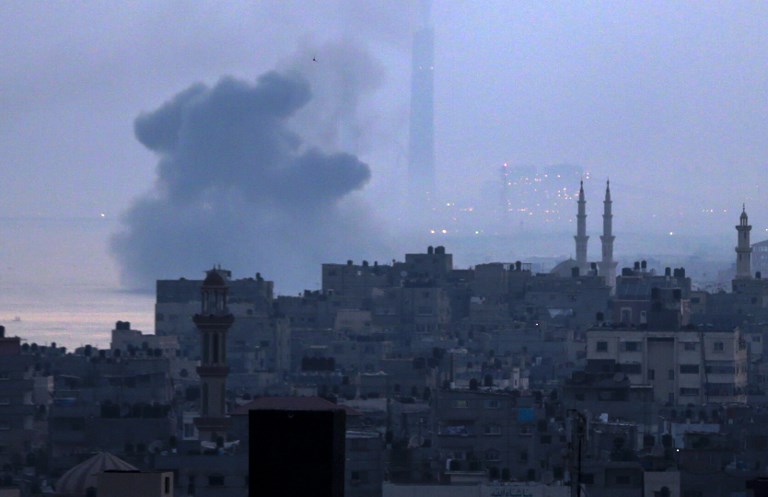
As of Sunday afternoon, the identity of those responsible for breaking the unofficial ceasefire agreement and firing a series of rockets at Israel from the Gaza Strip overnight was not yet clear.
Six projectiles were fired overnight at southern Israel by Palestinian terror groups in the coastal enclave. The Iron Dome missile defense system intercepted four, with another apparently landing in Israeli territory and one not clearing the border.
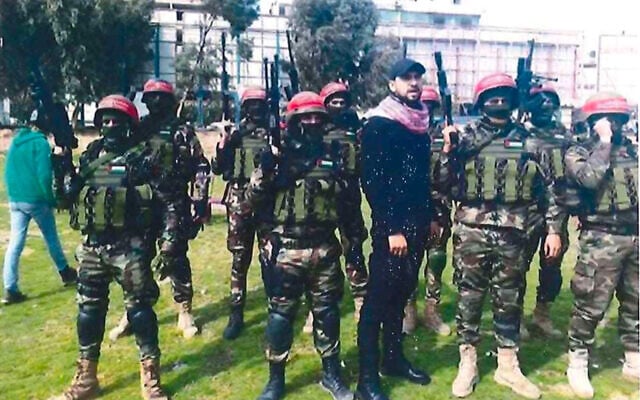
A number of Gaza pundits said that the most likely suspects were quasi-rogue factions, sometimes subcontracted by Hamas. This means that Hamas officials would have had to turn a blind eye, giving a green light to the splinter groups to launch attacks at Israel.
If that is true, it would mean that Hamas is trying to a convey a new message to Israel: If Palestinians are killed during the weekly Gaza border protests, the group will respond with rocket fire.
There was a resonant fatality at the border over the weekend. On the Palestinian side of the fence Saturday, thousands attended a funeral for a young female volunteer medic who Palestinians say was shot and killed by the IDF while she was tending to the injured during violent protests on the Gaza border on Friday. The Israeli army is investigating the incident.
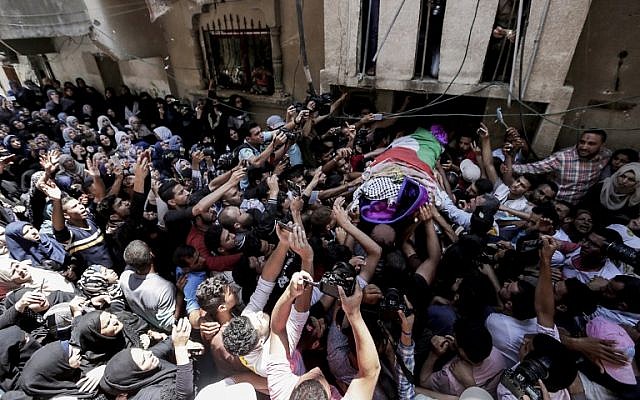
But it could also be that the rocket fire was actually an effort by rogue Salafist groups to embarrass Hamas and escalate tensions with Israel.
The situation is still opaque. The first of the Saturday night rockets were launched during Iftar, the evening Ramadan fast-breaking meal.
A few hours later, in posts on social media, the Shahid Abu Rish Brigades and the Al-Aqsa Martyrs Brigade (both affiliated with Hamas’s archrival, Fatah) simultaneously took responsibility for the fire. But neither group has been active in the Gaza Strip for many years, suggesting that the real perpetrators were seeking to hide their true identity.
From there, rumors began to spread in Gaza that Hamas had given its blessing to rogue groups to launch the rockets, but did not want to admit openly that it had broken the fragile ceasefire in place since Wednesday morning.
And events of recent months certainly indicate that when Hamas wants there to be rocket fire, there is — and when it doesn’t, there isn’t.
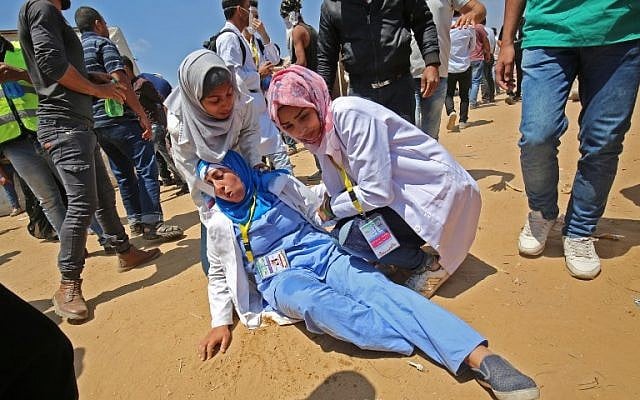
The renewed rocket fire followed significant clashes on the Gaza border on Friday and a massive flareup last week, in which Palestinian terror groups launched over 100 rockets and mortar shells into southern Israel and the military responded by striking more than 65 Hamas and Palestinian Islamic Jihad sites in the Strip.
As expected, the Saturday-Sunday rocket fire drew a response from Israel, which bombed a number of Hamas military targets in the Strip without causing any casualties.
If you’re wondering how that’s possible, it’s a technique that was developed in previous rounds of conflict. First, pilots drop a nonexplosive device on a building, which warns the occupants of an imminent airstrike and allows them to escape unharmed. Only about a minute later does a real missile destroy the building.
The IDF uses this technique to convey its own message to Hamas: Israel does not intend to escalate tensions.
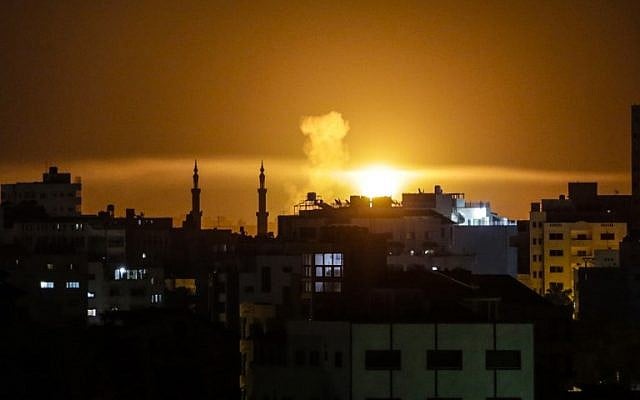
But this message hasn’t made an impression on the Hamas leadership, which has its own considerations to worry about. The economic and humanitarian situation in Gaza is so dire that the people there are calling for change, even at the cost of war, but change never comes.
Last week, the Palestinian Authority promised to resume paying salaries for its staff in Gaza, but that didn’t happen.
Israel, Egypt and others constantly talk about change in the Gaza Strip, but there have been no dramatic developments.
As of this writing, since 3 a.m. Sunday morning, there has been a lull in the rocket and mortar shell fire from Gaza. But unfortunately, at least for now, there is one thing that Israel and Gaza can agree on: this quiet is fragile, and it won’t be long before we witness another escalation.







The Times of Israel Community.