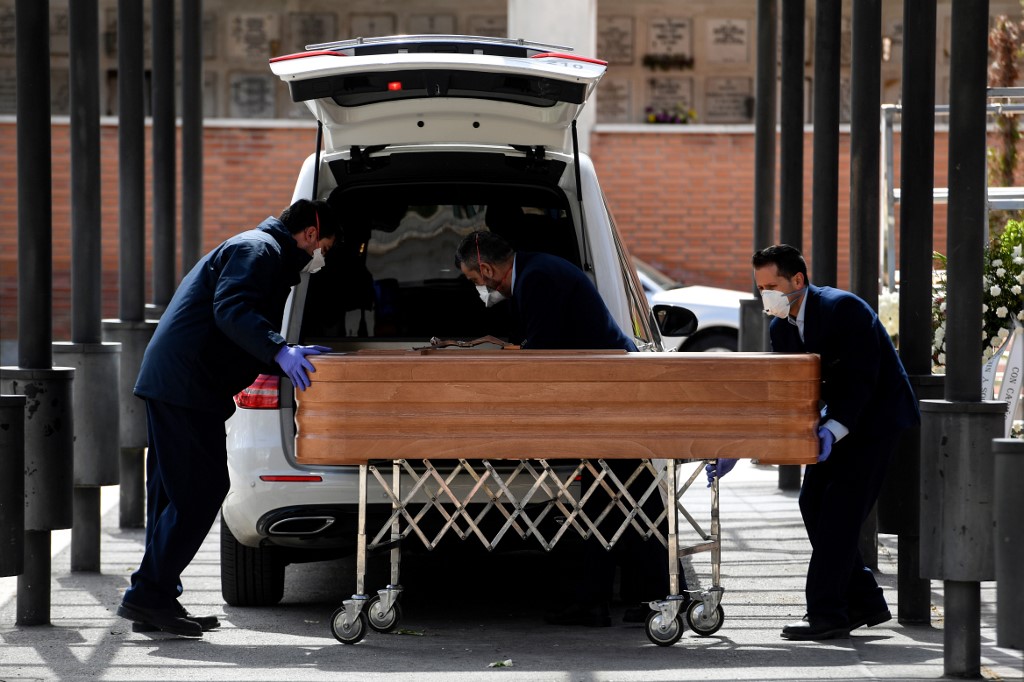
Mortuary employees wearing face masks wheel a coffin into the crematorium of La Almudena cemetery in Madrid during the funeral of a COVID-19 coronavirus victim, on March 24, 2020. -(OSCAR DEL POZO/AFP)
The coronavirus death toll in Spain surged to 4,089 after 655 people died within 24 hours, the health ministry said on Thursday.
It was a 19 percent increase on figures released Wednesday by the authorities in Spain, which has the world’s second highest death toll from the disease after Italy.
The number of confirmed cases of COVID-19 rose to 56,188, the ministry said.
Despite a national lockdown imposed on March 14, which parliament on Thursday agreed to extend until April 11, both deaths and infections have continued to mount, with officials warning this week would be particularly bad.
But the rise in the number of new deaths was smaller than that recorded on Wednesday when the figure rose by 738 or 27%.
Get The Times of Israel's Daily Editionby email and never miss our top stories
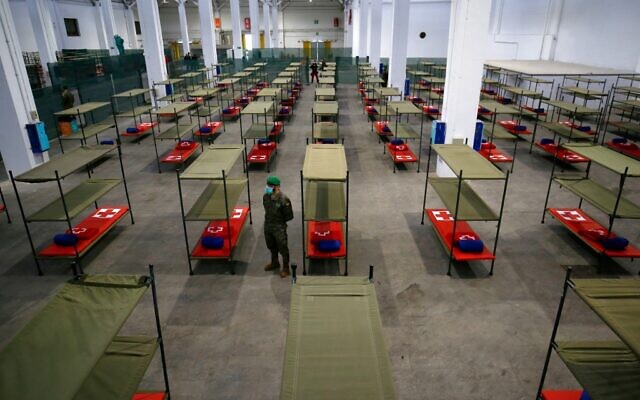
A Spanish soldier stands next to beds set up at a temporary hospital for vulnerable people at the Fira Barcelona Montjuic center in Barcelona during the coronavirus epidemic, March 25, 2020. (Pau Barrena/AFP)
Health authorities are hoping it will soon become clear whether the lockdown is having the desired effect.
The Madrid region has suffered the brunt of the epidemic with 17,166 infections — just under a third of the total — and 2,090 deaths, or 51% of the national figure.
Prime Minister Pedro Sanchez, whose wife is infected with the virus, has said this is the country’s most difficult moment since its 1936-39 civil war.
Advertisement
“Only the oldest, who knew the hardships of the civil war and its aftermath, can remember collective situations that were harsher than the current one. The other generations in Spain have never, ever had to face as a collective something so hard,” he said when he imposed the state of emergency on March 14.
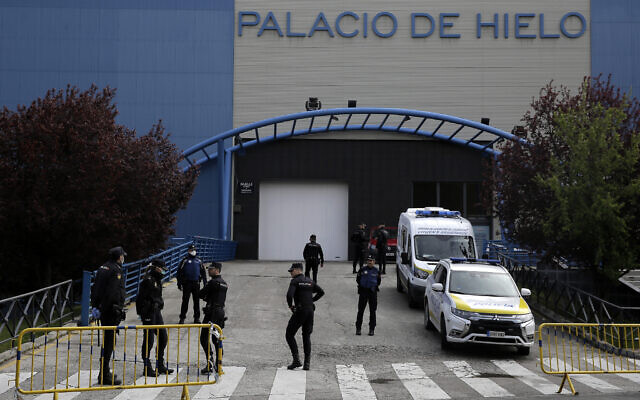
Police officers stand in front of Madrid’s ice rink turned into a temporary morgue due the COVID-19 crisis in Madrid, Spain, March 24, 2020. (Manu Fernandez/AP)
Spain’s demographics partly explain why it has been one of the worst-affected nations.
The country has one of the longest life expectancies in Europe and the pandemic has taken a high toll on its large elderly population, who are especially vulnerable to the disease.
Help us report truthfully on social media
As a multimedia journalist, my job is to take the quality, fact-based journalism produced by The Times of Israel newsroom and make it accessible across every platform — from Instagram posts to podcasts to short-form videos.
This is how many, especially young people, consume news these days. But misinformation is rampant on social media. Our team at ToI produces accurate, responsible short-form reporting on Israel and the Jewish world.
If you believe in the importance of factual social media journalism, please consider joining our reader support group, The Times of Israel Community. Your financial support is essential to sustain responsible multimedia reporting.
We’re really pleased that you’ve read X Times of Israel articles in the past month.
That’s why we started the Times of Israel - to provide discerning readers like you with must-read coverage of Israel and the Jewish world.
So now we have a request. Unlike other news outlets, we haven’t put up a paywall. But as the journalism we do is costly, we invite readers for whom The Times of Israel has become important to help support our work by joining The Times of Israel Community.
For as little as $6 a month you can help support our quality journalism while enjoying The Times of Israel AD-FREE, as well as accessing exclusive content available only to Times of Israel Community members.
Thank you, David Horovitz, Founding Editor of The Times of Israel


 Add ToI as a Preferred Source on Google