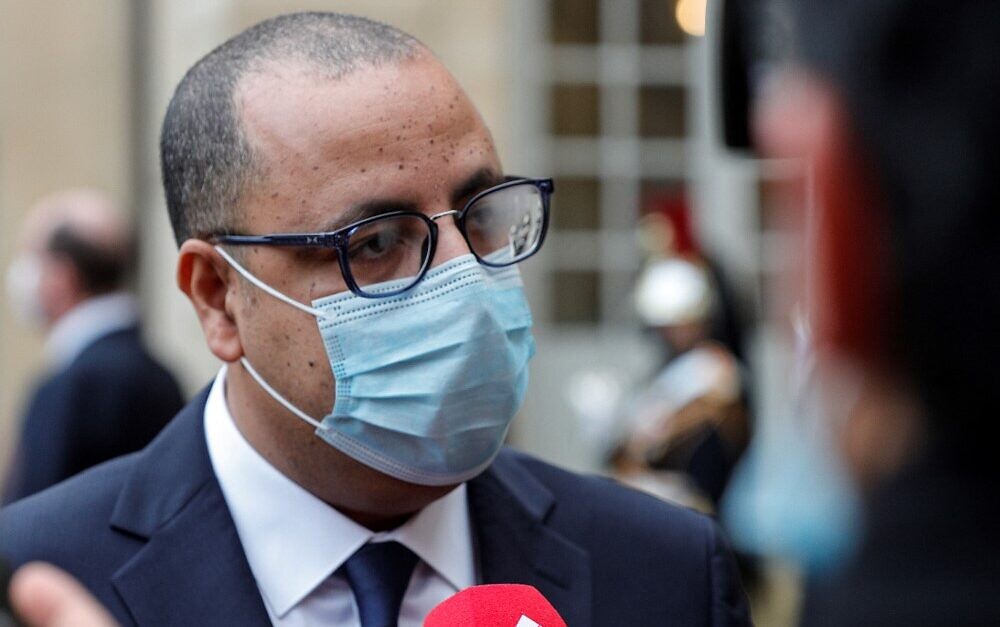
Tunisian Prime Minister Hichem Mechichi speaks to the press after a meeting with his French counterpart at the Hotel Matignon in Paris on December 14, 2020. (Geoffroy Van Der Hasselt/AFP)
PARIS — Tunisia has no plans to match Morocco’s decision to recognize Israel, Tunisian Prime Minister Hichem Mechichi said, insisting that establishing relations with the Jewish state was “not on the agenda.”
Last week, Morocco became the fourth country in the Arab League to recognize Israel since August, in a flurry of diplomatic deals brokered by outgoing US President Donald Trump.
The United Arab Emirates, Bahrain and Sudan have also recently normalized ties with Israel as part of a push that weakens the Arab world’s previously united front over the Palestinians’ struggle for statehood.
“We respect Morocco’s choice, Morocco is a sister country that we love very much,” Mechichi told France 24 broadcaster in an interview late Monday.
But, he said, “for Tunisia, the question is not on the agenda.”
Get The Times of Israel's Daily Editionby email and never miss our top stories
Tunisian demonstrators hold up placards against US President Donald Trump’s Israeli-Palestinian peace plan during a protest on February 5, 2020, in Tunis. (Fethi Belaid/AFP)
Mechichi said he had not been approached by the Trump administration about the issue.
“Every country has its own reality, its own truth and its own diplomacy, which it considers best for its people,” he said.
Neighboring Algeria took a less charitable view of the deal struck with arch-rival Morocco, under which Washington recognized Morocco’s sovereignty over the disputed Western Sahara region in exchange for Rabat normalizing ties with Israel.
Advertisement
Algeria, which backs the Polisario independence movement in Western Sahara, said the move was part of “foreign maneuvers which aim to destabilize Algeria.”
Is our live election coverage important to you?
Are you relying on The Times of Israel for accurate and timely coverage of the 2026 Israeli election? If so, please join The Times of Israel Community. For as little as $6/month, you will:
Support our independent journalists who are working around the clock to report political developments as they unfold;
Read ToI with a clear, ads-free experience on our site, apps and podcasts; and
Gain access to exclusive content shared only with the ToI Community, including our DocuNationseries and weekly letters from founding editor David Horovitz.
We’re really pleased that you’ve read X Times of Israel articles in the past month.
That’s why we started the Times of Israel - to provide discerning readers like you with must-read coverage of Israel and the Jewish world.
So now we have a request. Unlike other news outlets, we haven’t put up a paywall. But as the journalism we do is costly, we invite readers for whom The Times of Israel has become important to help support our work by joining The Times of Israel Community.
For as little as $6 a month you can help support our quality journalism while enjoying The Times of Israel AD-FREE, as well as accessing exclusive content available only to Times of Israel Community members.
Thank you, David Horovitz, Founding Editor of The Times of Israel


 Add ToI as a Preferred Source on Google