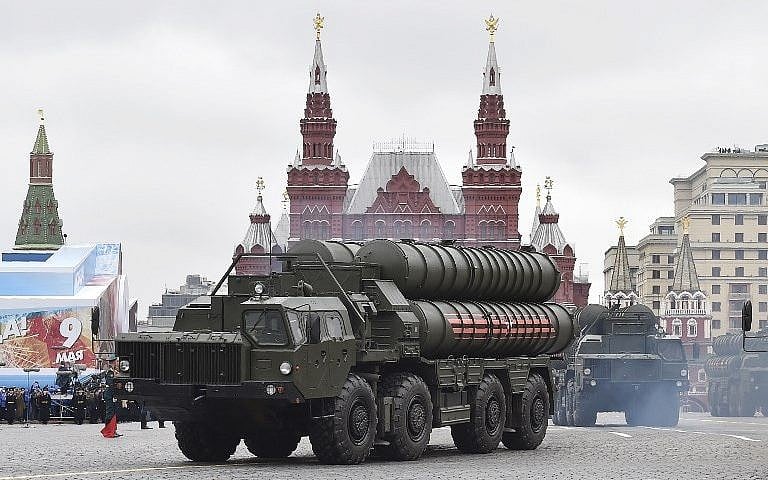
The Russian S-400 missile defense system during a Victory Day military parade in Moscow's Red Square, May 9, 2017. (AFP/Natalia Kolesnikova)
ISTANBUL, Turkey — President Recep Tayyip Erdogan said Tuesday Turkey would not withdraw from a deal made with Russia to buy an S-400 missile defense system despite pressure from the United States.
“We have made an agreement (with Russia). We are determined. There is nothing like backtracking from that,” Erdogan was quoted as saying by the official Anadolu news agency.
Ankara’s desire to buy the Russian S400 system has been a major source of contention between NATO allies Turkey and the United States, which has threatened sanctions.
Last week, a top Pentagon official said the consequences would be “devastating” for Turkey’s joint F-35 fighter program and its cooperation with NATO if the country goes ahead with plans to buy the Russian missile defense system.
Kathryn Wheelbarger, Acting Assistant Secretary of Defense for International Security Affairs, said Ankara’s planned purchase of the S-400 would damage Turkey’s ability to work with the Western alliance, and force Washington to hit the country with sanctions.
Get The Times of Israel's Daily Editionby email and never miss our top stories
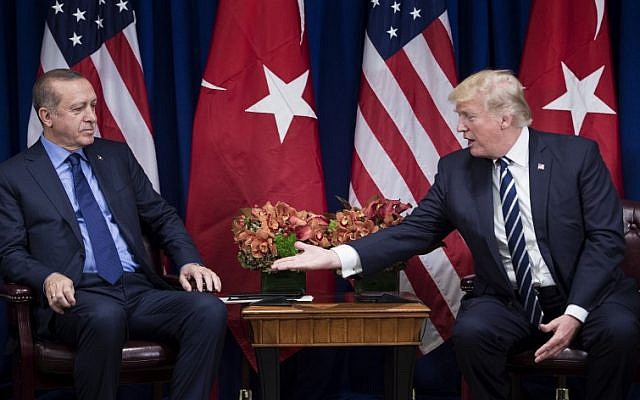
This file photo taken on September 21, 2017 shows US President Donald Trump reaching to shake Turkey’s President Recep Tayyip Erdogan’s hand before a meeting at the Palace Hotel during the 72nd United Nations General Assembly in New York City. (AFP PHOTO / Brendan Smialowski)
She said that the US administration, even if it does not want to punish Turkey for the purchase, could be forced to do so by a Congress unsympathetic to Ankara.
Turkey has defied the mounting pressure and said the purchase was a “done deal.”
Erdogan on Wednesday spoke with US President Donald Trump by phone and, according to the Turkish leader’s office, they discussed Ankara’s previous offer to form a “joint working group” on the missile system.
Advertisement
Help us report truthfully on social media
As a multimedia journalist, my job is to take the quality, fact-based journalism produced by The Times of Israel newsroom and make it accessible across every platform — from Instagram posts to podcasts to short-form videos.
This is how many, especially young people, consume news these days. But misinformation is rampant on social media. Our team at ToI produces accurate, responsible short-form reporting on Israel and the Jewish world.
If you believe in the importance of factual social media journalism, please consider joining our reader support group, The Times of Israel Community. Your financial support is essential to sustain responsible multimedia reporting.
We’re really pleased that you’ve read X Times of Israel articles in the past month.
That’s why we started the Times of Israel - to provide discerning readers like you with must-read coverage of Israel and the Jewish world.
So now we have a request. Unlike other news outlets, we haven’t put up a paywall. But as the journalism we do is costly, we invite readers for whom The Times of Israel has become important to help support our work by joining The Times of Israel Community.
For as little as $6 a month you can help support our quality journalism while enjoying The Times of Israel AD-FREE, as well as accessing exclusive content available only to Times of Israel Community members.
Thank you, David Horovitz, Founding Editor of The Times of Israel


 Add ToI as a Preferred Source on Google