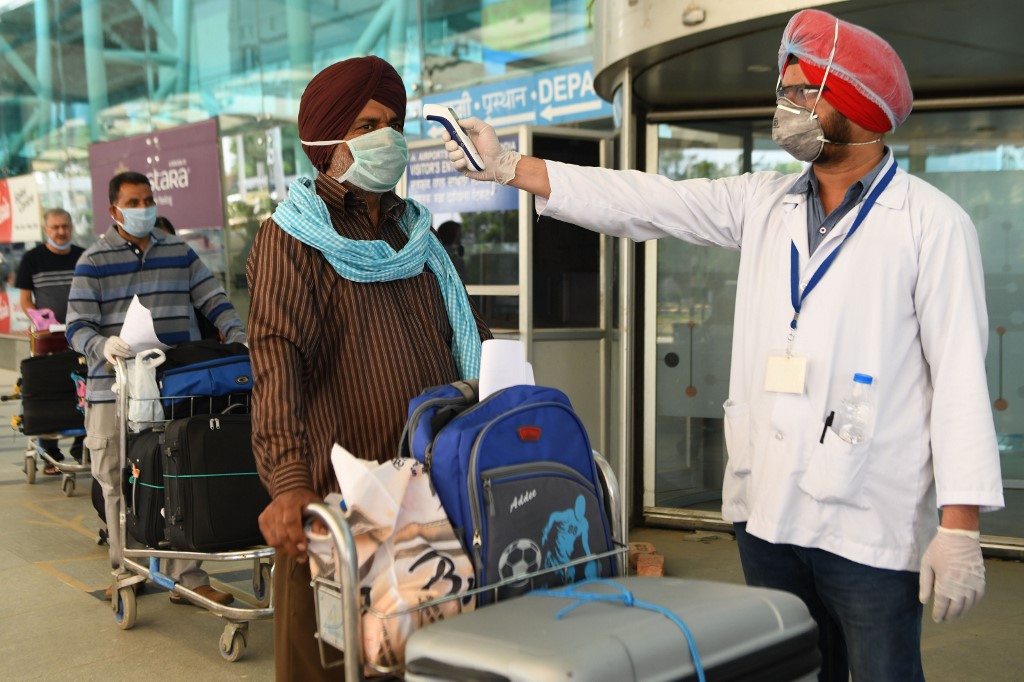
A health worker checks the body temperature of a British national queueing before checking-in for a special flight to London during a government-imposed nationwide lockdown as a preventive measure against the spread of the COVID-19 coronavirus, at the Sri Guru Ram Dass jee International Airport on the outskirts of Amritsar on May 7, 2020. (NARINDER NANU / AFP)
LONDON, United Kingdom — Suspected and confirmed cases of death from the coronavirus outbreak in Britain have risen to 48,000, according to official data published Tuesday.
The Office for National Statistics (ONS) figures tallied all fatalities in which COVID-19 was suspected or mentioned on death certificates up to May 22.
Its figure is significantly higher than the government’s latest daily figure of 39,045, which only includes deaths after confirmation of a positive test.
By either measure, the toll is Europe’s worst and puts Britain behind only the United States in officially announced deaths, although each country has different reporting lags and methods.
The data also showed that since the outbreak took hold in March there had been 56,308 more deaths in England and Wales than the five-year average.
Get The Times of Israel's Daily Editionby email and never miss our top stories
But in the week ending May 22, there were 2,589 mentions of “novel coronavirus” on death certificates in England and Wales — the lowest since the seven days to March 27.
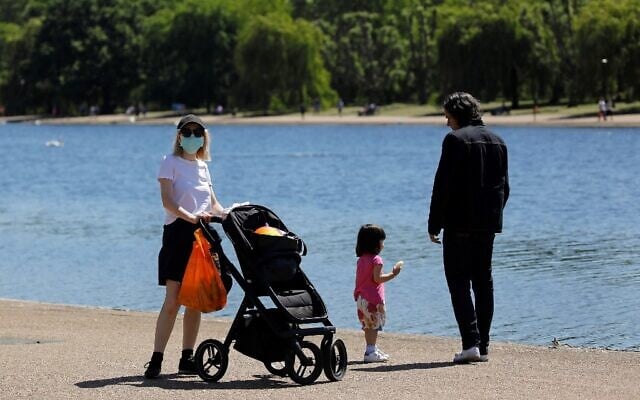
A woman wearing a face mask as a precautionary measure against COVID-19 stands with a buggy as they enjoy the afternoon sunshine in Hyde Park, London, on May 19, 2020, following the relaxing of lockdown restrictions imposed due to the COVID-19 pandemic. (Tolga Akmen/AFP)
Britain is one of the last European countries to start easing its stay-at-home restrictions, which were imposed on March 23.
Some younger children returned to school in England on Monday while some shops were allowed to reopen.
Advertisement
But most stores are closed and restaurants and cafes can only provide take out and delivery service.
Nonessential retail will resume on June 15 if the virus remains contained, according to the government’s plan.
The government maintains it is in a position to lift restrictions as infection rates are falling but critics fear it is still too soon, and could trigger a second wave of cases.
The devolved administrations in Scotland, Wales and Northern Ireland are easing restrictions more slowly, and schools remain shut.

We can't do this work alone.
The war with Iran has been draining for all of us in Israel. But when I heard about a high casualty incident – ballistic missile impacts in Arad and Dimona that left nearly 200 people wounded – I drank a cup of coffee, packed a bag, and headed south.
There, I spoke with Shilgit, the head of an after-school program for underprivileged youth. Standing outside her destroyed center, Shilgit said it was a miracle that no children were hurt and spoke about the community coming together in the hours since.
As a Times of Israel reporter, I’m committed to telling stories of resilience like Shilgit’s. But my colleagues and I can't do this alone. If you value work like this,please consider joining our reader support group, The Times of Israel Community. Your financial support is essential to keep real human reporting like this going.
We’re really pleased that you’ve read X Times of Israel articles in the past month.
That’s why we started the Times of Israel - to provide discerning readers like you with must-read coverage of Israel and the Jewish world.
So now we have a request. Unlike other news outlets, we haven’t put up a paywall. But as the journalism we do is costly, we invite readers for whom The Times of Israel has become important to help support our work by joining The Times of Israel Community.
For as little as $6 a month you can help support our quality journalism while enjoying The Times of Israel AD-FREE, as well as accessing exclusive content available only to Times of Israel Community members.
Thank you, David Horovitz, Founding Editor of The Times of Israel