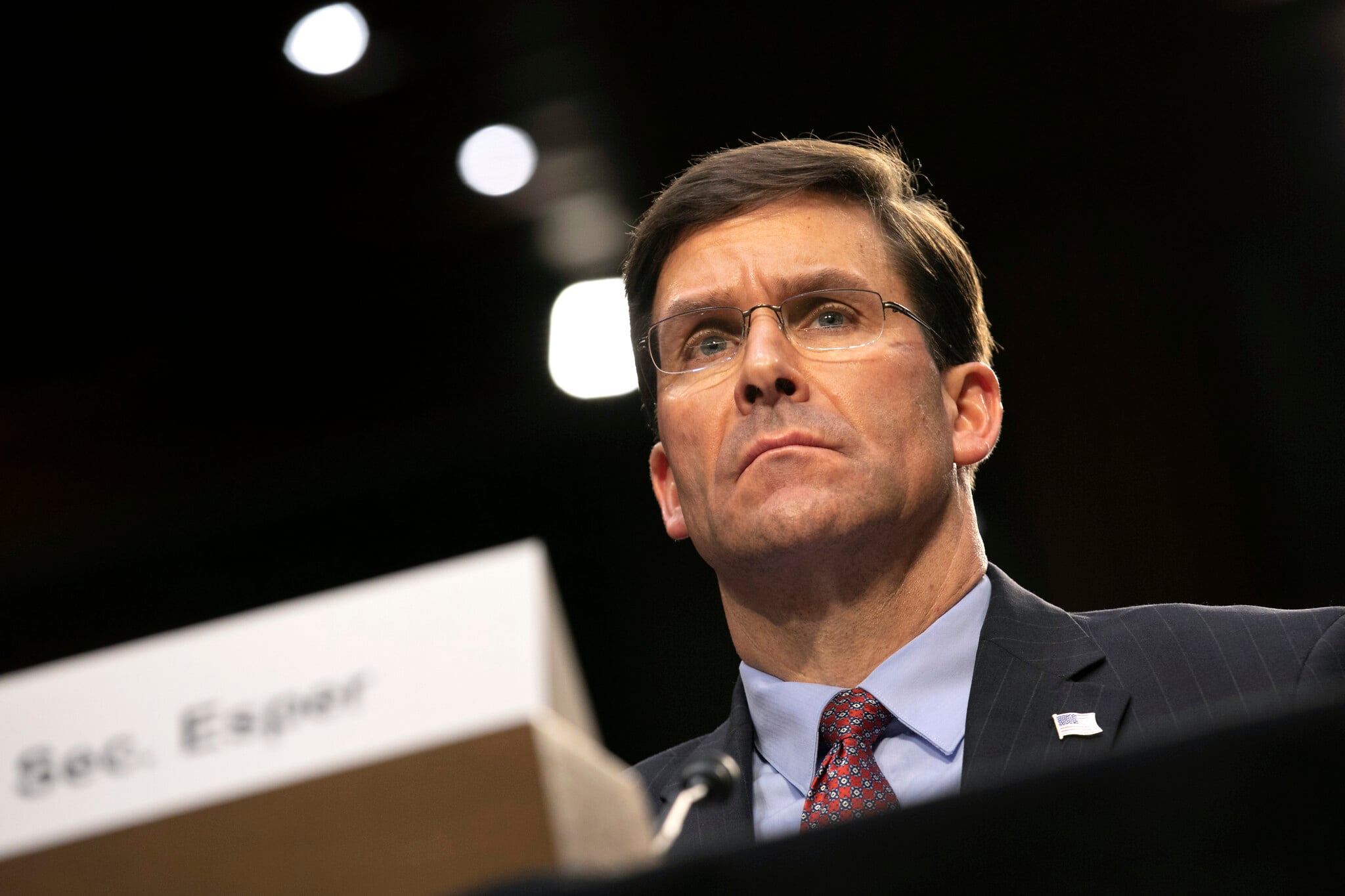
US Defense Secretary Mark Esper testifies to the Senate Armed Services Committee about the budget, March 4, 2020, on Capitol Hill in Washington. (AP Photo/Jacquelyn Martin)
US Secretary of Defense Mark Esper on Sunday visited Kuwait to extend the condolences of the US administration to the country’s leaders after the death of its emir, Sheikh Sabah al-Ahmad Al-Sabah.
Esper expressed “sincere condolences” for the loss of Sheikh Sabah, who died on Tuesday at the age of 91, in a meeting with the new emir Sheikh Nawaf al-Ahmad Al-Sabah, who also expressed concern over the health of US President Donald Trump.
Sheikh Nawaf said he was glad that Trump, who has been hospitalized after being diagnosed with coronavirus, was “recovering and well.” Esper thanked him for his “expression of concern.”
Kuwait and the United States are close allies, bound by a defense agreement that expires in 2022.
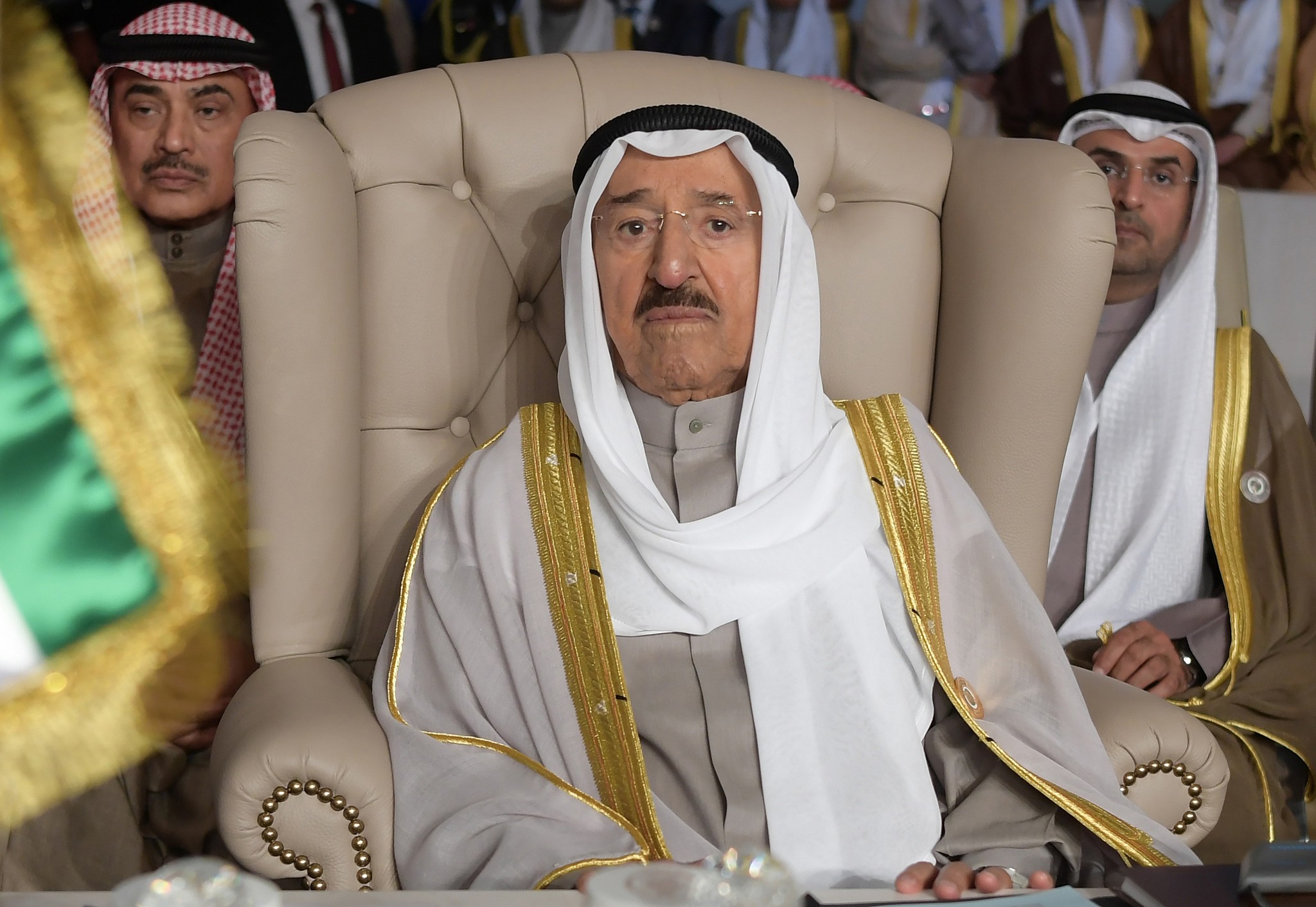
Kuwait’s former ruling emir, Sheikh Sabah al-Ahmad al-Jaber al-Sabah, attends the opening of the 30th Arab Summit, in Tunis, Tunisia, March 31, 2019. (Fethi Belaid/Pool photo via AP, File)
Their alliance was sealed with the Gulf War in 1991, during which a US-led international coalition expelled Saddam Hussein’s Iraqi troops from Kuwait after seven months of occupation.
Get The Times of Israel's Daily Editionby email and never miss our top stories
Camp Arifjan, near the Saudi border, is a key base for US troops stationed in the country.
Before arriving in Kuwait on Sunday, Esper spent the night in Qatar, another US ally in the oil-rich Gulf, where he discussed “the importance of the strong defense partnership” between the two countries.
Esper thanked Qatar for hosting some 8,000 US military personnel at the Al-Udeid Air Base, the US’s largest in the region.
Advertisement
The Pentagon chief had been on a North Africa tour aimed at beefing up the fight against jihadists in war-torn Libya and the Sahel, and on Friday signed a military cooperation deal with Morocco.
Help us report truthfully on social media
As a multimedia journalist, my job is to take the quality, fact-based journalism produced by The Times of Israel newsroom and make it accessible across every platform — from Instagram posts to podcasts to short-form videos.
This is how many, especially young people, consume news these days. But misinformation is rampant on social media. Our team at ToI produces accurate, responsible short-form reporting on Israel and the Jewish world.
If you believe in the importance of factual social media journalism, please consider joining our reader support group, The Times of Israel Community. Your financial support is essential to sustain responsible multimedia reporting.
We’re really pleased that you’ve read X Times of Israel articles in the past month.
That’s why we started the Times of Israel - to provide discerning readers like you with must-read coverage of Israel and the Jewish world.
So now we have a request. Unlike other news outlets, we haven’t put up a paywall. But as the journalism we do is costly, we invite readers for whom The Times of Israel has become important to help support our work by joining The Times of Israel Community.
For as little as $6 a month you can help support our quality journalism while enjoying The Times of Israel AD-FREE, as well as accessing exclusive content available only to Times of Israel Community members.
Thank you, David Horovitz, Founding Editor of The Times of Israel


 Add ToI as a Preferred Source on Google