

Well-wishers and tsk-tskers: What the press is saying on October 4
There’s plenty to cover in Israel with the pandemic and protests ongoing, but media attention is focused on Walter Reed Hospital, with feelings mixed regarding one man inside
 Add ToI as a Preferred Source on Google
Jacob Magid is The Times of Israel's US bureau chief
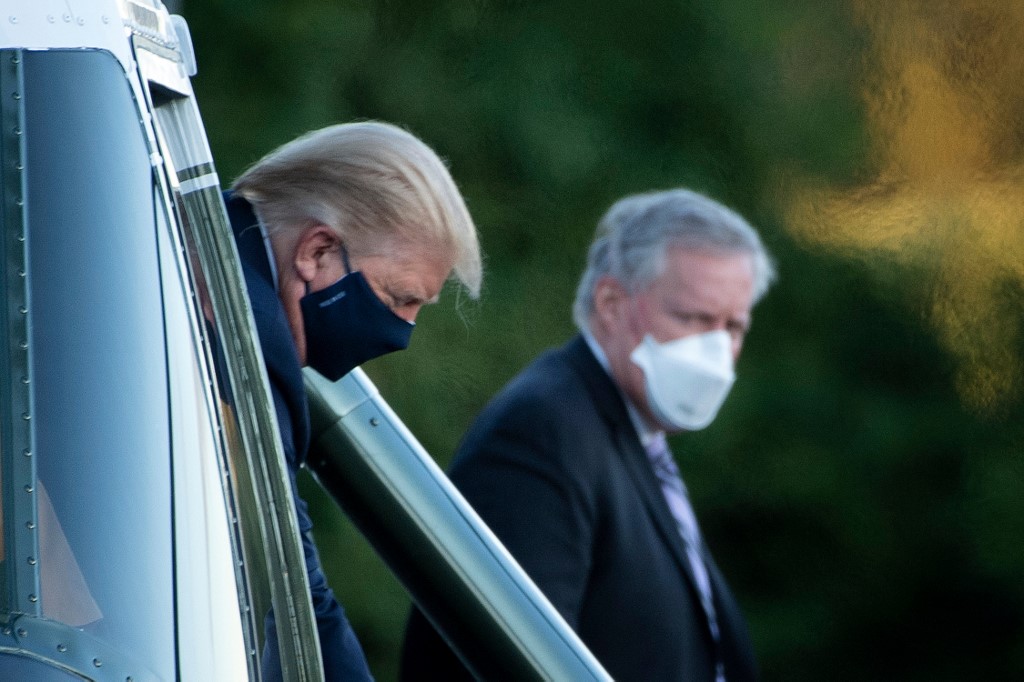
1. Number 1 something, alright: Donald Trump and his coronavirus are given much of the spotlight on both Saturday evening news broadcasts and the front page of the Sunday morning papers, allowing Israelis to focus on other people’s problems for once.
- Editors at the pro-Netanyahu Israel Hayom and the often- sensationalist Yedioth Ahronoth appear to have been working in sync, with the former going with the “Infected No. 1” headline and the latter sufficing with “Patient No. 1”
- On its website, Israel Hayom makes a little photo montage in honor of Trump with the caption “Get well soon, Mr. President.”
- It is capped off with an equally mushy op-ed by diplomatic correspondent Ariel Kahane that is largely a regurgitation of the president’s Israel policies. The op-ed is headlined “The state of Israel is crossing its fingers for the best friend it’s ever had.” In it, Kahane writes in dramatic fashion, “It is precisely during these hours, when he is lying in the hospital, that it is worth mentioning Trump’s list of pro-Israel moves.”
- The paper’s Avraham Ben Tzvi admits that Trump will now face an uphill battle in the upcoming election as the agenda in the US shifts back to the pandemic, on which the president does not have as strong a case to make. “The ideal scenario for Trump would be recovering from the virus, which would allow him to claim that even the elderly are not that at risk.”
2. Elephant in the room: But even Israel Hayom can’t ignore the awkward reality that Trump’s infection could likely have been avoidable, plastering over pages four and five a picture of the packed White House lawn at last week’s introduction of the president’s Supreme Court nominee Amy Coney Barrett, which many are speculating was a super-spreader event.
- Other outlets are not as kind to the president. “Something deeper and more disturbing has been revealed: the extent to which the American leadership has become addicted to folly and denial, hugging and kissing on the White House lawn as a virus rages. This stunning stupidity will long be remembered in the history of the plague,” writes Nadav Eyal in Yedioth.
- Elsewhere in Yedioth, Nachum Barnea goes after the White House physicians who insisted to the public that the president was doing swimmingly when it’s becoming increasingly clear that that was not the case.
- “Had Trump been in good shape he would have appeared last night in front of the cameras himself or, at the very least, flooded the net with his tweets. When he settled for just three tweets, suspicions filled the net. This is the punishment of a nonstop tweeter: he has no privilege of remaining silent,” Barnea writes.
- Pointing to the White House event introducing Barrett, Kan’s Moav Vardi says that unlike the outdoor protests and prayer services that are being held in Israel, the DC event was held in close quarters with hundreds of guests edged up against one another, many of them not wearing masks. He adds that there were also parts of it that were held indoors, where Trump could just have easily have contracted COVID-19.
- Highlighting Trump’s age, gender and medical history, infectious disease expert Galia Rahav speculates on Kan that the chances that the president’s condition might spiral are between 20 and 30 percent.
- Kan’s Nathan Guttman cites Trump’s tweet from Saturday in which the president said he was doing well. But the Kan correspondent points out that when Trump is only tweeting once a day, “it’s a sign he’s not doing well at all.”
- Haaretz leftie columnist Chemi Shalev writes that while much of the world is praying for Trump to recover in time to be booted out of office come November, “Israelis are probably an exception to the global rule: In the eyes of most Israelis, the perceived benefits of Trump’s pro-Israel record will always outweigh whatever havoc he wreaks on his own country and elsewhere…At the very least, their embrace of Trump should humble Israelis.”
3. Doth protest too much? Meanwhile in Israel, tens of thousands of people protested across the country against Prime Minister Benjamin Netanyahu and the government he leads, against the backdrop of highly contentious legislation passed this week that curbed such demonstrations — limiting them to 20 socially distanced participants, with the apparent possibility of multiple “clusters” of such 20-strong groups where space allows — as part of coronavirus lockdown restrictions.
- Haaretz’s Tomer Applebaum snaps quite the photo of a lone protester standing in front of a horse-riding police officer that leads the paper’s front page.
אורנה בנאי ומפגין אלמוני מול הסוסים pic.twitter.com/1FvitVn8Mc
— Tomer Appelbaum (@tomerappelbaum) October 3, 2020
- Haaretz reporter Lee Yaron writes that “the law limiting protests will go down in history as the law that expanded them.” (Saturday’s various protests are said to have drawn tens of thousands in total; in some reports, a record 100,000.)
- Reporting from the Tel Aviv protest, Kan’s Itai Shikmin points out how many of the demonstrators are not maintaining a social distance from one another, but viewers are likely distracted by what he’s saying as every five seconds his mask falls below his nose, causing him to constantly tug it back up to no avail.
- But the protesters weren’t just in the typical places. Makor Rishon’s Batel Kolman reports from the settlement of Efrat where several gathered at a main intersection of one of the more pro-Netanyahu towns beyond the Green Line holding up signs calling on the premier to resign.
הערב באפרת.
נראה שגם למתנחלים נמאס מנתניהו pic.twitter.com/1MmsqInwkR— batel kolman בתאל קולמן (@batelkol) October 3, 2020
4. One man’s freedom fighter is another man’s anarchist: Recapping the evening of protests, Yamina MK Bezalel Smotrich writes, “The story of the evening is simple and don’t let anyone try to sell you a false narrative: Several thousand anarchist criminals who deliberately broke the law by defying health regulations confronted police who were required to enforce against them. The protesters nonetheless received absurd backing from a biased and irresponsible left-wing media that did not even try to maintain an appearance of professionalism.”
- Walla news reporter Barak Ravid responds by joking that Smotrich “had launched a campaign to scare away voters from Yamina.”
- The chaotic scenes of scuffles between protesters and police in Tel Aviv were compared by many journalists to the seemingly more calm scenes in ultra-Orthodox Bnei Brak, where a number of health guideline violations were allegedly taking place, with crowds in Sukkahs and synagogues, but with limited enforcement from police, and definitely with no officers on horseback, Channel 12 points out.
- “I wandered through Bnei Brak tonight. The synagogue next to Rabbi Kanievsky’s house is open, as are many other synagogues. A significant number of people are walking around without masks at all… Reports of what happened on the holiday itself in Mea Shearim are also not encouraging,” reports the network’s Yair Cherki.
- The Haredi news site B’hadrei Haredim offers a different take on police enforcement, leading its homepage with the headline “Protests yes, learning Torah no.” The corresponding article laments the decision by cops to bust an illegal study session that was taking place in a sukkah in Bnei Brak.
- Meanwhile, Channel 13 reports that the brother of Deir al-Assad’s mayor succumbed to the virus, leading to the gathering of hundreds for his funeral procession in violation of health guidelines.
- The network brings on Likud minister Tzachi Hanegbi to discuss the government’s response to the spiraling situation across the country, but the interview quickly turns into a shouting match between Hanegbi and reporter Baruch Kra who sought to defend the anti-Netanyahu protesters. Hanegbi then gets up from his seat and begins to pull the microphone out of his ear before the presenter calms him down and assures him that only she will be asking him questions as had been agreed upon beforehand.
- The scene angers several reporters who take to Twitter to ask why Channel 13 agreed to have Hanegbi on under such conditions. “Why for God’s sake do you agree in advance with ministers regarding who is allowed to ask them questions in the studio? Such a despicable practice. Don’t come, then. Let’s see them give up the opportunity for coverage,” writes Haaretz Noa Landau.
4. Black and Blue and White: The resignation of Blue and White Tourism Minister Asaf Zamir appears to have further shaken up the centrist party that already seemed to be hanging on by a thread, with many once again using the latest development to call curtains for one of the more disjointed unity governments Israel has ever seen.
- Bravely speaking on the condition of anonymity, one Blue and White official tells Army Radio that “from here on out, there will be two governments. Our partnership with Likud has ended.”
- Israel Hayom’s Mati Tochfeld argues that while the protesters are calling for Netanyahu’s head, the real one being served up on a silver platter is Blue and White chairman Benny Gantz, who is running out of reasons to explain his partnership in such a government. “The protesters are a part of the public he still sees as his main base of supporters, even though large parts of it have already abandoned him upon his decision to enter government.”
- “The partnership between Blue and White and Likud, which seemed from the start like the cohabitation of a school of piranhas and goldfish, effectively lapsed on Friday. The chain of events surrounding Israel’s second nationwide coronavirus lockdown and the legislation to restrict protests sparked disillusionment and sobered up even the most optimistic, well-intentioned Blue and White members,” writes Yossi Verter in Haaretz.
- “This process, heralded by Gantz, won’t lead to the appointment of a state prosecutor [as Gantz declared Friday he was now seeking]. In the end, the government is meant to approve the nominee presented by the justice minister, but as long as Netanyahu stays in office it won’t happen. This show of independence isn’t designed to appoint a prosecutor, but to remind Blue and White voters that the party – slaughtered in all latest election polls – is still alive. For now, at least,” he adds.
- Not finished, tearing into Blue and White, Verter says: “More acts of defiance can surely be expected down the road. Forgotten promises, shelved principles, and discarded commitments will all be pulled out of the archives and laid on the table.”
- His paper’s editorial board takes a similar stance. “But whether this is a real threat or merely a hope, it’s possible that Gantz has begun to realize both his sorry political situation as well as the condition of the country, which is declining under the baton of a man under criminal indictment,” the editorial staff writes, apparently convinced that collapsing the government and spiraling the country into another election in the middle of a pandemic is the best move forward.




The Times of Israel Community.