

And now for something completely horrific
Deadly terror attack has papers taking a break from daily grind of financial scandals and coalition skullduggery to report on Tel Aviv shooting and fears that Palestinian violence may be on upswing
 Add ToI as a Preferred Source on Google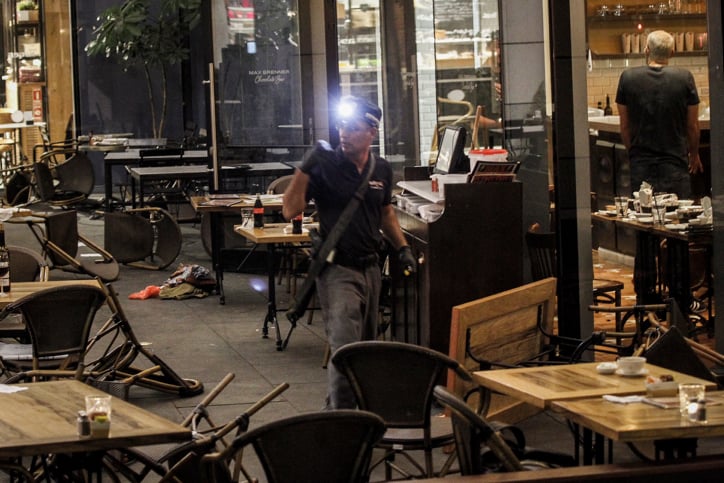
It’s said never to start an article with a quote, but it’s hard to find a better way to express both the horror of a Tel Aviv shooting spree by two terrorists Wednesday night, and the press’s reaction in a country where such attacks have become the unfortunate norm, than Nahum Barnea in Yedioth Ahronoth.
“The rumors of the demise of the intifada were premature. The improvised gun replaced the knife. Men in suits replaced schoolkids, but the terror is still here, deadly as ever,” he writes. “The world works as it does. In Palestinian villages, they will celebrate for a night, filling the Ramadan sky with fireworks, shooting into the air and waving flags, and afterwards will sink back into another day of occupation. 50 years they are celebrating and what have they achieved except a long list of martyrs that killed and were killed for nothing? And the world works as it does also for us.
“Under the assumption, more a hope, that the attack in Sarona won’t give way to more attacks, in a day or two we’ll go back to our lives. The blood will be cleaned off, the blow will be absorbed, the headlines will change. That’s how we are: Living at once in two worlds … We’ll go back and watch the Euro 2016 soccer tournament in France as if our fate is decided on the pitch; the price of summer camp will anger us; we’ll make cheesecake for Shavuot and wear white; and yes we’ll aggressively investigate the frauds of our leaders, the money they get, their travels, their expenses. Everything is small compared to the deaths of four civilians in a terror attack.”
And so it is. Where a day before were headlines about peace plans and funding scandals, now are scenes of panic, horror and bloodshed in the aftermath of a terror attack in central Tel Aviv that left four people dead. The images splattered across the front pages are of a coffee shop disrupted by gunfire, bloodshed and bedlam shot in grainy security camera footage.
“Slaughter in Sarona” reads the front page headline of Israel Hayom, showing gunmen wreaking havoc and people fleeing. Only in Israel, where wearing suits regularly is the almost exclusive domain of the ultra-Orthodox, does the fact the gunmen wore jackets and slacks make headlines, as it does in Israel Hayom.
Eran Swissa’s op-ed in Israel Hayom was probably meant to be an homage to the Sarona Market, Tel Aviv’s alt-neu “beating heart,” but instead it smacks of native advertising for the shopping center.
“In the first moments after the attack the streets surrounding the area emptied. Perhaps from fear, perhaps out of solidarity. Either way, it’s not nice to get drink at the bar when a few meters away some innocent civilians were killed,” he says in a more poignant moment.
Yedioth also goes heavy on the security camera footage in its 16 pages of coverage, which, like the other papers, is a mix of straight reporting on what the papers knew about the attack to that point, eyewitness accounts, and a whole lot of analysis. Like many headlines in Israel and abroad, the paper barely holds back its disgust about the fact that the terrorists “ate chocolate dessert and opened fire.”
Only Haaretz holds back, devoting just a news story and a single analysis to the attack. In the three months since a deadly stabbing spree in Tel Aviv left American tourist Taylor Force dead, writes Amos Harel in Haaretz, “there was a noted a steep drop in the severity of terrorism and the number of injured, which even led to projections and assessments that this period of violence was already behind us.”
“The terror attack on the Sarona complex clarifies that it’s not exactly thus,” he says. Yossi Yehoshua, in his parallel analysis in Yedioth Ahronoth, points out that most IDF battalion commanders argued that nothing had improved in recent months despite growing confidence that the worst violence was behind us. He runs the numbers: there’s no question there was a drop in attacks, from 61 in October to three in May, and 40% of the total in the past 10 months were carried out by Palestinians from the Hebron area, like the two gunmen last night.
“This is the first terror attack of the month of Ramadan, which began this week,” Harel says in his sobering analysis. “Several times in the past there’s already been drawn a connection between Ramadan and a certain inflaming of the public atmosphere in the territories, which leads to terror attacks. It’s understood that the murder of three [sic] civilians in central Israel will be seen by Palestinians who support terrorism as a success — and may be following by imitation attempts.”
He also says that the attack will put Defense Minister Avigdor Liberman to the test, and the coming days will show whether his policy will match his rhetoric and depart from his predecessor’s cooperative efforts to ease the violence.
Yehoshua predicts no sea change in IDF policy by Liberman. The Israeli military has no magic bullet to stave off these types of attacks, he says, “and therefore, despite the militant proclamations heard in the field, and apparently at the end of the cabinet meeting convened today, there isn’t expected to be a significant change at this time even when the defense minister is Avigdor Liberman.”


The Times of Israel Community.