

Public but no longer primary
A new report shows that state schools are losing students; a river gets even more polluted, and there’s talk of gas mask taxes
 Add ToI as a Preferred Source on Google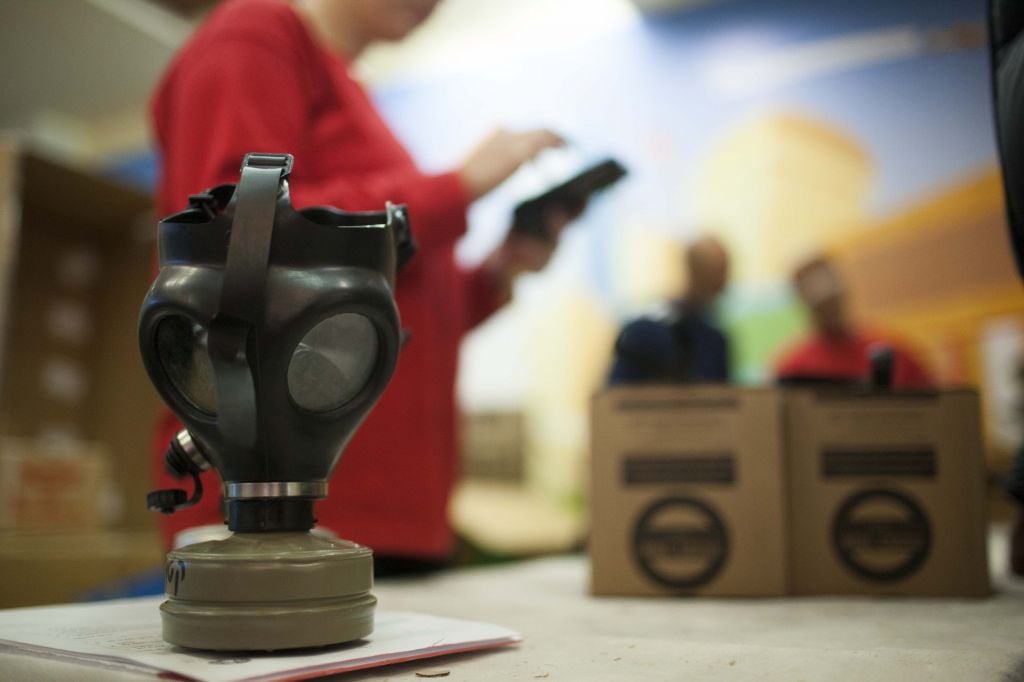
Summer vacation ends in three weeks but the Israeli press is looking well past that, all the way to the year 2019. There’s a new report that shows that by that time over half of the nation’s first graders will be in a non-state school.
The report, which takes center stage on Yedioth Ahronoth’s front page, states that in 2019 over half of Israel’s first graders will be enrolled in either ultra-Orthodox or Arab schools (both systems are allowed to operate outside the state-sanctioned curriculum). The paper points out that in state schools pupils study basic subjects like math, literature and science, while also taking internationally recognized tests. The state curriculum also teaches that Israel is a Jewish and democratic state.
The Arab school system teaches the basic subjects, only without the Zionism track, while the ultra-Orthodox don’t teach the state’s curriculum and don’t take part in international testing. In 2019, these two school systems are expected to make up about 45% of the country’s first graders, compared to 42% in nonreligious state schools. The main point Yedioth drives home is that in a few years almost half the country’s students won’t be learning that Israel is a Jewish state and a democracy.
Haaretz finds a bright side of this in the fact that projections point to a slowdown in population growth. The paper shows that despite the expected increase in the ultra-Orthodox and Arab populations, they aren’t growing as fast as they used to: growth in the Israeli Arab sector is expected to fall from 3.4% per year to 1.3%, and in the ultra-Orthodox sector from 4.7% per year to 3.6%.
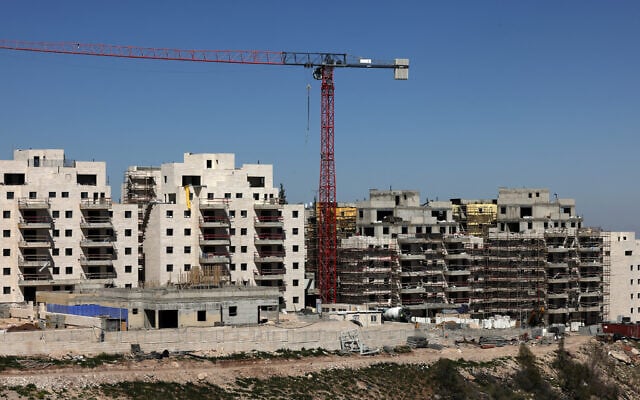
Maariv’s front page also tackles Israel’s changing population, reporting on an internal Knesset document that shows that the population of both the north and south decreased while there was a drastic increase in the West Bank. In 2001-2010 the north saw an emigration of over 30,000 residents and the south of the country saw over 25,000 leave in the same time period. Meanwhile, the West Bank saw an overall increase of over 38,000 people through 2010.
Maariv includes the story of a family that moved to the territories from Givatayim (outside of Tel Aviv). The headline sums up why the secular family moved to a settlement just over the Green Line, “We found an amazing quality of life at a reasonable price.” Micah, the father, told the paper, “I never dreamed that I would live in Samaria, but investment here in children and youth is something that does not exist anywhere else. Here there is an incredible quality of life that’s unparalleled, and at reasonable prices.”
Israel Hayom ignores schools and the territories and focuses its front page on America’s heightened terror alert in the Middle East. The paper gives a broad roundup on the US government reaction to threats of a possible terror attack in Yemen, both evacuating embassy personal and conducting airstrikes.
Boaz Bismuth writes an accompanying op-ed piece that criticizes the Obama administration for going after al-Qaeda’s core leadership in Pakistan and Afghanistan but not in Sinai, Syria, and Iraq. “The reality proves that al-Qaeda can always adapt to changing situations and even establish itself in the Middle East especially after very inconsistent US conduct,” he writes. In the end he reminds his readers that the goal of terrorism is to disrupt the lives of everyday people and that’s exactly what happened to American diplomats this week.
Nature lovers in Israel are in shock after a truck overturned and spilled an oily substance into the Lakhish River. Pictures of oil-covered birds bedeck a two-page spread in Yedioth, which reports that dozens of birds seem to have no chance of survival. The river, which runs from Ashdod to the Mediterranean Sea, is one of Israel’s most heavily polluted rivers and in the past years volunteers have tried to make it cleaner. The overturned truck that spilled the oil was apparently hauling fuel waste illegally.
It may be getting a bit more expensive to have that government-ordered gas mask. Haaretz reports that with the price of gas masks expected to reach NIS 1.3 billion (approximately $365 million), the government is weighing a tax on the mandatory masks. Haaretz doesn’t say how much the tax might be but writes that the government will also have to pay an extra NIS 300 million (approximately $85 million) in annual upkeep. The Home Front Command responded to the paper’s report, denying that any tax was being considered.



The Times of Israel Community.