Ilan Ben Zion is an AFP reporter and a former news editor at The Times of Israel.
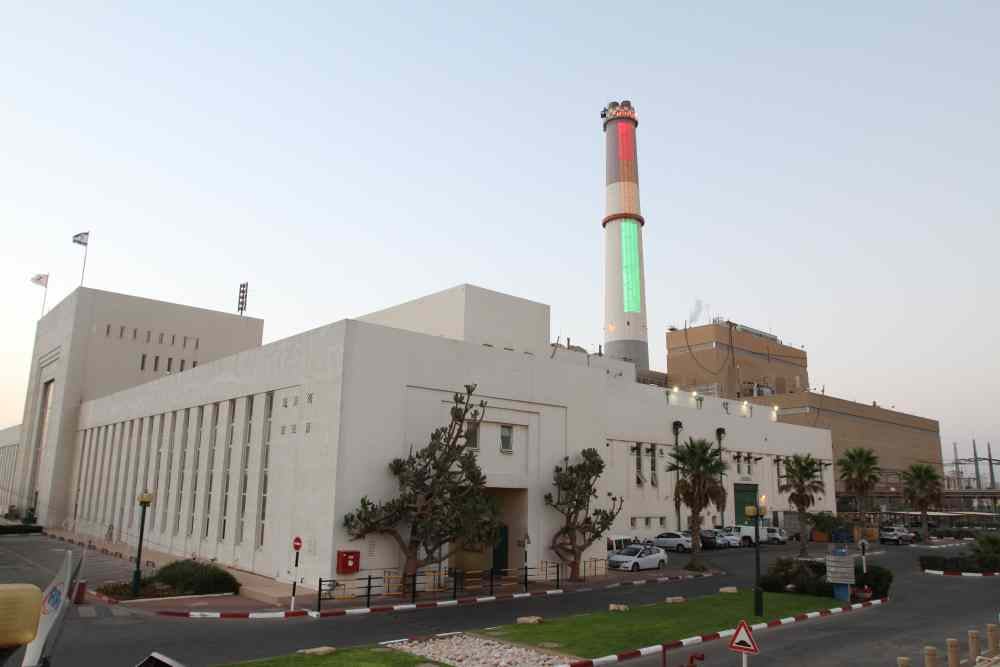
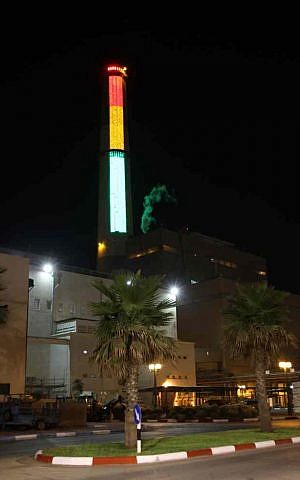
The Reading power plant lit up with the national power consumption graph. (photo credit: Chen Leopold/Energy Ministry)
In an attempt to raise public awareness about national energy consumption as the summer heat drains Israel’s power production capability, the Energy and Water Ministry launched a unique venture to put the country’s energy usage in front of every Tel Avivi’s eyes Wednesday night.
The Reading power plant lit up with the national power consumption graph. (photo credit: Chen Leopold/Energy Ministry)
A graph made up of 270,000 LED bulbs on 4.5km of tracking has been installed on Tel Aviv’s Reading power plant’s smoke stack. The installation rises 100 meters over Tel Aviv’s port, is six meters wide and consumes a mere nine kWh, the power used to run four electric kettles. It plots the country’s energy consumption in real-time.
“Presenting a graph of the energy demand aims to light up the eyes and enlighten the nation regarding the power shortage,” National Infrastructure Minister Uzi Landau said.
The project, designed by artist and lighting designer Gil Teichman, displays and illustrates electricity demand versus production capacity in real-time.
Israel is in the midst of a severe power shortage. Power supplies took a major blow with the halting of natural gas supplies from Egypt earlier this year, and the IEC warned that this summer its power-generating abilities would be a mere one percent above the expected demand.
Get The Times of Israel's Daily Editionby email and never miss our top stories
The war with Iran has been draining for all of us in Israel. But when I heard about a high casualty incident – ballistic missile impacts in Arad and Dimona that left nearly 200 people wounded – I drank a cup of coffee, packed a bag, and headed south.
There, I spoke with Shilgit, the head of an after-school program for underprivileged youth. Standing outside her destroyed center, Shilgit said it was a miracle that no children were hurt and spoke about the community coming together in the hours since.
As a Times of Israel reporter, I’m committed to telling stories of resilience like Shilgit’s. But my colleagues and I can't do this alone. If you value work like this,please consider joining our reader support group, The Times of Israel Community. Your financial support is essential to keep real human reporting like this going.
We’re really pleased that you’ve read X Times of Israel articles in the past month.
That’s why we started the Times of Israel - to provide discerning readers like you with must-read coverage of Israel and the Jewish world.
So now we have a request. Unlike other news outlets, we haven’t put up a paywall. But as the journalism we do is costly, we invite readers for whom The Times of Israel has become important to help support our work by joining The Times of Israel Community.
For as little as $6 a month you can help support our quality journalism while enjoying The Times of Israel AD-FREE, as well as accessing exclusive content available only to Times of Israel Community members.
Thank you, David Horovitz, Founding Editor of The Times of Israel