

The polio grounds
The south becomes ground zero for a vaccination drive, while Turkey and the Knesset become proving grounds for civilian-military kerfuffles
 Add ToI as a Preferred Source on Google
Joshua Davidovich is The Times of Israel's Deputy Editor
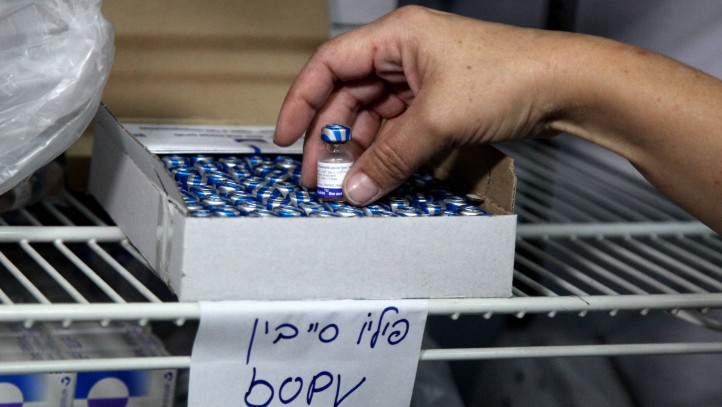
Israeli mainstream press seems to be of two minds Tuesday morning, with two papers leading with the mass anti-polio vaccination program that kicked off in the south Monday (both have the same headline), and two papers running the same lead picture of riots in Turkey.
It’s unlikely either story would have been front page fodder in, say, September, proving that the country is truly in the doldrums of summer, or, as they call it here, cucumber season.
Yedioth Ahronoth is one of the papers that leads off with the anti-polio program, trying to drum up some drama by telling the story of 7-year-old Yonatan’s actually-not-that-scary-trip to the doctor, in mind-numbing detail. “Yonatan relented and opened his mouth, but when the drops with the live attenuated virus hit his tongue, he made a face at the bitter taste. ‘It was disgusting but I took it anyway,’ he said proudly.”
Not everyone is giving in as easily as Yonatan, though, the paper reports, giving space to one Itzik Dahan, who does not want his kids inoculated since he wonders why they are only giving the treatment to kids in the south and not across the country.
“My feeling is that we are being experimented on, us southern residents. They stopped giving this treatment eight years ago, so why is the World Health Organization suddenly pushing the Health Ministry to give it to us exactly now?” he wonders.
Israel Hayom, which also led with the story, takes the other tack and brings in pediatric medicine expert Prof. Ron Dagan to explain why the Health Ministry’s decision is the right one: “The weakened live virus strengthens the immune system on one hand, and lowers the risk the wild virus will spread on the other… I’ve worked 40 years as a doctor in the south, and I will recommend my granddaughter who lives in Tel Aviv also be vaccinated if the programs advances to there. I have no doubt that in order to stop the spread of the virus and people getting sick in Israel and elsewhere this program is safe and correct.”
Haaretz, which along with Maariv is more concerned with Turkey than viruses, leads off with some commentalysis from Zvi Bar’el who writes that the harsh sentences for several top-ranking generals over an alleged coup attempt show that prime minister Recep Tayyip Erdogan has won yet another battle against the army, which he has tried to weaken over the last several years: “His is not a personal struggle, but rather an ideological one over the future image of Turkey. The government agencies from which the army was excluded constituted part of the concept of the ‘deep state,’ a term that relates to bodies and authorities whose purpose is to preserve the Kemalist ideology and to thwart political subversion — not necessarily by legal means. The ‘deep state’ is not an Erdogan invention.”
Maariv leads off with a more local civilian-army battle, the one over the future of the ultra-Orthodox draft. The paper writes that the army’s representative to the legislative panel tasked with writing new rules for a mandatory draft accused the heads of yeshivas of covering for students by pretending they are studying when they are actually not, to help them avoid the draft. “It’s impossible that the heads of yeshivas are lying and signing that they have students, as if the student is there full time when the student is actually not there at all,” the paper quotes Brig. Gen. Gadi Agmon telling the committee. “There are thousands that aren’t learning in yeshivas, but we have no mechanism to identify them in order to draft them.”
The paper also reports on other highlights from the meeting and notes that they are now being held behind closed doors because MK Ayelet Shaked, who heads the panel, decided sunshine was not the disinfectant she wanted, despite the fact that there is no security reason that would allow her to close off the committee proceedings under law.
No shoulder to cry on
Doing a bit of public service journalism, Yedioth follows up on the deadly bus crash of Sunday, which occurred when a bus hit a truck stopped on the shoulder, by identifying other major highways across the country with no shoulder for vehicles to stop on in an emergency. Among the offenders are most of Route 6, Route 90 in the Jordan Valley, a big chunk of the Coastal Road (Route 2) and much of Route 65 in the Lower Galilee.
Israel Hayom writes that an eyewitness says the driver of bus was distracted because he was on the telephone. The paper reports that the driver, who was lightly injured, was questioned by police and that he repeated his earlier testimony that he didn’t see the truck on the side of the road because his view was blocked by another truck he was tailing. The police told the paper they will likely recreate the accident, which will mean closing the highway and bringing in a bus and two trucks.
On the topic of peace talks (remember those) Haaretz’s Kobi Niv tries his hand at imagining what the region will look like when peace reigns over the land, and writes it will be a magical time when all strife is forgotten and we are able to commemorate victims and killers together in harmony, in something that sounds an awful lot like a binational state. “Just imagine, for example, in another 12 or 27 or 40 years, the joint Memorial Day for the fallen of the wars of the past between our two nations,” he writes. “At the very same moment, a two-minute siren will be heard in the streets of Tel Aviv, Nablus, Beersheba and Ramallah. The sons and daughters of both nations — irrespective of where the border will be — will all stop their cars, emerge and stand silently — Jews with kippot, Arabs with kaffiyehs, young Israelis and Palestinians, standing side by side — on roads, in schools and in public institutions.”


The Times of Israel Community.