Add ToI as a Preferred Source on Google
KIBBUTZ RAMAT RACHEL — Looking at the peaceful resort’s sprawling pool complex and expansive orchards, it’s hard to imagine this was once a battle-scarred frontier outpost.
But when Kibbutz Ramat Rachel’s early founders began building a settlement on Jerusalem’s outskirts in 1926, they were surrounded by hostile Arab villages. As they sought to create a new type of socialist agricultural society, they first engaged in a stark battle for survival.
As the kibbutz celebrated its 100th anniversary in August, members reflected on its challenges as it evolved from a frontier community under fire during Israel’s battle for independence to a real estate powerhouse controlling — and then selling the rights to — some of the most valuable land in the country.
“The founders of Ramat Rachel didn’t know about agriculture. They didn’t know how to raise cows. They didn’t know how to bake bread. They didn’t know how to grow vegetables,” said David Drumlevich, a veteran member of the kibbutz who acts as one of its unofficial historians.
“They had to learn everything from scratch when they came to the desert as pioneers, committed to building a new type of equal and fair society in Israel,” said Drumlevich.
With its location on the outskirts of the Holy City, its real estate dealings, alongside its tourism and agriculture businesses, have made Ramat Rachel “not one of the wealthiest kibbutzim in Israel, but somewhere around the middle.” Members enjoy a high quality of life and clash over the collective’s future, according to kibbutz economic coordinator Ofer Cohen.
“It’s nice to be marking a century of accomplishment here, but it’s hard to think about the next hundred years,” Cohen said. “We’re just trying to figure out the next decade.”

Fighting for its borders
To understand Ramat Rachel today, “you can’t jump straight to the buildings on our orchards,” Drumlevich said. “You have to start with the pioneers who created this community over the dark hills past Jerusalem’s edge.”
When the idealistic members of the Gdud HaAvodah (Labor Battalion) began working to settle Jerusalem in the 1920s, they first lived in a temporary work camp, hewing stones and hauling sacks of potash at the city’s old train station, Drumlevich said.
In 1926, through the Keren Kayemeth LeIsrael-Jewish National Fund, the group acquired a stony hill from the Greek Orthodox Patriarchate and named it after the biblical matriarch Rachel, who is traditionally believed to be buried in nearby Bethlehem. The fledgling kibbutz was destroyed during the 1929 riots, when Arab looters attacked the community, but members returned in the following years to resuscitate its homes, bakery and agricultural fields.

During the 1948 War of Independence, Ramat Rachel’s strategic position overlooking Hebron Road made it a key defensive position on Jerusalem’s southern edge.
“Arab forces coming northward went through Hebron to occupy Jerusalem,” Drumlevich said. “After Gush Etzion fell, Ramat Rachel was the last point defending Jerusalem.”
Kibbutz members and other Israeli fighting groups were able to hold back Egyptian and Jordanian forces during some of the war’s fiercest battles. When the armistice agreements were signed in 1949, Ramat Rachel remained within Israeli territory, bounded on three sides by Jordan.
Many of the members who had survived the fighting decided they could not rebuild Ramat Rachel a third time and left to help establish Kibbutz Carmel near Haifa. Other Israelis, including youth movement graduates such as Drumlevich, arrived over the years to take their place.
In 1954, Polish sculptor David Polus gifted the kibbutz a statue of the biblical Rachel weeping, inscribed with the prophecy from Jeremiah, “And the children shall return to their own border.”

During the 1967 Six Day War, Ramat Rachel again came under heavy Jordanian shelling. Its location on high ground once again proved a strategic asset as the IDF used the kibbutz as a defensive post and staging area for a counterattack.
Following Israel’s subsequent victory and conquest of the West Bank, Ramat Rachel suddenly found itself free of hostile neighbors for the first time — and it would soon face new types of challenges its founders never imagined.
A new type of building
After the Six Day War, Jerusalem began to expand rapidly, and the municipality and the state began to see Ramat Rachel’s hills not as agriculture or a security frontier, but as land for much-needed housing on some of the city’s most valuable undeveloped space.
What followed over the following decades was a sea change for the kibbutz as hundreds of dunams of agricultural fields were carved away from the rural Mateh Yehuda Regional Council and annexed directly into the Jerusalem municipality.
In the early 1990s, as the country faced massive waves of immigration from the former Soviet Union, Israel forged a new policy encouraging urban kibbutzim to rezone agricultural leases for housing. Ramat Rachel gave up its northern fruit orchards, used for developments in the Young Arnona neighborhood, in exchange for a clearance of its historical debts, ownership of apartments in the new towers, and commercial rights that laid the groundwork for its pivot into hotel and leisure industries.
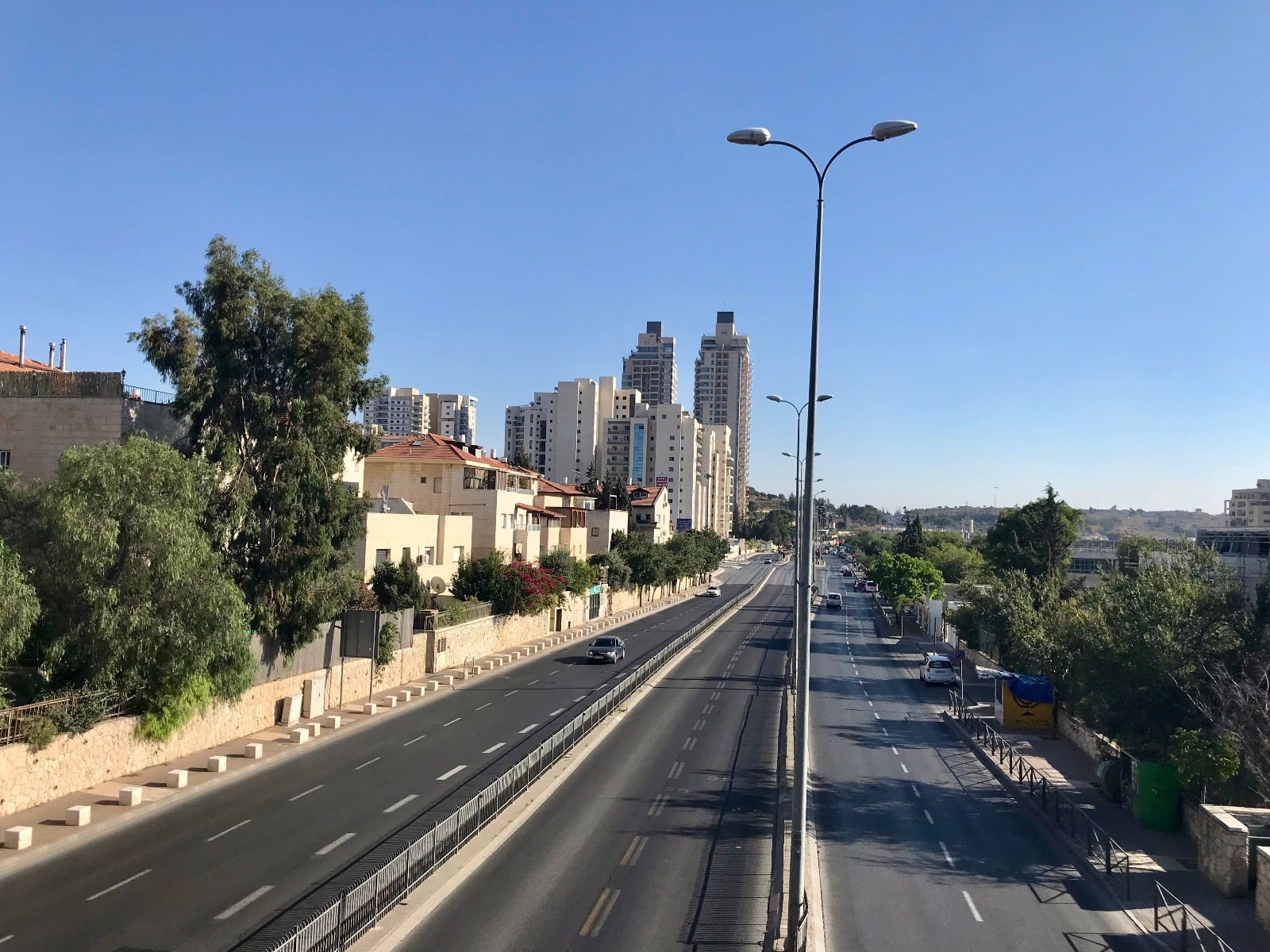
Several decades later, in the 2010s, the kibbutz allotted land from its eastern slopes for the Mordot Arnona project, consisting of roughly 1,800 to 2,000 housing units. For that project, the kibbutz secured building rights for 300 residential units and two hotel sites, which it later sold to private real estate developers for about NIS 50 million (then about $14 million). That massive windfall helped Ramat Rachel fund its hotel expansion and diversify its commercial investments, Cohen noted.
Around that time, the kibbutz bought several buildings in Ashkelon as an investment, Cohen said. It sold those at a NIS 45 million profit in June this year.
Another development project, known as the Lower Aqueduct plan, will develop Ramat Rachel’s southern flank into a neighborhood with up to 1,800 residential units, although the kibbutz will receive only negligible benefits. This project will connect Ramat Rachel with the adjoining neighborhoods of Giv’at HaMatos and Har Homa, while blocking a potential contiguous expansion between East Jerusalem and Bethlehem, to the dismay of international organizations.
Ramat Rachel’s transformation is part of a much longer history, Drumlevich noted. The kibbutz maintains an archaeological park on the site of a 2,700-year-old royal palace and citadel from the Kingdom of Judah, where archaeologists uncovered elaborate royal gardens and sophisticated water installations. The site later served as an administrative center under Persian rule and, over the following centuries, was home to Second Temple-era ritual baths, a Roman Tenth Legion estate and a Byzantine monastery dating to the fifth century.
Today, these ruins sit alongside the kibbutz, offering another reminder of how dramatically its landscape has changed over time.

A changing community
Drumlevich, who served as the kibbutz’s economic coordinator at the time of the first real estate deals, believes the municipality unfairly coerced Ramat Rachel into giving up its orchards. But for the most part, the kibbutz believes it received a good deal for what was available at the time, Cohen said.
“These deals improved our economic situation significantly, and we were able to pay back very large debts and send money to other kibbutzim,” he said. “Once the money started coming in, people were able to start moving to bigger houses, and we were able to invest more in tourism.”
The widespread perception that the kibbutz got wealthy from its real estate dealings is overblown, however, Cohen said.
“Relative to others, we are about average,” he insisted, noting that some of Israel’s 270 kibbutzim have developed very successful high-tech businesses. “Some kibbutzim are much wealthier than we are, while others are struggling.”
Drumlevich’s freestanding home on the kibbutz, built in 2000, is larger than the 64-square-meter (roughly 690-square-foot) home he raised his kids in, and is a rarity in Jerusalem, he conceded.
“But these are normal, simple homes, not palaces,” he added.
Nevertheless, members who came to the kibbutz during simpler times for idealistic reasons have conflicted feelings about its material success.
“I know people outside think we are bourgeois,” said Arza Ginga-Navama, a member who joined Ramat Rachel in the 1980s. “Maybe our pool complex is bourgeois, but I’m not getting any more money now.”

Ramat Rachel’s pool, where Ginga-Navama works and teaches, is perhaps the kibbutz’s most visible symbol of changing fortunes. Built by kibbutz members in 1977 as an urban oasis, the pool complex was relaunched in 2018 as a sophisticated health complex, with indoor and outdoor pools, spas, and a fitness club.
“We decided at the time we would invest a lot of money to make it the best pool in Jerusalem,” Cohen said.
But as membership nearly doubled from 4,000 before the revamp to 7,000 today, the pool changed from a small, family-like environment to something larger and more chaotic, Ginga-Navama said.
“Members appreciate that the facilities are nicer, but many think it feels very cold and impersonal now,” she said.

Beyond the century mark
As Ramat Rachel celebrates 100 years, its economic future is far from certain. Most of its real estate income has already come in, and that revenue stream will be almost completely dried up by the end of 2027, Cohen said.
Real estate comprises about 30% of the kibbutz’s overall income today, but its main revenue channel is tourism, with a hotel and sports complex that currently bring in about 40% of revenues, Cohen said. Its agriculture business brings in another 30%, led by sales of its signature cherries, along with other fruits and organic crops grown on 50 acres of orchards.
Additional revenues come from harvesting and selling solar energy, Cohen noted. The kibbutz’s event hall, a popular venue for weddings until it closed several years ago, will reopen after the municipality approves a new concession to operate it, he added.

But those revenues must support a relatively large communal infrastructure. Among the roughly 600 residents, Ramat Rachel has 220 official members, comprising about 150 to 160 who currently work and about 70 pensioners, Cohen said. Children and young adults, along with most spouses, are not considered members. About half of the working members are employed on the kibbutz, while the rest work outside and pay their salaries into the communal account.
Members receive monthly stipends for expenses and enjoy a range of communal benefits, from activities and facilities to a strong sense of belonging, Cohen said. But many of the younger generation are leaving, the kibbutz is short on housing, and the members are increasingly divided over whether the cooperative kibbutz model can survive.
Most members want Ramat Rachel to change from the current model, in which income is shared and property is communally owned, to the newer privatized model, where members retain personal ownership and enjoy communal services in exchange for monthly dues. Since the kibbutz movement got hit by a debt crisis in the 1980s, about 80% have gone private.
But the push has yet to clear Ramat Rachel’s required threshold. About 64% of members have voted in favor of leaving the cooperative model, Cohen said, short of the 75% needed for the resolution to pass.
“This issue is causing a lot of social tension among our members,” Cohen said.

For a community that began with pioneers determined to build a more equal society on the edge of Jerusalem, the debate over privatization goes to the heart of what Ramat Rachel has become — and what its members want it to be. It’s a challenge that its founders could never have foreseen at the time.
“None of the first pioneers here ever dreamed that the kibbutz would develop the way it has,” Drumlevich said. “We have bigger homes today, and greater resources, and this is all due to their hard work and sacrifices. Things here have changed, and we’ll have to see how things evolve here in the future.”
The Times of Israel Community.