

All pact up with nowhere to go: 7 things to know for April 21
A long-awaited coalition deal is finally signed, but many are critical and few are confident it will do much more than keep Netanyahu in power
 Add ToI as a Preferred Source on Google
Joshua Davidovich is The Times of Israel's Deputy Editor
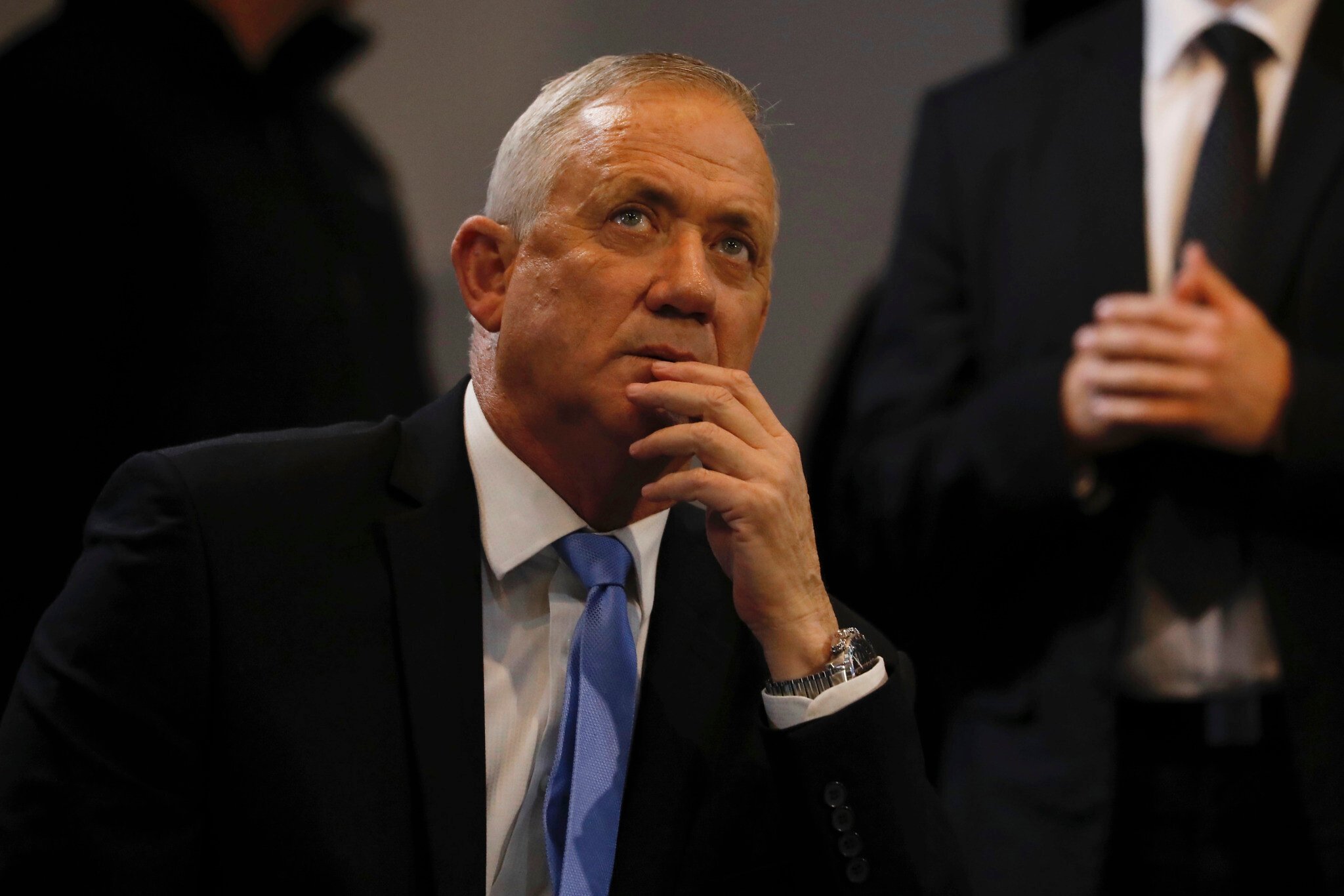
1. News on a day of remembrance: Holocaust Remembrance Day — Yom Hashoah — is not normally a day for news, per se. It is normally a day when the daily hustle and bustle of breaking news reporting, political squabbles and horse trading and other culture war-ish things fades, if only for a few hours, into the background. This year was already going to be different, with the pandemic impacting state memorial ceremonies and more intimate encounters with survivors. Now, with a coalition deal being signed between Likud leader Benjamin Netanyahu and Blue and White head Benny Gantz, there is actual news pervading the day of solemn remembrance.
- Both the Yedioth Ahronoth and Israel Hayom tabloids put Holocaust-related packages as the main item on their front pages, reserving the government deal for a bottom strip of real estate (more on those later). Maariv, another tabloid, “solves” the problem by going with large side by side packages of equal size for each story, taking up the whole front page (most page designers would tell you this is a no-no).
- Broadsheet Haaretz meanwhile, uses all of the space above the fold for the coalition deal — including five analyses/commentaries lambasting the agreement. And Haredi newspapers, following the line of the ultra-Orthodox community which generally does not recognize Yom Hashoah (they memorialize the Holocaust in December or January, lumping it in with an existing Jewish fast day), also lead off with the coalition agreement and round out coverage on their front pages with coronavirus-related stories.
- By early afternoon on Tuesday, most Hebrew news sites were leading with Holocaust remembrance related coverage.
2. Deal with the devil? But the news, in the purest and coldest sense of the word, is the coalition deal, so we shall begin with that.
- Israel Hayom celebrates the deal as it would a birth after an extra long and dangerous pregnancy, crowing about “the end of the crisis,” just as “drama reached its peak.”
- “After three tough and poisonous rounds of elections, a year and a half without a permanent government, long days of stubborn negotiating, and a political crisis of a type the country has never known, Likud and Blue and White signed on a unity government yesterday,” the paper’s lede reads.
- Haaretz, which as noted leads its print edition with the coalition deal, notes in its headline that the agreement gives Netanyahu a veto over the appointment of an attorney general or state prosecutor, which it hints but does not say outright at least in its straight news piece, could have something to do with Netanyahu’s upcoming trial.
- Throwing subtlety to the wind, Haaretz editor Aluf Benn calls the deal an “alliance of scoundrels” at the top of his paper’s front page. Gantz “vowed he was entering the Netanyahu government to protect the rule of law and democracy, but in actuality, the deal is a fire sale on those two values,” the paper’s Gidi Weitz writes.
- In Yedioth, Sima Kadmon writes: “This isn’t an emergency government. It’s not even a unity government. It’s a government of caving, with the coronavirus as an excuse for creating it.”
3. Protecting Bibi: Walla’s Tal Shalev recalls that Netanyahu once said — about a gas resources exploitation agreement — that when he wants something he gets it. “Gantz and Blue and White have now become an even better example.”
- “Blue and White gave [Netanyahu] political cover that will last throughout his trial [due to start in May]. And in doing so it also took apart the most serious alternative to coalesce against him in the last decade,” she writes.
- But Channel 12’s Daphna Liel writes that Gantz actually did pretty well for himself: “Gantz’s political crusade indeed ended without the holy grail in hand, but with a promise in his pocket and plenty of significant areas of power.”
- Confused? You’re not alone. ToI editor David Horovitz writes that much of the deal is devoted to “complex legalese intended to ensure that neither of these rivals-turned-partners can trick the other out of the prime ministership.”
- “Gantz’s ex-allies in the Yesh Atid party, unswerving in their mistrust of Netanyahu and their fury at Gantz’s change of course, were adamant late Monday that … Gantz has merely handed Netanyahu at least another six-month stint as prime minister, during which the incumbent will further boost his current much-improved popularity by quashing the pandemic, healing its economic consequences, and pushing ahead with annexation. And if the High Court disqualifies Netanyahu as prime minister during this period, the terms of the coalition deal would require new elections, in which he would run on a platform promising legislation to heed the will of the people by overriding the court.”
- In Haaretz, Anshel Pfeffer says that the point of the deal isn’t for Netanyahu to avoid handing over the premiership in 18 months, but to make sure he keeps it until then. “The complex case against Netanyahu – which, if he loses, will almost certainly continue with an appeal – is expected to take at least the next two years. Netanyahu is now assured of remaining the most powerful person in Israel while on trial, with Benny Gantz, his personal bodyguard, ensuring he remains in office throughout.”
4. The government at war with itself: The divvying up of powers means that the government is not united and will find it difficult to govern through the deadlocks, notes ToI’s Haviv Rettig Gur.
- “Each side is given sweeping powers to stymie the other side. Gantz and Netanyahu must agree on every item placed on the cabinet’s agenda. In the “emergency” phase, each has a straightforward veto on all legislation. In the later “unity” phase, Gantz’s justice minister — slated to be MK Avi Nissenkorn — will chair the powerful Ministerial Committee for Legislation, which gives the government’s imprimatur to new bills and whose decisions both blocs have committed to follow, but Likud will hold the deputy chairmanship. Both chair and deputy must agree on the committee’s agenda. Then there are the astoundingly convoluted mechanisms by which each man hopes to force the other to fulfill their side of the bargain,” he writes.
- “Optimists may yearn for a new era of conciliation and mutual understanding, but the odds are that the parties will bring their grudges and hostilities to the cabinet forums and parliamentary committees they will now jointly command,” writes Haaretz’s Chemi Shalev. “Instead of national unity, Israel could wind up with a perpetual battle royale even fiercer than the traditional fight between coalition and opposition.”
- Even Israel Hayom’s Mati Tuchfeld writes that he does not expect the new government to make much progress on “amending the disastrous judiciary revolution, fixing the legislative, judicial, and prosecutorial systems and more.
“Although the new government taking shape won’t rush to advance such changes, we can hope it at least won’t reverse the little progress that has already been made,” he writes.
5. What’s the damage? Yedioth Ahronoth notes that it is the largest government in the country’s history, and devotes much of its coverage to complaints about how much this is going to cost us: “The peak of the coronavirus crisis, with the economy crashing and a million out of work, is just when a massive government arises, blowing up to no less than 36 ministers,” it writes on its front page.
- The so-called Norwegian law, which allows ministers to give up their spots as Knesset members, “means more salaries and postings, [so] the government will be among the most expensive in the country’s history,” it adds.
- And that’s not even mentioning the existence of two prime ministers, which leads the paper’s Ariella Ringel-Hoffman to call the whole thing a “farce.”
- “We should hope these people, who would not give in on anything… will do the work as is needed. Without taking advantage of state budgets… without overloading expenditures… without filling their bureaus with aides,” she writes, expressing little confidence they actually will.
- Kan reports that Blue and White is interested in bringing Yisrael Beytenu into the government as well, which could grow it even larger, though the party already rejected the idea once. “According to a Blue and White source, additional efforts are expected to bring [Avigdor] Liberman into the government, in exchange for portfolios designated for Blue and White, to ensure that Liberman will be in Gantz’s camp.”
6. Remembering from afar: Much of the coverage of Holocaust Remembrance Day is colored by the coronavirus crisis and how it has affected survivors and forced memorials to adapt.
- In ToI, Joy Bernard writes that survivors have been among the most badly hit by the pandemic.
- “Like the majority of the elderly population in the country, Holocaust survivors have not been able to leave their homes for the past five weeks. As long as the lockdown persists, they are projected to have to stay separated from the rest of society for the weeks, probably months, ahead. Many of them have expressed anxiety over their deteriorating health or informed the authorities that they are afraid of running out of money, food and medicine,” she writes.
- Army Radio tells the story of two survivors “who survived the Holocaust, but were felled by the coronavirus.”
- “It will be a long time until we understand the full effect that coronavirus had on the last generation of Holocaust survivors,” reporter Noga Zak says.
- In Haaretz, Allison Kaplan Sommer writes that the commemorations, virtual, or devoid of survivors, offer a glimpse into the future when no survivors are left. Zikaron BaSalon, which organizes intimate sessions for survivors to tell their stories, already began planning for such a scenario when they realized they had too many people signing up for Zoom meetings and not enough survivors to go around.
- “We had already decided that, even in the ‘in-person’ Zikaron BaSalon gatherings that we had before the coronavirus, we were going to have to begin using recorded testimonies and second- and third-generation testimonies, because there are increasingly fewer survivors left to testify,” group co-founder Dana Sender-Mulla says.
7. In this together: Yedioth’s front page is mostly taken up by a picture of the gates of Auschwitz, empty of people, and the headline “At the closed gates of Hell.”
- “We will return, with our heads held high,” survivor and former chief rabbi Yisrael Meir Lau writes.
- Israel Hayom, meanwhile, uses its front page to push a message calling for all Jews to move to Israel (ironic, as this is the one time when immigration has pretty much been halted.)
- But the paper also features columns pushing the message that Jews are just one part of a larger global family in the face of the coronavirus.
- “It is clear from this current crisis that all of humanity is in this together. We are all partners in this world. Among the many things humanity must work on together is to expose and root out all forms of hatred, wherever it exists. My experience over the past three years at the White House gives me hope that perhaps humanity is ready for this. I am not starry-eyed or naive. I recognize that today, even in the United States, this beautiful ‘land of the free,’ the age-old pernicious ideology of anti-Semitism is nipping, biting and in some cases now ferociously attacking our communities,” writes former White House aide Jason Greenblatt.
- The AP’s Aron Heller writes that groups fear the crisis is giving anti-Semitism a chance to rear its head: “Since the beginning of the COVID-19 pandemic, there has been a significant rise in accusations that Jews, as individuals and as a collective, are behind the spread of the virus or are directly profiting from it,” he quotes Moshe Kantor, president of the European Jewish Congress.





The Times of Israel Community.