

Author Matti Friedman to launch real-life spy thriller in a live ToI interview
Meet the writer at the Israel debut of his new book, hosted by The Times of Israel in partnership with Beit Avi Chai, in Jerusalem on April 10
 Add ToI as a Preferred Source on Google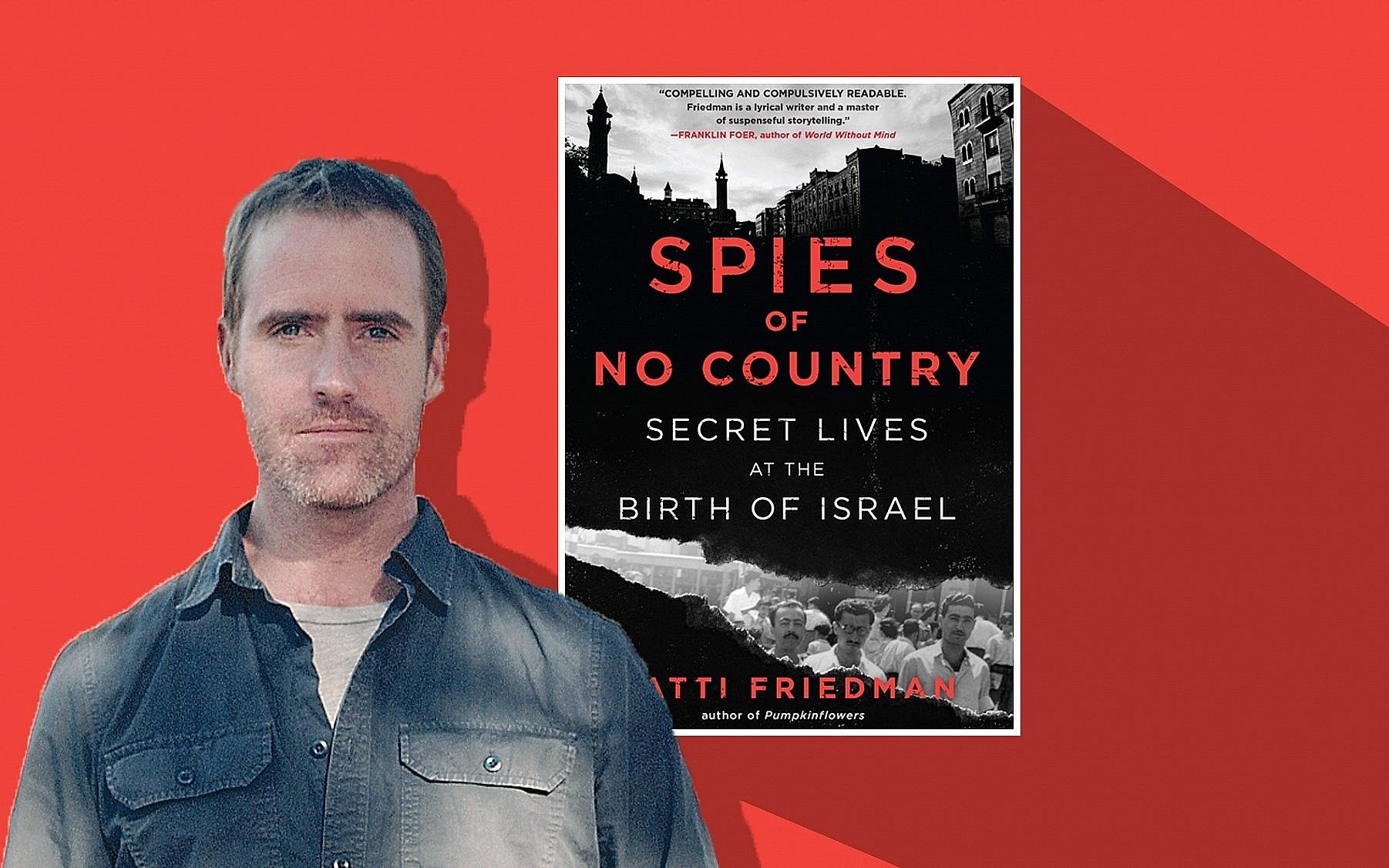
“Spies of No Country,” the new book from award-winning author Matti Friedman, recounts the extraordinary genesis of Israel’s pre-state clandestine security service, which laid the foundations for the modern-day Mossad.
Following the adventures of a handful of young undercover agents in the Palmach’s ragtag Arab Section, Friedman accompanies them across enemy lines as they mingle with Arab refugees fleeing the War of Independence, establish their clandestine foothold in the bazaars and backstreets of Beirut, and try to infiltrate the Jordanian-held half of Jerusalem.
I will interview Matti Friedman about his new book at the Israel launch of “Spies of No Country” hosted in partnership with Beit Avi Chai in Jerusalem, on Wednesday, April 10. Books will be on sale for signing by the author.
Based on firsthand interviews and previously classified documents from Israel’s most secret archives, Friedman recounts the real-life stories that read like spy fiction: concealed radios with antennas disguised as washing lines; buried caches of weapons and explosives; nighttime landings on enemy beaches; sudden disappearances; arrest; torture and death.
Readers hoping for undercover Jewish Jason Bournes will be disappointed, however: There are no great intelligence coups or history-turning assassinations. The richness of these young men’s stories lies almost in their banality – the daily struggle with tension and boredom, the constant fear of discovery, their ingenuity in creating new identities and lifestyles in the heart of an enemy country.
Isolated, surrounded and cut off from the fledgling state as it struggles to survive the onslaught of seven Arab armies, they are the original mista’arvim – “ones who become like Arabs” – now playing the starring roles in “Fauda” on Netflix. The young spies risk their lives collecting information, identifying potential targets and mapping out the first secret steps toward establishing the world’s most admired intelligence service.
“Spies of No Country” completes a loose trilogy alongside Friedman’s two previous books. “The Aleppo Codex” is a thrilling investigation into the disappearance, smuggling, retrieval and mysterious cannibalizing of a thousand-year old Torah manuscript once housed in Syria and revered by generations as the authoritative text of the Hebrew Bible. “Pumpkinflowers” is the wrenching firsthand account of a soldier’s military service in Israel’s security zone in southern Lebanon. In his latest work, Friedman returns to the soil of Lebanon, the setting of his second book, in the company of the Arabic-speaking Jewish spies and smugglers, the protagonists of his first book.

Friedman is a veteran former reporter for the Associated Press and The Times of Israel, and his honed journalistic skills are here on full display. At the heart of “Spies of No Country” are two exceptional treasure troves of information that only an experienced multilingual journalist could ever hope to unearth.
First, there are Friedman’s four heroes – or perhaps anti-heroes – the three young immigrants from Syria and Yemen and their Palestine-born colleague through whose recruitment, training and field assignments we learn the story of the Arab Section. The author stumbles across them by chance, not because he is planning to write about them – he didn’t even know of their activities at first – but because Friedman has “learned over years as a reporter that time spent with old spies is never wasted.”
The reporters’ curiosity that leads to Friedman’s meeting and blossoming relationship with 93-year-old, Aleppo-born Isaac Shoshan, as the book is nearing completion, leads to his discovery of this largely ignored chapter in the history of Israel’s early years, and introductions to the stories of the other three men.

Friedman’s second journalistic achievement is not to be satisfied with the colorful stories he hears once he’s met his main characters. Pursuing the threads like an investigative reporter, Friedman finds two histories of the Arab Section – neither translated from the Hebrew, both now out of print, one of them written by Gamliel, one of his four protagonists. Nor does he stop there, rather goes on to unearth unpublished testimonies from other members of the section who have already died, unpublished photographs, and documents from the archives of Israel’s military and the Hagana pre-state forces – many of them declassified and referenced here for the first time at Friedman’s request.
Even with this rich vein of information, “Spies of No Country” might not have succeeded were it not for Friedman’s natural skills as a storyteller. He brings to life some wonderful characters, including the teacher Sam’an, worshiped by the ragtag collection he tries to mold into a secret service.
Meanwhile, his recruits grapple with their position as Arabic-speaking Jews in a Hebrew community, and as non-Europeans in a society straining to become a beacon of Westernized culture. Later, Sam’an would become one of Israel’s most revered spymasters, and instructor of the country’s most famous spy, Eli Cohen.
The result, as Friedman says, is not a comprehensive history of Israel’s intelligence service or even the Arab Section. It is rather a snapshot of four young men engaged in clandestine work in Haifa and Beirut during “twenty pivotal months” from January 1948 to August 1949, when the state of Israel was being born, and then fighting for its young life. This is the story of their part in that struggle.
‘Spies of No Country’: Book Launch with Matti Friedman
In association with Beit Avi Chai
8:30 p.m., Wednesday, April 10
Beit Avi Chai, King George St., Jerusalem
Tickets NIS 40 HERE
To join our priority booking list and receive details of all our future English-language events, email the word “subscribe” to: events@timesofisrael.com








The Times of Israel Community.