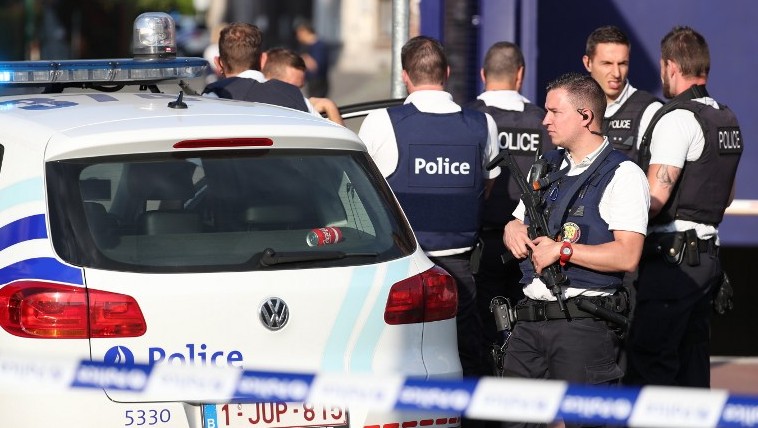
Police stand as they secure the area around a police building in the southern Belgian city of Charleroi following a machete attack on August 6, 2016. (AFP/Belga/Virginie Lefour)
BRUSSELS, Belgium — Belgium’s prime minister Sunday announced a terrorism probe into a machete attack that wounded two policewomen, in what appeared to be the latest in a string of jihadist attacks in Europe.
“We have been informed by federal prosecutors that an investigation has started for attempted terrorist murder… given certain elements (in the case),” Charles Michel told reporters.
The prime minister was referring to the attacker’s cry of “Allahu Akbar” (God is greatest) during the assault in front of a police station.
Meanwhile, prosecutors said Sunday the attacker was an Algerian national known to police for criminal offenses but not terrorism.
The 33-year-old attacker, identified by the initials K.B., had been living in Belgium since 2012, the federal prosecutor’s office said in a statement.
Get The Times of Israel's Daily Editionby email and never miss our top stories
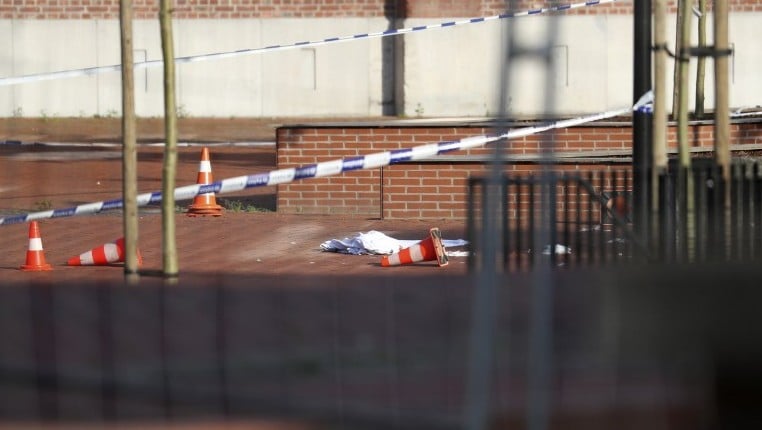
This picture taken on August 6, 2016 shows a blanket on the ground in the area around a police building after a man wounded two policewomen with a machete in the southern Belgian city of Charleroi. AFP/ BELGA / VIRGINIE LEFOUR)
The attack Saturday outside the main police station in the city of Charleroi, around 60 kilometers (40 miles) south of Brussels, left one of the policewomen with “deep wounds to the face” while the other was slightly injured, Belga news agency said.
Charleroi police said the attacker was shot and killed, while the two victims were out of danger.
Advertisement
Belgium has been on high alert since suicide bombers struck Brussels airport and a metro station near the European Union’s institutions on March 22, killing 32 people.
Those attacks were claimed by the Islamic State (IS) jihadist group, which controls large areas of territory in Iraq and Syria and has claimed numerous terror strikes in Europe over the last year.
We can't do this work alone.
The war with Iran has been draining for all of us in Israel. But when I heard about a high casualty incident – ballistic missile impacts in Arad and Dimona that left nearly 200 people wounded – I drank a cup of coffee, packed a bag, and headed south.
There, I spoke with Shilgit, the head of an after-school program for underprivileged youth. Standing outside her destroyed center, Shilgit said it was a miracle that no children were hurt and spoke about the community coming together in the hours since.
As a Times of Israel reporter, I’m committed to telling stories of resilience like Shilgit’s. But my colleagues and I can't do this alone. If you value work like this,please consider joining our reader support group, The Times of Israel Community. Your financial support is essential to keep real human reporting like this going.
We’re really pleased that you’ve read X Times of Israel articles in the past month.
That’s why we started the Times of Israel - to provide discerning readers like you with must-read coverage of Israel and the Jewish world.
So now we have a request. Unlike other news outlets, we haven’t put up a paywall. But as the journalism we do is costly, we invite readers for whom The Times of Israel has become important to help support our work by joining The Times of Israel Community.
For as little as $6 a month you can help support our quality journalism while enjoying The Times of Israel AD-FREE, as well as accessing exclusive content available only to Times of Israel Community members.
Thank you, David Horovitz, Founding Editor of The Times of Israel