

Facing new COVID-19 restrictions, Bnei Brak adapts
Frustrated and feeling targeted, residents of ultra-Orthodox city say they are doing all they can to prevent the spread of the coronvairus in their close-knit community
 Add ToI as a Preferred Source on Google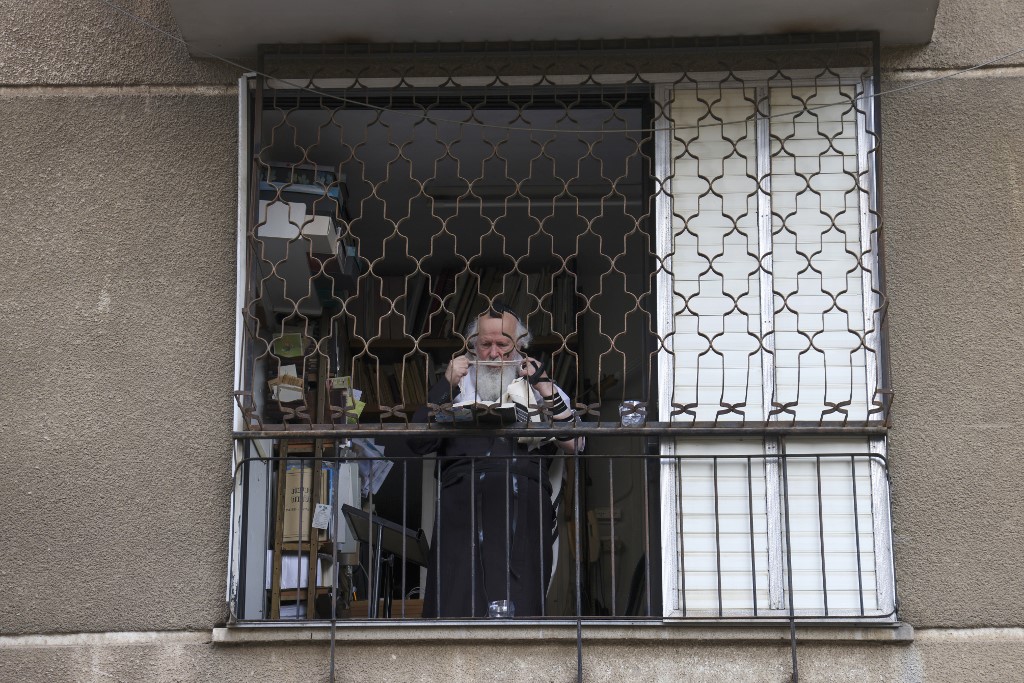
BNEI BRAK (AFP) — “We’re under attack,” said Yonatan, a blue mask across his shaggy beard in Bnei Brak, an ultra-Orthodox city where authorities are set to restore a partial COVID-19 lockdown.
For many of Israel’s ultra-Orthodox community, the resumption this week of coronavirus restrictions feels as if they have been specifically targeted — and many are frustrated.
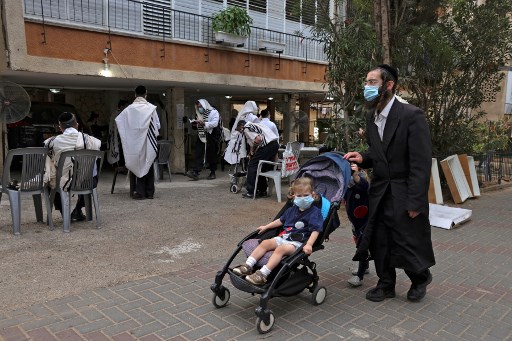
At 7 a.m., on Monday in this satellite city of Tel Aviv, men in black frock coats were hurrying on their way, some twirling their sidelocks as they walked, in the morning’s early light.
Blue mask, white mask, improvised mask — nearly every face was sporting one, in stark contrast to the first days of the pandemic.
In March, Bnei Brak was an initial “rebel” city against the government’s coronavirus rules, compelling authorities to deploy soldiers to help police impose containment measures.
But after infection rates peaked across the country, the government on Sunday announced new, partial confinement on 40 cities, including northern Arab areas — and in Bnei Brak.
Masks and prayers
“It should be the whole country, not just us,” said Avraham, a Holocaust survivor in his 80s, with piercing blue eyes framed by rectangular glasses.
At 7:30 a.m., the former high school teacher went to study Talmud in a small neighborhood synagogue.
Inside, the men were separated by transparent plastic sheeting, introduced due to the pandemic.
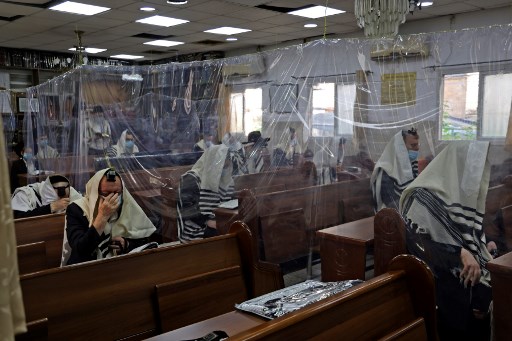
Only elderly men were to be found in the synagogue.
The young men, Avraham explained, were in yeshivas — talmudic schools — outside Bnei Brak, in order to separate the young from the old.
As rumors of a new lockdown loomed, a marriage in the family was moved forward to Sunday. But even then, guests split their celebrations between young and old.
“We adjusted the hours to avoid spreading the virus and infecting the older, more fragile ones,” Avraham said, explaining how the older generation left by 9 p.m., after which the young arrived.
“My wife wore her mask the whole evening, and even chose not to eat, so as not to have to remove it,” he said.
Outdoor synagogue
Elsewhere in Bnei Brak, on Ben Zakkai Street, Chanoch Vexler prayed on the first floor of a sand-colored apartment block.
He looked down from his window at about 20 of his sons, grandsons, and relatives praying in the building’s front yard.
To protect Chanoch’s fragile health, an outdoor synagogue was improvised adjacent to the building.
Cooling fans pushed the air, turning the pages of prayer books, as the sound of shofars — ram horns blown during the month of Tishrei in the lead-up to the festival of Rosh Hashanah — rang out.
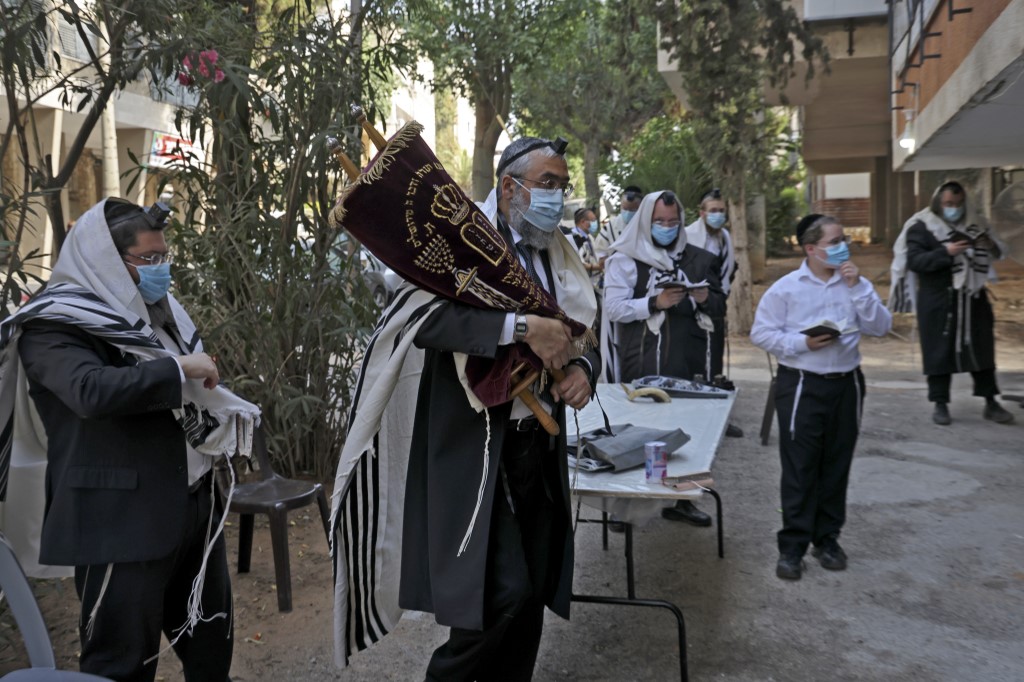
A Torah scroll was unrolled, nearly knocking over a plastic bottle of hand sanitizer gel on the edge of the table.
“It’s an adaptation to the coronavirus,” said Yaakov, 72, who spent the entire 50 minutes of prayer wearing a mask, connected by tubes to an oxygen supply to help him breathe with his poor lungs.
Yaakov loves praying outside, but like many, has bitter memories of the early days of the pandemic.
In recent days, members of the ultra-Orthodox parties that are part of Prime Minister Benjamin Netanyahu’s coalition pressed the premier not to impose a total lockdown.
“Because of the resistance, Netanyahu decided on a curfew at night, and not total confinement” in the 40 cities, said Yaakov.
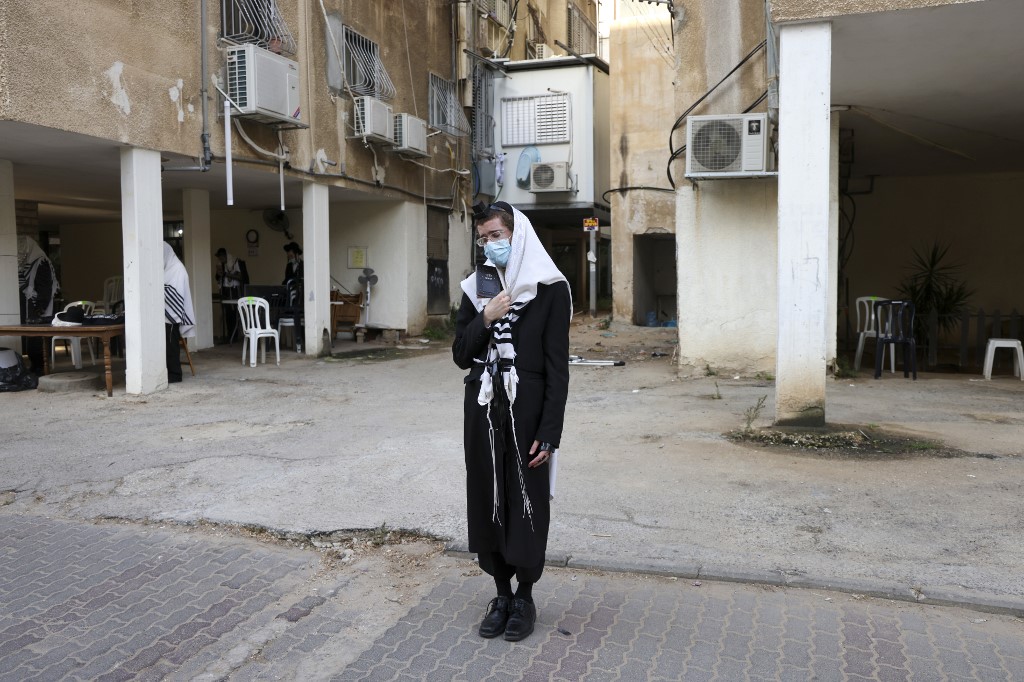
Residents of this ultra-Orthodox city insist that they now follow government rules.
“We wear the mask, we do whatever it takes,” said Yonatan, who believes there is a divine source to the virus.
“This coronavirus came on us from God, to remind us of our being given the Torah on Mount Sinai,” Yonatan said, referring to one of the key events in Judaism.
Avraham would put it differently.
In a world of technology, he said, God had decided on a “shutdown.”
Times of Israel staff contributed to this article.


The Times of Israel Community.