An ambulance believed to transporting Alexei Navalny arrives at the Charite hospital in Berlin, Germany, August 22, 2020. (AP Photo/Markus Schreiber)
BERLIN — The German government says tests performed on samples taken from Russian opposition leader Alexei Navalny showed the presence of the Soviet-era nerve agent Novichok.
Navalny, a politician and corruption investigator who is one of Russian President Vladimir Putin’s fiercest critics, fell ill on a flight back to Moscow from Siberia on August 20 and was taken to a hospital in the Siberian city of Omsk after the plane made an emergency landing.
He was later transferred to Berlin’s Charite hospital, where doctors last week said there were indications that he had been poisoned.
Chancellor Angela Merkel’s spokesman, Steffen Seibert, said in a statement Wednesday that testing by a special German military laboratory had shown proof of “a chemical nerve agent from the Novichok group.”
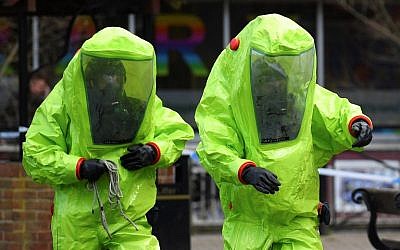
In this photo from March 8, 2018, members of the emergency services in green biohazard encapsulated suits investigate the site where Russian spy Sergei Skripal and his daughter Yulia were found on March 4 in critical condition at The Maltings shopping center in Salisbury, southern England. (AFP Photo/Ben Stansall)
Novichok, a Soviet-era nerve agent, was used to poison former Russian spy Sergei Skripal and his daughter in Britain. It is a cholinesterase inhibitor, part of the class of substances that doctors at the Charite initially identified in Navalny.
Get The Times of Israel's Daily Editionby email and never miss our top stories
Seibert said the German government will inform its partners in the European Union and NATO about the test results. He said that it will consult with its partners in light of the Russian response “on an appropriate joint response.”
Navalny’s allies in Russia have insisted he was deliberately poisoned by the country’s authorities, accusations that the Kremlin rejected as “empty noise.”
Russian opposition leader Alexei Navalny in a courtroom in Moscow, Russia, August 27, 2018. (AP Photo/Pavel Golovkin)
The Russian doctors who treated Navalny in Siberia have repeatedly contested the German hospital’s conclusion, saying they had ruled out poisoning as a diagnosis and that their tests for poisonous substances came back negative.
Advertisement
We can't do this work alone.
The war with Iran has been draining for all of us in Israel. But when I heard about a high casualty incident – ballistic missile impacts in Arad and Dimona that left nearly 200 people wounded – I drank a cup of coffee, packed a bag, and headed south.
There, I spoke with Shilgit, the head of an after-school program for underprivileged youth. Standing outside her destroyed center, Shilgit said it was a miracle that no children were hurt and spoke about the community coming together in the hours since.
As a Times of Israel reporter, I’m committed to telling stories of resilience like Shilgit’s. But my colleagues and I can't do this alone. If you value work like this,please consider joining our reader support group, The Times of Israel Community. Your financial support is essential to keep real human reporting like this going.
We’re really pleased that you’ve read X Times of Israel articles in the past month.
That’s why we started the Times of Israel - to provide discerning readers like you with must-read coverage of Israel and the Jewish world.
So now we have a request. Unlike other news outlets, we haven’t put up a paywall. But as the journalism we do is costly, we invite readers for whom The Times of Israel has become important to help support our work by joining The Times of Israel Community.
For as little as $6 a month you can help support our quality journalism while enjoying The Times of Israel AD-FREE, as well as accessing exclusive content available only to Times of Israel Community members.
Thank you, David Horovitz, Founding Editor of The Times of Israel