

Horror on the roads, fury at Islamic State
A horrific bus accident in Israel leaves 8 dead; while Islamic State’s latest execution crosses another line
 Add ToI as a Preferred Source on Google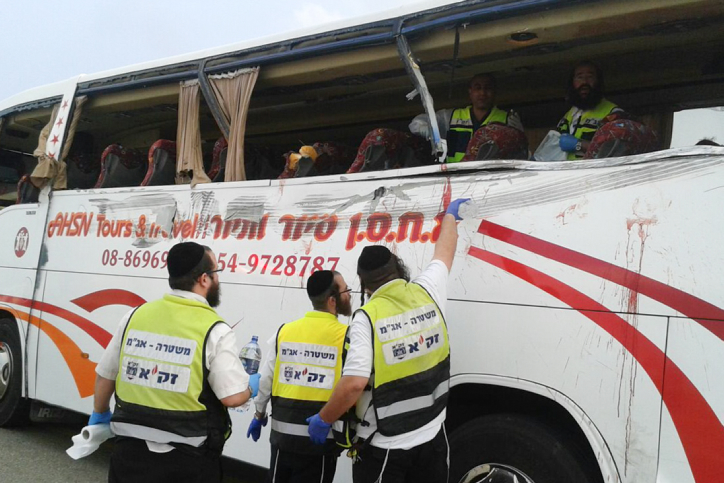
Wednesday’s editions of the Hebrew dailies are particularly difficult to look at. The front pages feature both pictures of the aftermath of a tragic bus accident in Israel’s south and the Jordanian air force pilot in a cage moments before being burned alive by Islamic State (IS).
Yedioth Ahronoth and Israel Hayom use the identical headline to describe the accident, “The bus of death.” Yedioth describes how a flatbed truck carrying a tractor sideswiped a bus returning from Jerusalem. The accident killed eight people and injured at least 20. Police suspect that the tractor wasn’t properly secured and jutted out as the bus passed, causing the accident. The truck driver was arrested and is being investigated for negligence.
Unfortunately, the stretch of Route 31 where this took place (just north of Beersheba) is known to be dangerous and Yedioth calls it “The southern road of death.” The paper recounts four major accidents that occurred on the same stretch over the last four years. Annually, it reports, there are nine deaths a year on Route 31, and over the past 10 years 76 people have been killed and 1,369 people injured in 465 separate accidents.
Israel Hayom reports that 87 people have died on the road over the past decade and writes, “Why do people have to die before we address this problem?” The Transportation Ministry allocated 900 million shekels (about $230 million) in June 2014 to upgrade the entire road, which stretches 80 kilometers (about 50 miles) from the Dead Sea region to Hanasi Junction, but construction has yet to begin. The paper notes that the police define the road as a “red road” (meaning it is dangerous) and mayors and regional councils have been pushing the government for years to upgrade it.
Islamic State’s burning alive of a captive Jordanian pilot is the other story that unites the front pages. Haaretz gives a straightforward accounting of the murder, the video of which was released on Tuesday. The sleekly produced video shows the pilot in a cage and then set aflame by a masked jihadist. Authorities believe that the pilot, Moaz Kasasbeh, was actually killed about a month ago.
“Unbridled cruelty” is the Yedioth’s front page headline over a disturbing image taken the second before flames engulf the captive pilot. The paper’s Ben-Dror Yemini writes that “this isn’t just a fight against a radical group, this is something different. The human brain has a hard time understanding this.” He agrees with Saudi Arabia’s late King Abdullah, who said that IS represents a threat to world peace. In the years after 9/11 the world of jihad has gotten stronger and more brutal while the West has become weaker, he writes. Like 9/11 was a wake-up call for America, he hopes that this brutal murder is a wake-up call for the West before it is too late.
Israel Hayom’s Boaz Bismuth writes that “we can no longer say we don’t know.” He writes, “Islamic State’s message to Jordan is clear: the Hashemite Kingdom, our friends across the border, is the next target of the scum of the human race.” But that isn’t just a problem for Jordan, it’s everyone’s problem, and Bismuth agrees with Yemini that we all need to wake up. “The Middle East is freaking out. Countries are falling apart, presidents (Assad) kill their own people and survive, Western forces returned home as if the threat is over…And meanwhile in Israel we are focused on recycling bottles [a reference to Bottlegate]. Islamic terrorism only provides new horror stories.”
Investigations thwarted and renewed
Operation Protective Edge ended in August but the United Nations’ investigation into it was just getting started when it came to light that the head of the commission had done some work for the PLO. Haaretz reports that it was Israel who alerted the UN to the possible conflict of interest for William Schabas, and provided the material it used to open an investigation into the claim. Schabas received $1,300 for a legal opinion he prepared in 2012 for the PLO and said that legal opinion was no different from any other he produced for other governments or organizations. Schabas resigned on February 2 and Mary McGowan-Davis was appointed to head the inquiry in his place.
While Schabas won’t be conducting any investigations, Yedioth reports that Menny Naftali, the former house manager for the Netanyahus, is expected speak to investigators about the Netanyahu’s household finances. Naftali is expected to meet with the national fraud investigation unit on Wednesday to discuss possible fraud stemming from the refunds for recycled bottles and garden furniture possibly paid for with public funds. “I’m going to tell the police everything,” Naftali told the paper. The paper points out that this is not a criminal investigation yet and the meeting may be used to determine if a criminal investigation should be opened.
Isi Leibler writes in Israel Hayom that this election is the most vulgar that he can remember, and he places the blame squarely on Yedioth’s publisher, Noni Mozes. He writes that Mozes hates Netanyahu and that hate is compounded by the support Netanyahu receives from Yedioth’s main competitor, Israel Hayom. “It seems that Mozes instructed its employees to demonize Netanyahu, and the front pages of his gutter press were lined with personal attacks against Netanyahu and his wife.” He concludes that he hopes that the media can put this ugliness behind it and focus on the real issues that matter to Israelis, not recycled bottles.






The Times of Israel Community.