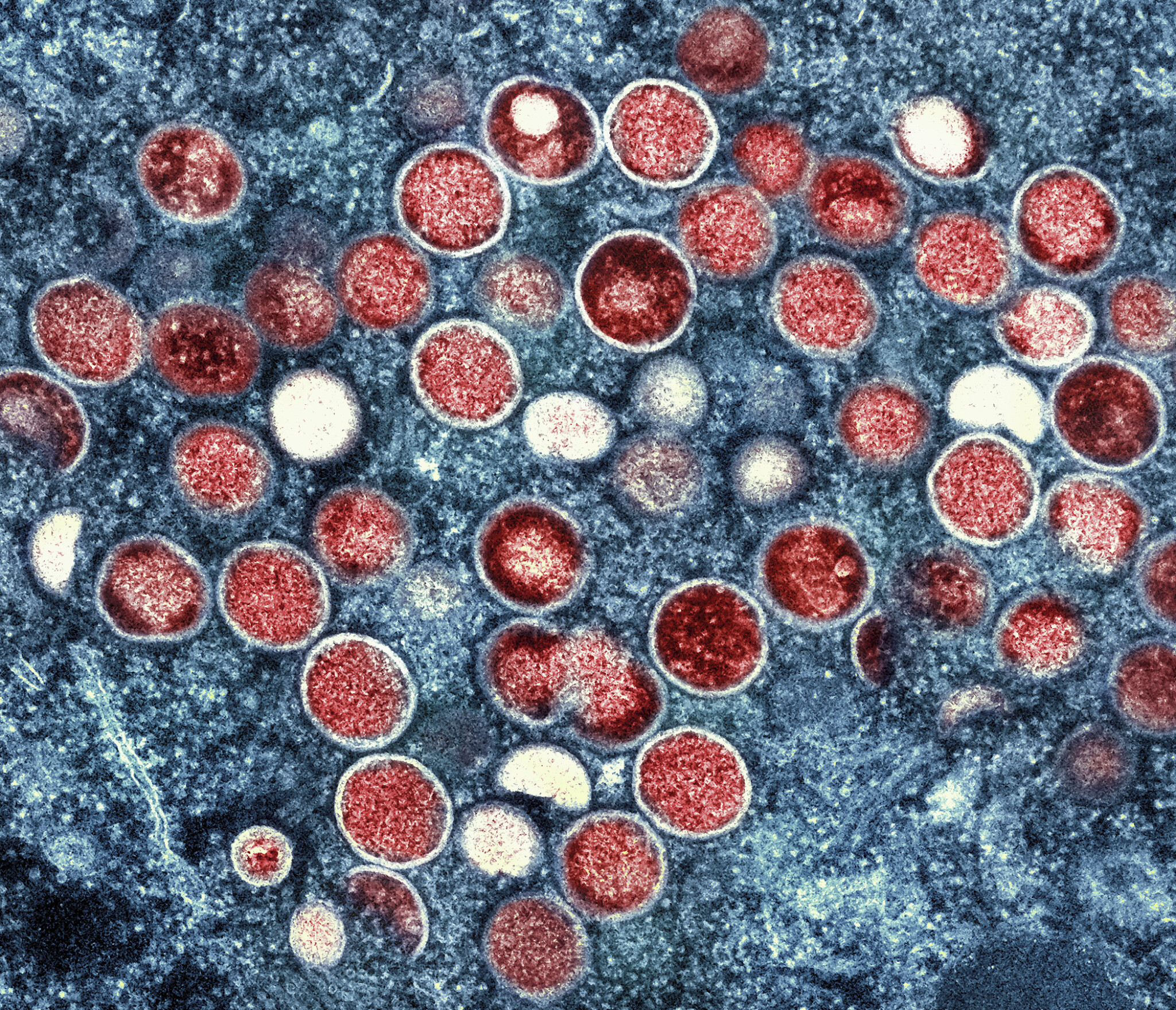
This image provided by the National Institute of Allergy and Infectious Diseases (NIAID) shows a colorized transmission electron micrograph of monkeypox particles (red) found within an infected cell (blue), cultured in the laboratory at the NIAID Integrated Research Facility (IRF) in Fort Detrick, Maryland. (NIAID via AP)
A woman has been diagnosed with monkeypox in Israel for the first time since the recent outbreak of the virus in the country, the Health Ministry said on Sunday.
The ministry said the woman was diagnosed after she came into close contact with a suspected case.
According to Health Ministry data, 233 people have been diagnosed with monkeypox since the virus arrived in the country in May, while 2,700 people have been vaccinated against it.
Around 5,000 vaccines have arrived so far, and Israel is expected to receive 5,000 more in the coming weeks. As cases have been almost exclusively among men who have sex with men, vaccines have so far only been eligible to those in this demographic who are considered at the highest risk.
Last Thursday, the World Health Organization reported a 21 percent decrease in the number of monkeypox cases reported worldwide, reversing a month-long trend of rising infections and signaling that Europe’s outbreak may be waning.
Get The Times of Israel's Daily Editionby email and never miss our top stories
The UN health agency tallied 5,907 new weekly cases and said two countries, Iran and Indonesia, reported their first cases. To date, more than 45,000 cases have been reported in 98 countries since late April.
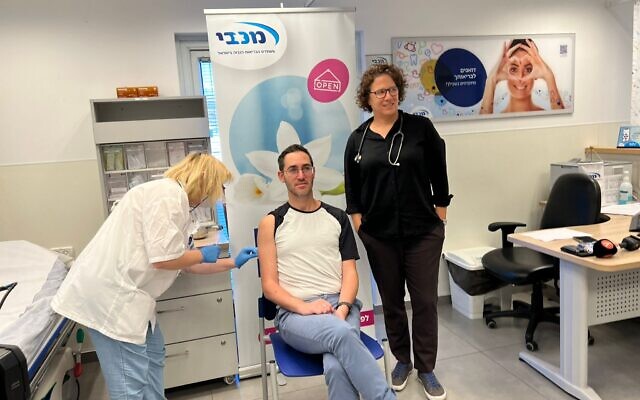
An Israeli man receives a vaccine against monkeypox, administered by Maccabi Healthcare Services. (Maccabi Healthcare Services)
Monkeypox is characterized by a rash that can look like pimples or blisters, from which the virus can be transmitted, normally through skin-to-skin contact.
The WHO declared the recent outbreak of the virus a global health emergency in July, labeling it an “extraordinary event.”
Advertisement
Times of Israel staff contributed to this report.

We can't do this work alone.
The war with Iran has been draining for all of us in Israel. But when I heard about a high casualty incident – ballistic missile impacts in Arad and Dimona that left nearly 200 people wounded – I drank a cup of coffee, packed a bag, and headed south.
There, I spoke with Shilgit, the head of an after-school program for underprivileged youth. Standing outside her destroyed center, Shilgit said it was a miracle that no children were hurt and spoke about the community coming together in the hours since.
As a Times of Israel reporter, I’m committed to telling stories of resilience like Shilgit’s. But my colleagues and I can't do this alone. If you value work like this,please consider joining our reader support group, The Times of Israel Community. Your financial support is essential to keep real human reporting like this going.
We’re really pleased that you’ve read X Times of Israel articles in the past month.
That’s why we started the Times of Israel - to provide discerning readers like you with must-read coverage of Israel and the Jewish world.
So now we have a request. Unlike other news outlets, we haven’t put up a paywall. But as the journalism we do is costly, we invite readers for whom The Times of Israel has become important to help support our work by joining The Times of Israel Community.
For as little as $6 a month you can help support our quality journalism while enjoying The Times of Israel AD-FREE, as well as accessing exclusive content available only to Times of Israel Community members.
Thank you, David Horovitz, Founding Editor of The Times of Israel