

In squabble over Gaza war intel, echoes of 1973’s failure
The Shin Bet’s accusation that leaders ignored warnings ahead of the summer’s fighting cuts deep for a community still shaken by missed signals ahead of the Yom Kippur War
Mitch Ginsburg is the former Times of Israel military correspondent.
Hatra’a lemilhama – advance warning of a war – are words that reek of the intelligence failure of the Yom Kippur War; words that end careers, and sometimes lives, in Israel. Hence the extraordinary letter from IDF Chief of General Staff Lt. Gen. Benny Gantz to Prime Minister Benjamin Netanyahu, published in Thursday’s Yedioth Ahronoth.
“I hereby firmly declare that the Shin Bet did not pass on an advance warning, and did not warn, about Hamas intentions for war in July,” Gantz wrote. The Shin Bet security service, he added, violated “every moral and ethical norm” by indicating otherwise in a TV documentary aired Monday.
In the show, “Uvda” with Ilana Dayan – one of Israel’s most highly regarded investigative news programs – a senior officer in the Shin Bet’s southern command identified as R, said that “in effect it starts in January. We begin to understand that it (Hamas) is starting to train for a campaign or a war with Israel at the end of June.”
Shin Bet commander Yoram Cohen, according to the program, stated in a cabinet meeting two days after the war: We knew and we warned a long time ago about a war in July.
Maj. Gen. Aviv Kochavi, the commander of the IDF’s Military Intelligence Directorate and a certain future candidate for the chief of staff position, reportedly responded, in atypically loud tones: You never said anything, to anybody, ever, about Hamas intentions to start a war in July.
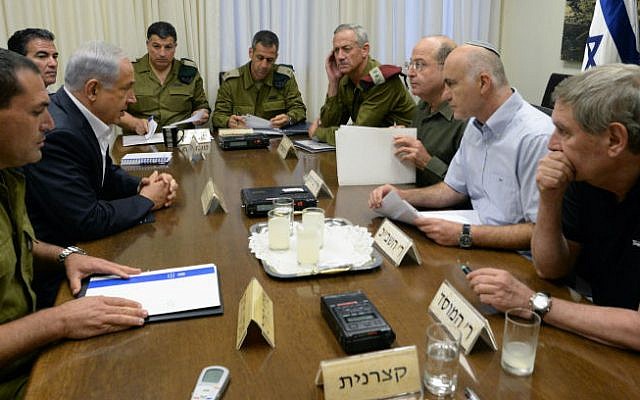
On Wednesday, Netanyahu, who also was quoted as being unaware of any explicit warning about a Hamas-initiated war in July, called Cohen and Gantz into his office and scolded them publicly and insisted that they bury the hatchet.
In the wake of the meeting, the Shin Bet published a clarification Thursday, explaining that it had warned of a large terror attack that could lead to a war, but not of a war itself.
But truly burying the hatchet will be difficult. The accusation, which unnamed Shin Bet officials made on camera without using the word “warning,” mirrors, albeit to a lesser extent, the scenario in September-October 1973, when a uniquely placed Mossad source – the son-in-law of Egyptian president Gamel Abdel Nasser – sounded the warning alarm for imminent war.
Members of the Military Intelligence unit doubted the information until the very last day and, as the Israeli saying goes, didn’t let the facts confuse them.
That failure left an indelible mark on the army’s Military Intelligence branch. Defense Minister Moshe Ya’alon, a former head of MI, wrote in his autobiography that the first thing he did upon learning that he had won the appointment to the intel unit was read from cover to cover the Agranat Commission’s report on the failures leading up to the Yom Kippur War.
Kochavi, marking 40 years since the war last year, wrote an op-ed for the Walla news site where he discussed the still-reverberating dangers of unchecked self-confidence. “Blessed is the intelligence officer who is perpetually concerned,” he wrote.
Kochavi has since vacated the office in Tel Aviv and moved north, to take over the IDF’s Northern Command. Gantz is set to finish his term of service in February. Cohen is slated to finish his five-year term in May 2016. Gantz and Cohen, assuming Netanyahu is not forced to take stronger action, have roughly 10 more weeks together.
The nature of the cooperation between the army and the Shin Bet is closer than “a man and his spouse,” Brig. Gen. (res) Shmuel Zakai, a former Gaza Division commander, told Army Radio Thursday.
The regional army brigade commander of, say, the Binyamin region surrounding Ramallah has to have utter confidence in the Shin Bet district commander, knowing that the intelligence he is acting upon is free of all ulterior motives. The two work hand in hand almost daily, Zakai noted, and top-down acrimony, in such a situation, “is very, very dangerous.”





The Times of Israel Community.